

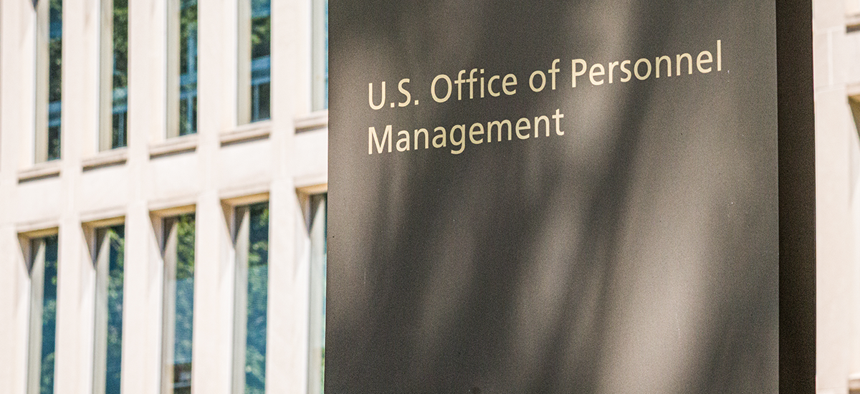
OPM shrank its total headcount by 35% between December 2024 and March 2026, according to a recent report from the Government Accountability Office. J. David Ake/Getty Images




OPM taps new healthcare and insurance chief ahead of Open Season
Matthew Kiley will take over as the division prepares for Open Season following a round of workforce cuts.

The Office of Personnel Management’s healthcare and insurance division, following recent staffing reductions, is getting new leadership ahead of its busy Open Season.
Matthew Kiley, a former Department of Health and Human Services official under the first Trump administration, will serve as the associate director of OPM’s healthcare and insurance division, starting Sept. 8, according to an internal memo obtained by Government Executive.
A copy of Kiley’s resume shared with OPM employees and partially viewed by GovExec shows Kiley is the founder and former president of the Weyhill Group, a boutique management consulting firm in the greater Philadelphia area that serves clients in financial services, insurance and healthcare.
According to Kiley’s LinkedIn page, he also led the Office of Health Policy within HHS’ Office of the Assistant Secretary for Planning and Evaluation (ASPE) between November 2019 and and January 2021.
Kiley wrote that during his tenure at HHS, he “helped the department make significant progress in improving the health of all Americans and moving toward a more patient-centered and sustainable system.” Projects he worked on include eliminating surprise billing for patients, lowering “excessive drug prices" and addressing rural health issues.
Kiley was also involved in the administration’s response to the COVID-19 pandemic, providing information used to allocate ventilators and relief funds. Earlier in his career, Kiley was a senior executive with Aramark, a consultant for McKinsey and an underwriter for Berkshire Hathaway's Insurance Group.
Kiley will take over for Shane Stevens, who announced in May that he was voluntarily stepping down. Kiley and OPM did not respond to requests for comment.
OPM shrank its total headcount by 35% between December 2024 and March 2026, according to a recent report from the Government Accountability Office. GAO found that more than half of OPM employees who left during this period had 11 or more years of service.
Nearly 60% of OPM employees who have left under the second Trump administration did so through the deferred resignation program. GAO wrote staffing reductions “have reduced institutional knowledge and operational capacity at the agency.”
OPM recently carried out further workforce cuts. The agency announced in June that it would give employees in its healthcare and insurance division another shot at opting into the deferred resignation program, before rolling out an “organizational change.”
OPM H&I employees accepted into this round of the DRP went on paid administrative leave at the end of August, and will officially separate from the agency in March 2027. The agency is shrinking its healthcare and insurance workforce a few months before OPM’s busy Open Season, a one-month period in which federal and Postal Service employees can make changes to their healthcare plans.
Open Season starts in November and ends in December. Health plan changes made during this period go into effect in January. An OPM spokesperson told Government Executive in July that “we feel very confident in our staffing levels and OPM’s ability to deliver on a successful open season.”
Earlier this year, OPM called on federal health carriers to reduce costs while promoting a “well care” model in the federal insurance marketplace. In its March 31 call letter, OPM emphasized that members of Federal Employees Health Benefits and Postal Service Health Benefits plans should take a more active role in their health.
Health plan participants have faced significant premium hikes in recent years. For 2026, enrollees in FEHB and PSHB paid an average of 12.3% and 11.3% more, respectively, toward their health insurance premiums.
If you have a tip that can contribute to our reporting, Jory Heckman can be securely contacted at jheckman.29 on Signal.
NEXT STORY: Scammers are making the government harder to trust