

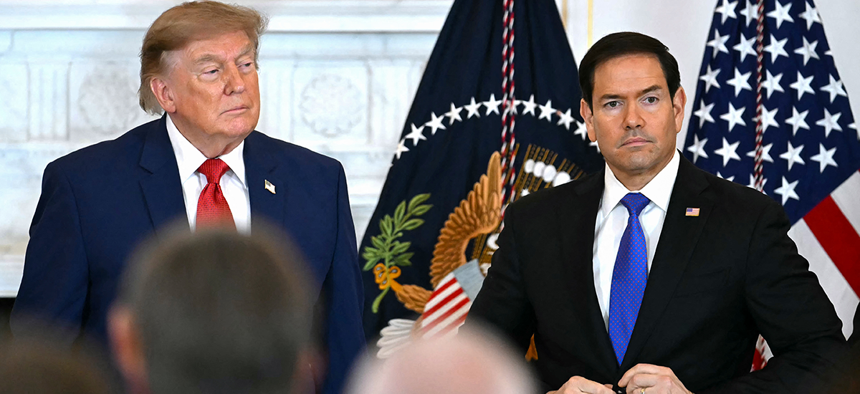
Secretary of State Marco Rubio hasn't appointed anyone to the Foreign Service Grievance Board, which is slated to run out of members in October. Kent NISHIMURA / AFP via Getty Images





State Department board’s ability to challenge firings undercut by DOJ
Critics of the decision say the Justice Department's opinion is another step in the Trump administration's goal of making it easier to fire federal employees who are not fully aligned with its policy goals.
The Trump administration is challenging the authority of an independent board to prevent the State Department from firing or disciplining Foreign Service employees who face allegations of misconduct.
The Foreign Service Grievance Board, a panel created under the 1980 Foreign Service Act, can reverse disciplinary measures and reinstate Foreign Service employees who face termination if the board deems there is insufficient evidence for the State Department to justify those actions. While the board views its role as an evidentiary check to ensure the department’s case holds up, the administration views this check as an infringement on executive power.
In a legal opinion released last Friday, the Justice Department’s Office of Legal Counsel determined that the grievance board violated the Appointments Clause of the Constitution because it had “unreviewable authority" over the secretary of state.
Assistant Attorney General T. Elliot Gaiser wrote that although the secretary of state appoints members to the board, he cannot remove them except for cause. In most cases, the board’s decisions can be appealed to federal district courts.
“The Act violates the Appointments Clause by vesting final decisionmaking authority in the Board, rather than the presidentially accountable Secretary,” Gaiser wrote.
DOJ wrote in a press release that the Foreign Service Grievance Board may continue to hear grievances, but that the secretary of state “will retain final decision-making authority, as the Constitution requires.”
Rubio’s failure to fill board vacancies serves as a practical, albeit passive, way to achieve the administration’s goal of weakening independent oversight.
Deputy Secretary of State Christopher Landau posted on X that the board “effectively has the power to overrule the secretary and the president on whether particular conduct — e.g. alcoholism, drug use, spousal abuse, or even espionage — warrants disciplinary consequences and, if so, what kind.”
“Under our Constitution, the President and the Secretary of State must have the final word on whether Foreign Service officers, who represent our country abroad, are subject to disciplinary consequences, including termination, for their actions,” Landau wrote.
Critics of the decision say the DOJ opinion is part of the Trump administration's goal of making it easier to fire federal employees who are not fully aligned with its policy goals.
Last summer, the State Department sent reduction in force notices to nearly 1,350 employees. Last year, the department made "fidelity" to the Trump administration’s policy goals a new criteria for promotions and career advancement within the Foreign Service.
Daniel Crowley, a partner with the law firm Crowley So LLP, noted that the Foreign Service Grievance Board serves as a vital check, determining whether the department has gathered sufficient evidence to justify disciplinary action or termination. He warned that without this independent oversight, "we’re going to have cases where they can’t prove it, and they just fire them anyway. It’s really just about the administration’s desire to fire employees for any reason."
Crowley said the Foreign Service’s "up-or-out promotional system" already holds officers to a high performance standard. While the administration frames the shift to easier terminations as a mechanism for accountability, critics argue the existing system already enforces high standards, suggesting the change is less about performance and more about removing obstacles to executive discretion.
Last month, the Office of Personnel Management finalized regulations that significantly shrink the role of the Merit System Protection Board in hearing appeals from federal employees.
Charles Carron, chairman of the Foreign Service Grievance Board, told lawmakers and the State Department in July that Rubio hasn't named anyone to serve on the board. He said the terms of its remaining members will expire on Oct. 1, and that the board “will cease to function until new members are appointed by the Secretary.”
In the board's latest annual report, Carron wrote that its inability to function “is contrary to the intent of the Congress, which established the Board as the sole, independent grievance appeals body of the Foreign Service, adjudicating grievances from the Department of State and other foreign affairs agencies within its jurisdiction.”
Carron said the board received nearly three times as many new cases in the first half of 2026 as it did for the same period the prior year. He wrote to Rubio in May, asking if he intended to make any appointments to the board, but did not yet receive a response.
“Right now, they’re at half-staff with an explosion of cases because of everything that’s happened at the State Department and across the government,” Crowley said. “They’re already pretty hamstrung, and this is just the next step.”
George Chuzi, senior counsel at the law firm Kalijarvi, Chuzi, Newman & Fitch P.C., said the DOJ decision is just the latest in a series of legal opinions giving President Donald Trump broad authority to reshape the federal workforce.
The Supreme Court last summer allowed the Trump administration to proceed with mass layoffs. In June, the court ruled in Trump v. Slaughter that the administration is free to fire members of most independent boards — with the exception of the Federal Reserve. This empowers the secretary of state to act unilaterally on these personnel decisions, reinforcing the "unreviewable authority" point made earlier.
“The Supreme Court, in the Slaughter case, has made clear that the president’s power to appoint, even with the advice and consent of the Senate, cannot be limited by Congress,” Chuzi said. “If he has the power to appoint them, even with advice and consent, for whatever reasons he wants, he can terminate them.”
Members of the Foreign Service Grievance Board serve two-year terms and can be removed by the secretary of state only “for corruption, neglect of duty, malfeasance, or demonstrated incapacity to perform his or her functions."
DOJ's Gaiser said the board in 2013 reinstated a Foreign Service member who had been terminated for downloading and viewing pornography on his government-provider computer. Crowley said that in this particular case, the employee was accused of viewing pornography at work, but the department didn't present evidence at the hearing fully supporting it claims. The department, he added, didn’t appeal the board's decision in federal court.
“That’s not a case of the grievance board saying that this person who viewed pornography at work shouldn’t be fired. It’s the grievance board saying there was no evidence that person viewed pornography at work,” he said.
The American Foreign Service Association said in a statement that the legal opinion “threatens a key safeguard of the professional, nonpartisan Foreign Service.”
“An independent review process cannot provide the same safeguards if the department whose action is being challenged ultimately has the power to overrule the decision,” AFSA said.
House Foreign Affairs Committee Ranking Member Gregory Meeks, D-N.Y., said the DOJ opinion is "part of a broader effort to politicize the federal civil service, purge career public servants, and replace them with unqualified political lackeys.”
If you have a tip that can contribute to our reporting, Jory Heckman can be securely contacted at jheckman.29 on Signal.
NEXT STORY: Blanche is confirmed. Now Congress needs to hold him accountable