

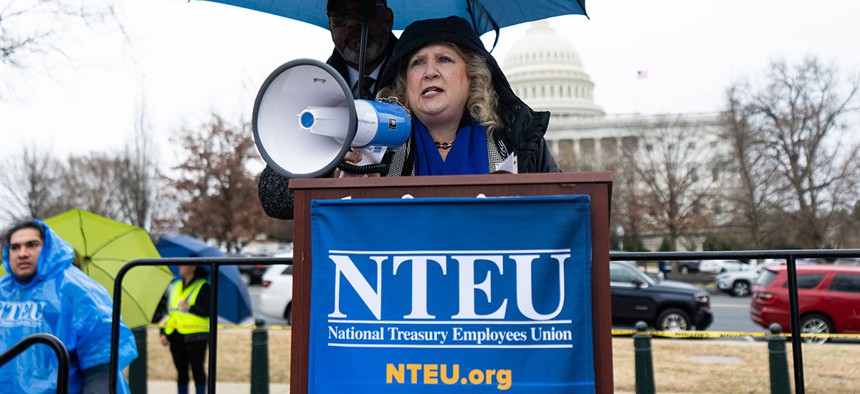
Doreen Greenwald, national president of NTEU, which represents federal employees at 38 departments and offices. Bill Clark/CQ-Roll Call, Inc via Getty Images





NTEU sets deadline for its members to resume paying dues
The union’s deadline comes as the Trump administration has stripped collective bargaining rights from roughly two-thirds of NTEU members and disrupted its primary source of revenue.
Amid the Trump administration’s rollback of collective bargaining rights across the federal workforce, the National Treasury Employees Union is setting a deadline for many of its members to resume paying dues.
According to three union officials, NTEU members who do not sign up for dues payments by Sept. 5 will lose access to the union’s benefits until they resume paying dues.
This includes eligibility for NTEU representation, either individually or as part of a group, the opportunity to receive remedies or settlements won through NTEU litigation, as well as member-only information and updates.
Last month, an independent arbitrator sided with NTEU and ordered the IRS to restore 2024-era telework agreements for its workforce. Meanwhile, a federal judge has barred IRS officials from confiscating and disposing of pro-NTEU flyers and other decorations from employees’ communal and personal workspaces.
NTEU's deadline will impact thousands of members who are currently not paying dues to the union.
“We have not imposed any specific requirements to pay dues for over a year, but we have to get the ball rolling again,” one union official told Government Executive.
NTEU did not immediately respond to a request for comment.
Although NTEU represents federal employees at 38 departments and offices, about half of all NTEU members work at the IRS. The IRS terminated its collective bargaining agreement with NTEU in February.
In a pair of executive orders signed last year, President Donald Trump cited a seldom-used provision of the 1978 Civil Service Reform Act to bar unions at nearly 40 agencies on national security grounds.
Those executive orders have stripped collective bargaining rights from roughly two-thirds of NTEU’s members. NTEU is challenging the executive orders, and the litigation remains pending.
Following the Trump administration executive orders, many agencies stopped automatic dues deductions from employees’ paychecks, dealing a significant blow to union revenue.
“This is going to have a lasting impact on the labor movement within the federal workforce,” a second union official said.
In a lawsuit challenging the executive orders, NTEU wrote that the administration’s actions will “immediately and drastically reduce the number of employees that NTEU represents and prevent NTEU from collecting dues from those members via payroll deduction.”
“This will threaten NTEU’s very existence and will severely diminish NTEU’s influence at the bargaining table,” the union wrote in its March 2025 complaint.
In fiscal 2024, member dues accounted for nearly 85% of NTEU's total revenue, the union wrote in its complaint. The unions received about 95% of those dues through payroll deductions.
The American Federation of Government Employees touted a surge in new dues-paying members in the early days of the second Trump administration. But the Associated Press reported in April 2025 that AFGE laid off more than half of their staff.
AFGE National President Everett Kelley said the union’s finances took a “very direct hit,” after the administration's executive orders removed over 200,000 of its dues-paying members.
Early in the Trump administration’s union crackdown, AFGE encouraged its members to pay their union dues directly to AFGE through regularly scheduled online payments.
In February 2026, NTEU began a phased rollout of its own online payment system, called “Dues Direct,” which allowed members who previously paid dues via automatic payroll deductions to send payments directly to NTEU. According to union officials, NTEU did not impose any deadline for members at impacted agencies to sign up for Dues Direct until it fully completed all phases of the system’s rollout.
The second union official said NTEU leadership has tried to avoid frustrating members who never stopped paying their dues because their agencies still recognize the union.
“Agencies that haven’t had their payroll deductions turned off have been putting pressure on NTEU leadership for over a year to take this action,” the second union official said.
NTEU’s second-largest agency, Customs and Border Protection, still allows its employees to pay union dues via payroll deductions. CBP employees make up about 25% of NTEU’s total membership.
But in several IRS chapters, NTEU leaders have only gotten a small percentage of their members to enroll in Dues Direct.
“I think it’s intentional on the part of the administration, to demoralize our workers, starve the union, and try to make it look like the union can’t help,” the second union official said. “I don’t know how we’re going to ever rebuild, if we win in court and retain our right to unionize.”
If you have a tip that can contribute to our reporting, Jory Heckman can be securely contacted at jheckman.29 on Signal.
NEXT STORY: Todd Blanche is officially the nation’s top law enforcement official