

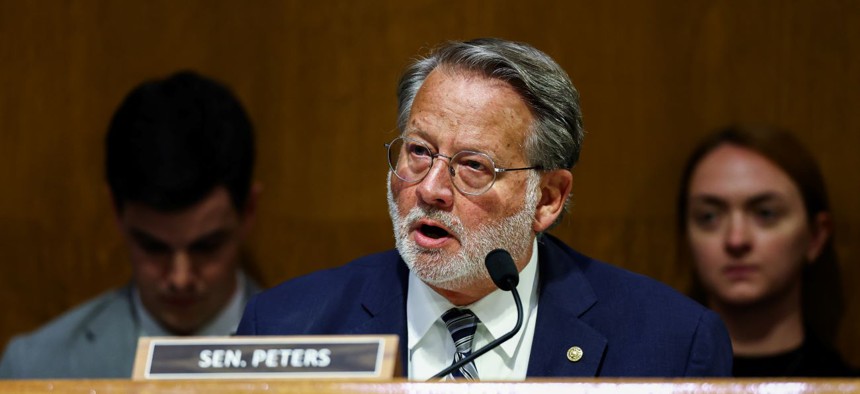
Sen. Gary Peters, D-Mich., urged Senate Homeland Security Committee Chairman Rand Paul to delay consideration of President Trump's nominees to serve on the bipartisan U.S. Postal Service Board of Governors until the president nominates another Democrat. Finn Gomez/Getty Images




USPS nominations test the future of bipartisan boards
Federal law requires that no more than five members of USPS’ Board of Governors be from the same political party. The Trump administration has only submitted Republican nominees so far.
Senate Homeland Security and Governmental Affairs Committee Ranking Member Gary Peters, D-Mich, asked Chairman Rand Paul, R-Ky., this week to put a hold on the current slate of USPS nominees until the administration identifies Democratic nominees to also serve on the board.
The USPS Board of Governors, which currently has two Democratic members, one Republican member and one independent member. The board has five vacancies, and Trump has submitted four Republican nominees. By law, no more than five members of the USPS board can belong to the same political party.
“This imbalance in representation would be unprecedented and would undermine public confidence in the Board’s ability to serve the public interest above any partisan political aims,” Peters wrote.
Trump submitted a mix of Democratic and Republican nominees to the USPS board during his first administration and consulted with congressional leaders from both political parties, keeping with the tradition of prior administrations.
“Unfortunately, President Trump has departed from this long-standing practice and has not engaged in any consultation with the Senate Minority Leader or the Ranking Member of the Committee on Homeland Security and Governmental Affairs,” Peters wrote.
Senate Minority Leader Chuck Schumer, D-N.Y., and the top Democrats on several Senate committees sent a letter to the White House last month pushing back on the administration’s broader lack of Democratic nominees for independent agenices.
Peters’ letter comes less than a month after the Supreme Court’s decision in Slaughter v. Federal Trade Commission stripped removal protections from members of independent boards and commissions. Though that decision does not explicitly address instances when Congress has required the president nominate members of the other political party, Chief Justice John Roberts said Congress may not “saddle him with those with whom he cannot work.”
Trump has been more personally involved in USPS operations than his recent predecessors. He signed an executive order in March directing states to send USPS a list of voters who vote by mail, and to refuse to mail ballots to unlisted voters. State governments have the primary responsibility of carrying out elections.
Early in Trump’s second term, USPS agreed to work with Census Bureau this year on a test of the upcoming decennial count. Trump also considered merging USPS with the Commerce Department.
In his first term, Trump threatened to withhold pandemic relief funds from USPS unless it agreed to charge Amazon higher rates to deliver its packages. A Treasury Department task force also recommended privatizing some postal operations.
Paul Steidler, a senior fellow at the Lexington Institute, said it’s important to consider the nominations “in the broader context of the Trump administration’s views about Democratic appointments” and the Supreme Court’s recent ruling that gave the administration sweeping authority to fire members of independent agencies.
“It’s important to see the president’s actions in light of the Slaughter decision, and in light of the fact that the Supreme Court has backed up his ability to remove board members that he doesn’t want to have in place,” Steidler said.
Steidler said the postmaster general “has a ton of power, relative to the board,” and that the board’s political composition shouldn’t distract from the broader issue of postal reform and keeping USPS from running out of cash.
“Whether you like it or not, this gives Trump and the Republicans ownership of fixing the Postal Service,” Steidler said. “The focus has to be in reengineering the Postal Service. Part of that should be having a stronger, independent board that can look into what’s going on, and raise the alarm bells when there are serious issues that should be of concern to the American people.”
A spokesman for the American Postal Workers Union told Government Executive that the union is concerned the Trump administration has submitted nominees without any postal or logistics background. APWU will hold a national day of action outside post offices next Tuesday urging senators to reject these nominees.
“None of the current nominees have any experience in the Postal Service, or even in the wider logistics and delivery industry. Instead, what they share in common is experience in big business, finance, and management consulting,” APWU wrote in a fact sheet.
It’s not unusual for lawmakers to scrutinize the political makeup of the USPS board. In 2014, when the USPS board lacked enough members to hold a quorum, Sen. Bernie Sanders, I-Vt., put a hold on two of the Obama administration’s Republican nominees for the USPS board, who were already serving on the board and were tapped to serve another term.
Republicans, in turn, placed holds on the administration’s Democratic nominees to serve on the USPS board.
A USPS official who spoke on condition of anonymity said “it’s never good to not confirm nominees,” and that any attempts to hold up confirmations would be “counterproductive.”
“Is the Postal Service going to be any better or worse if we don’t approve these nominees? I know it’ll be worse off if they don’t. Because we’ll end up directionless again, which is what got us in this malaise in the first place,” the official said.
Experts warned that if the Senate moves forward on the USPS nominees, the maneuver may be just an opening salvo in a broader push to clear out Democrats from bipartisan boards. Many positions previously held by Democratic appointees before their 2025 firings remain vacant, such as at the Merit Systems Protection Board, and the Slaughter decision could spur renewed purges of those that remain, such as the recent termination of members of the Election Assistance Commission.
“It’s more than a trial balloon, I think,” said Don Kettl, professor emeritus at the University of Maryland and former dean of its School of Public Policy. “This is a broader, conscious effort brick by brick and step by step to expand presidential power. They’ll continue to do it until the courts say stop . . . This is about much more than the Postal Service just as Slaughter was about much more than the FTC.”
Michael Fallings, managing partner at Tully Rinckey PLLC, a law firm specializing in federal employment issues, said one-party rule over quasi-judicial boards like the MSPB and Equal Employment Opportunity Commission would hurt not just those appealing adverse actions, but the case law these agencies produce.
“If you have just one line of thinking, then those decisions have the potential not to be correct, not to look at the full facts, and generally be one-sided,” he said. “Even if it’s just through a dissent to a decision, that can be reviewed and evaluated for future cases as well.”
Jay Lerner, an adjunct professorial lecturer at American University’s School of Public Affairs and former inspector general of the Federal Deposit Insurance Corporation, said that while Slaughter has effectively short-circuited many of the laws aimed at insulating agencies from presidential power, a Congress looking to reassert its authority could establish new ways of influencing who the president can nominate for multi-member agency boards and commissions. One avenue could be strengthening often vague language requiring nominees to be “qualified” for their posts.
“Congress, depending on how strong it is now or in the next session, could voice objections and apply political pressure. It could pass different laws—not so much focusing on removal authorities, but on how appointees actually perform while in office. I think that Congress could enact laws requiring experts to identify performance standards for individuals holding a particular position. If there’s more specificity to those standards, then at least there are some concrete elements by which to assess an official's performance.”
If you have a tip that can contribute to our reporting, Erich Wagner can be securely contacted at ewagner.47 on Signal.
NEXT STORY: Trump appointees confirmed by the Senate are exiting their jobs in record numbers, report finds