

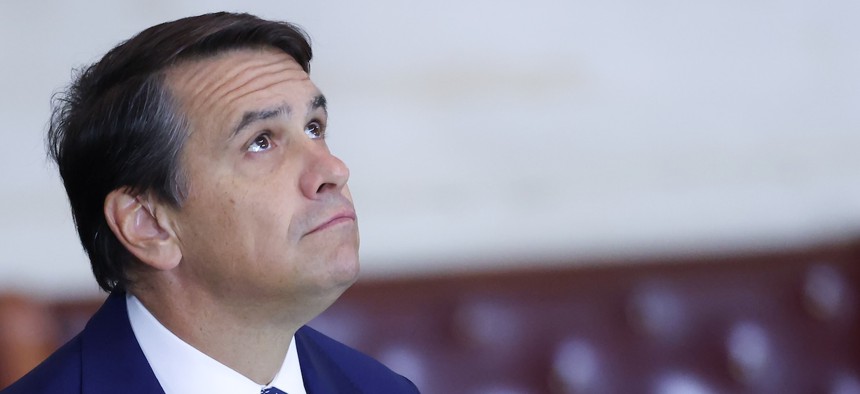
Lawmakers are demanding written confirmation to formally kill President Donald Trump’s controversial IRS tax immunity deal and "anti-weaponization fund" before they vote on Acting Attorney General Todd Blanche's confirmation. Win McNamee/Getty Images




DOJ nominee faces confirmation hurdle over agency commitments
Todd Blanche’s confirmation faces a potential delay as senators seek written guarantees limiting Trump’s anti-weaponization fund and the scope of audit protections included in a Justice Department settlement agreement.
Todd Blanche’s path to permanent confirmation as U.S. attorney general appears endangered amid concerns from Sen. John Cornyn, who says the Department of Justice has not provided him with the assurances he needs to vote Blanche’s nomination through the Judiciary Committee.
Blanche, who was formerly President Donald Trump’s personal lawyer, has led the Justice Department on an acting basis since April. Cornyn, unburdened by the usual political pressures after losing his Republican primary in May, has been a key undecided vote on putting Blanche permanently in charge of the agency, maintaining his opposition to a nearly $1.8 billion settlement agreement that the DOJ, under Blanche, reached with Trump to pay out victims of alleged DOJ weaponization.
Critics have voiced unease over the possibility that the fund could be used to compensate rioters who assaulted police officers when they stormed the U.S. Capitol on Jan. 6, 2021.
Though the DOJ backtracked and declared the fund dead, Cornyn has insisted that Blanche pen a written agreement nullifying it and assuring that it will not be revived in lawsuits. The outgoing Texas senator also wants the DOJ to modify, in writing, an audit immunity shield that the agency extended to Trump and his associates as part of the settlement agreement.
Cornyn and Blanche were set to meet Wednesday ahead of Thursday’s committee vote, but the senator said the meeting was called off. He told reporters the DOJ has not come through with the written guarantees he’s requested, and that if his demands were unsatisfied by Wednesday afternoon, the Judiciary Committee may need to pull tomorrow’s vote.
Less than two hours before the deadline, Cornyn said the DOJ had not followed up with him after he had sent over a “redline strikeout of what we need.”
“We’ve tried to make it easy for them,” Cornyn said. “They won’t take the help.”
As of Wednesday afternoon, after the deadline Cornyn laid out, the Senate Judiciary Committee had not made any changes to its schedule, keeping the Blanche vote on tap for Thursday morning.
The Blanche episode is the most prominent example yet of how Cornyn — long a team player and steady hand within the Republican conference — is using his leverage over the administration in the final months of his Senate career. Republicans control 12 of 22 seats on the Judiciary Committee that is deciding whether to advance Blanche’s nomination to the full chamber, meaning a defection from Cornyn would leave the committee deadlocked in a tie.
Cornyn ran for a fifth term but lost the Republican nomination to Attorney General Ken Paxton in a May runoff. The senior senator was the Senate’s second-in-command during Trump’s first term and pushed heavily for the president’s endorsement in his primary, even filing a bill to rename a section of highway after the president. After holding out for months, Trump endorsed Paxton, a longtime ally who tried to overturn the 2020 election results in key battleground states.
In the months since his runoff loss, Cornyn has played hardball.
“Maybe they think I’m just going to give up or go along,” Cornyn told reporters Wednesday morning. “But they’re mistaken.”
He successfully urged the Trump administration to move faster in releasing funds that Congress appropriated last year to reimburse states for border spending during the Biden administration, much of which is expected to go to Texas. And he threatened to vote against diplomatic nominations unless he received assurances that the Trump administration would distribute unspent funds on a global program combating HIV that began during George W. Bush’s presidency.
Meanwhile, Trump said he expected Blanche’s confirmation to be routine — and offered his own interpretation of Cornyn’s position.
“Maybe John Cornyn’s upset with me because I didn’t endorse him,” Trump said Wednesday afternoon in the Oval Office. “I don’t know what it is. But I haven’t heard that there’s a problem. I heard he’s going through quite nicely.”
Blanche did not answer questions from reporters Wednesday about his discussions with Cornyn or what he’s offered the senator.
At issue in Blanche’s nomination is whether Trump, or others, will be able to access taxpayer money over claims that the government was weaponized against them, and whether certain guardrails will be placed on the immunity from tax audits. Cornyn wants a guarantee in writing that the audit protection applies only to people who were parties to the lawsuit, and that it does not provide immunity for would-be future cases nor prevent other federal agencies from pursuing audits.
“They know what they need to do,” Cornyn said Wednesday morning. “But they simply refuse to do it.”
He added that he is “not prepared to vote yes” on Blanche’s nomination.
Could Trump’s potential support of the fund and the audit shield be the obstacle?
“I can see why he wants it, because it provides immunity from audits that no other taxpayer could possibly get,” Cornyn said. “That’s why we need to conform the actual document to what Todd Blanche testified to under oath.”
In a highly unusual move, Trump sued his own government in January, bringing a case against the Internal Revenue Service and the Department of the Treasury over the unauthorized release of his tax returns in 2019 and 2020. As part of the May settlement between Trump and the DOJ, which represented the IRS, Blanche issued an order barring the tax agency from auditing or examining the tax returns of the president, his family and his businesses.
The agreement was met with widespread criticism and allegations of corruption. Blanche eventually agreed to terminate the “anti-weaponization fund.” At his nomination hearing in mid-July, he called the issue moot and assured Cornyn that the fund was dead.
The verbal commitment proved insufficient for Cornyn, who has remained set on establishing concrete assurances that the fund cannot be brought back to life in any form and that the audit immunity will be as narrow as Blanche said he intends it to be during his Judiciary hearing. At Blanche’s nomination hearing, Cornyn pressed him on the potential for the fund to be resurrected by end-runs such as future breach of contract lawsuits from Trump or others in his orbit. Blanche continued to state that the fund was dead but conceded that, absent a written agreement or addendum, a plaintiff could sue.
The question-and-answer period between Cornyn and Blanche was, in typical Cornyn fashion, a polite exchange. But the former Texas attorney general and Supreme Court justice pointed out that Blanche’s promises were not reflected in the text of the agreement, and he has been unwilling to budge on his quest for the settlement agreement to be changed in writing.
Leading up to the nomination vote, Cornyn reiterated to reporters that this remained the key sticking point for whether he would support advancing Blanche to the Senate floor. He suggested Thursday’s vote could be postponed in order to get a termination clause on paper.
Sen. Thom Tillis, a North Carolina Republican who, like Cornyn, sits on the Judiciary Committee and is in his final term, has expressed similar reservations about confirming Blanche.
Cornyn and Tillis’ opposition has left Blanche’s nomination at serious risk, a rare occurrence in a GOP-led Senate that has shown significant deference to the White House on nominees. The Senate has yet to formally reject any of Trump’s picks, and the White House has only had to withdraw a handful of picks.
Beyond the anti-weaponization fund, a group of Jeffrey Epstein survivors has also pushed senators to block Blanche’s nomination based on his handling of the late child sex trafficker’s case and alleged treatment of them. They met with Cornyn’s staff Wednesday morning.
This article first appeared on The Texas Tribune.