

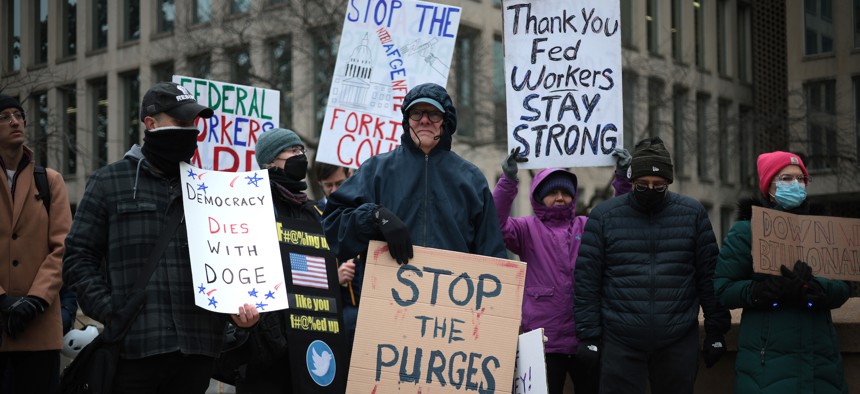
Protesters against the Department of Government Efficiency on Feb. 5, 2025, in Washington, D.C. DOGE pushed many civil servants out of government last year. Alex Wong / Getty Images





Survey: Feds were less engaged, less satisfied and more burnt out in 2025
But quarterly federal employee workplace scores generally showed improvements by the end of last year and the beginning of 2026.

Federal employee morale dropped last year, as President Donald Trump downsized and otherwise overhauled the civil service, according to a new data analysis from Gallup.
“[A]fter the reforms took effect, federal workers experienced declines in employee engagement and job satisfaction, alongside increases in burnout and job-search activity,” the researchers wrote. “These shifts were larger than those observed among comparable state and local government workers — and private sector counterparts — during the same period.”
The analytics firm noted, however, that the data shows there was a “rebound” in some areas by the end of 2025.
For the analysis, researchers compared federal employee worker engagement metrics with those of state and local civil servants. Between 2022 and 2024, the two groups exhibited similar worker satisfaction score trends.
“By comparing the change in federal employees to the change in state and local employees — rather than looking at federal trends alone — the analysis isolates the portion of the shift that occurred uniquely among federal workers after the reforms,” the researchers explained.
In the second quarter of 2025, the percentage of “engaged” federal employees decreased by six points more than it did for state and local workers. That gap narrowed to a four-point difference by the first quarter of 2026.
Likewise, feds were roughly 15 points less likely than their state and local counterparts to report having “high job satisfaction” in the second quarter of 2025. The difference between the two groups never went below 10 points for the remainder of the year.
Between the second and fourth quarter of 2025, feds went from being about eight to nine points more likely to report “high burnout” compared with state and local workers to approximately four to six points.
Feds were also around eight points more likely to be searching for a new job in the first quarter of 2025 than state and local civil servants, but “federal job-search behavior [by Q4 2025] was essentially indistinguishable from state and local peers and remained so in Q1 2026.”
For this analysis, Gallup researchers looked at data from the Bureau of Labor Statistics and the company’s ongoing workforce survey data of U.S. adults. The statistical models were controlled for characteristics like age, gender and race.
In March, Gallup reported that the percentage of feds who are classified as “thriving” decreased by 10 points between 2024 and 2025.
The Office of Personnel Management in 2025 did not conduct the Federal Employee Viewpoint Survey, with officials saying that changes were necessary to the annual poll of the government workforce in order to comply with Trump’s anti-diversity executive orders.
In response, the Partnership for Public Service, a nonpartisan good government group, developed its own survey of more than 10,000 current feds. It found that all 30 agencies represented in the poll experienced decreases from their 2024 FEVS scores; although, Partnership officials acknowledged that the results are not directly comparable because OPM’s survey includes significantly more respondents.
If you have a tip that can contribute to our reporting, Sean Michael Newhouse can be reached securely at seanthenewsboy.45 on Signal.
NEXT STORY: EPA’s restructuring could change who shapes chemical risk decisions