

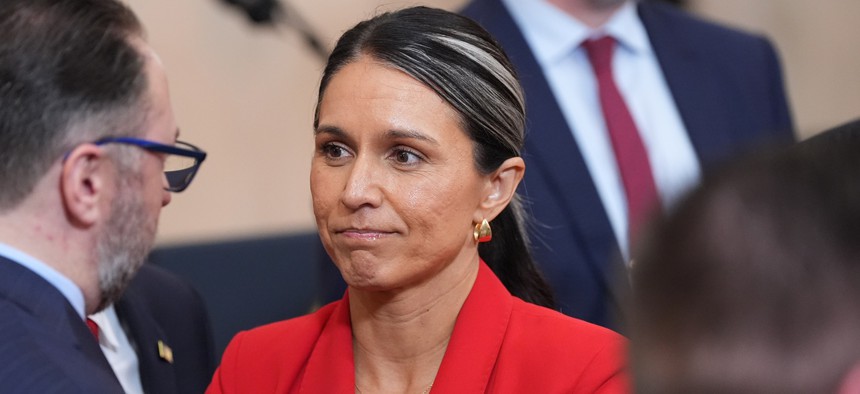
Director of National Intelligence Tulsi Gabbard stands after President Donald Trump spoke about the Iran war from the Cross Hall of the White House on April 1, 2026 in Washington, DC. Alex Brandon/Getty Images





Gabbard to resign as director of national intelligence, citing husband’s health
Her exit marks the end of a 16-month tenure overseeing the nation’s spy agencies, where the former Democratic congresswoman and 2020 presidential candidate sought to reshape ODNI around Trump’s priorities.

Director of National Intelligence Tulsi Gabbard will resign from her role in the coming weeks, her office confirmed to Nextgov/FCW on Friday.
Gabbard’s husband, Abraham Williams, was “diagnosed with a rare form of bone cancer, and she is stepping away from public service to be by his side and fully support him through this battle,” Olivia Coleman, a spokesperson for the Office of the Director of National Intelligence, said in an email.
In a Truth Social post that included Gabbard’s resignation note, President Donald Trump said she would be leaving June 30. It marks the fourth major cabinet departure of his second term.
During Gabbard’s roughly 16-month tenure overseeing the nation’s 18 intelligence agencies, the former Democratic congresswoman and 2020 presidential candidate sought to reshape ODNI around Trump’s priorities while facing persistent scrutiny over her past comments on Russia, Syria, Edward Snowden and surveillance authorities. She was narrowly confirmed to the position in February 2025.
In office, Gabbard launched a sweeping restructuring effort aimed at shrinking ODNI, including plans to cut staffing and consolidate or eliminate several offices tied to cyber, foreign influence and intelligence integration functions. Supporters framed the moves as long-overdue reforms, while critics warned they could weaken coordination across the intelligence community.
Gabbard also became a central figure in Trump’s efforts to target former intelligence officials viewed as political adversaries. Last year, she revoked security clearances for dozens of current and former national security officials, accusing some of politicizing intelligence and leaking classified information, which drew sharp criticism from Democrats and former intelligence leaders.
Her tenure was additionally marked by renewed disputes over U.S. intelligence assessments, including intelligence findings involving Venezuela.
Gabbard’s political rise was built in part around opposition to U.S. interventionism and what she called “regime change wars,” a posture that at times appeared increasingly at odds with White House actions involving military operations in Iran and Venezuela.
In March, a Senate hearing highlighted growing tensions between intelligence community assessments of the war in Iran and the administration’s framing of the conflict. It also came a day after the departure of then-aide and National Counterterrorism Center Director Joe Kent, who said he could not agree with the Trump administration’s premise for the war, which was launched alongside Israel in February.
In the hearing, Gabbard told senators that it’s “not the intelligence community’s responsibility to determine what is and is not an imminent threat” and that the president has authority to make such conclusions.
In a Friday statement, Sen. Mark Warner, D-Va. the vice chairman of the Senate Intelligence Committee, said his thoughts were with Gabbard and her family.
“Anyone who has watched a loved one go through a serious illness understands the toll it takes, and I wish him strength and hope for a full recovery in the difficult days ahead. I also appreciate her willingness to serve her country in a variety of different roles,” he said.
“The Director of National Intelligence is entrusted with one of the most serious responsibilities in government: providing objective, fact-based intelligence to policymakers and the American people, regardless of politics or pressure from the White House,” added Warner, who often sparred with Gabbard over issues involving her office.
“At a time when the boundaries between verified intelligence and politically convenient claims have too often been blurred, it is critical that the office remain grounded in facts, independence, and the rule of law,” he said.
“I thank Tulsi Gabbard for her service in this administration and in uniform, and I wish her the very best as she supports her husband Abe in his battle with cancer. Please join me in sending them prayers for a full and fast recovery,” said Sen. Tom Cotton, R-Ark., the intelligence committee chairman.
Editor’s Note: This story was updated with additional details.