

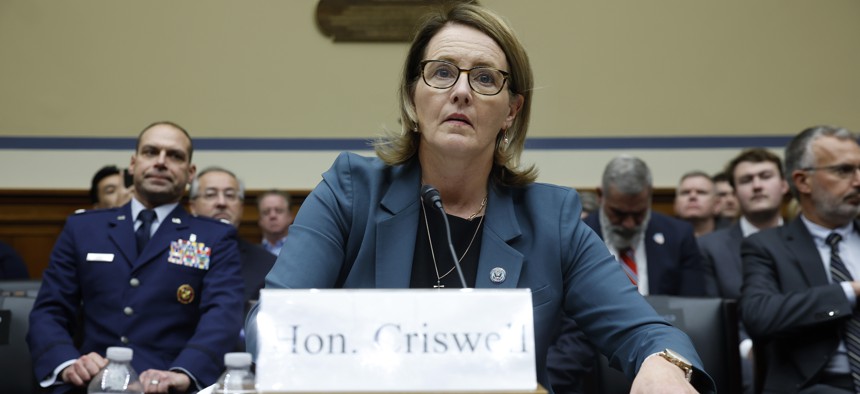
Then-FEMA Administrator Deanne Criswell testifies on Capitol Hill in 2024. In a recent interview, Criswell said critics of the agency were "lazy" and did not understand its role. Kevin Dietsch via Getty Images



Former FEMA administrator reflects on tumultuous time for ‘people-first’ agency
Deanne Criswell, who led the agency under former President Joe Biden, said critics who want to shift responsibility to states and localities use a “lazy way” to characterize its mission.

For four years, Deanne Criswell sat atop the Federal Emergency Management Agency as administrator and led its response to natural disasters, including Hurricanes Milton and Helene.
Those two hurricanes in late 2024 made for a tough time for the agency, which was the subject of various conspiracy theories and accusations that it deliberately denied relief to disaster victims that supported President Donald Trump, who had just won a second term. Florida’s then-Attorney General Ashley Moody even sued FEMA and Criswell over the allegations and what she termed political discrimination, although the state later dropped the lawsuit.
In a wide-ranging interview with our sister publication Route Fifty, Criswell said such accusations are par for the course for FEMA, which she acknowledged has had some difficult moments since its founding in the late 1970s. Social media has accelerated the spread of misinformation about the agency, she added.
“We're in a very different environment,” Criswell said. “FEMA has always been the subject of conspiracy theories from day one. You go back to April 1, 1979, when FEMA was created, and there probably was the first conspiracy theory on April 2. It's always been there.” Those conspiracy theories have seen accusations of the agency running camps, arming young people to take over communities, or being a shadow government.
The agency has stayed in the news since Criswell departed as former President Joe Biden left office. Outgoing Homeland Security Secretary Kristi Noem joined Trump in arguing that disaster relief should be more of a state-level responsibility and suggesting that FEMA be phased out altogether. U.S. Sen. Markwayne Mullin, an Oklahoma Republican that was just confirmed as her replacement, appears to have suggested a different approach focused on reforming the agency.
Noem also came under significant fire for introducing a policy that she had to personally approve any expenditure over $100,000, which a Senate report reportedly found delayed aid from being released for weeks. Mullin said FEMA should be “restructured” and that he would ensure it is properly staffed once the Department of Homeland Security is no longer shut down.
Talk of states having a larger role to play in disaster relief shows a fundamental misunderstanding of how FEMA works, Criswell said, as its role depends much on federalism. The agency can only employ its vast resources after a disaster if a request comes in from the affected state’s governor. The agency’s 10 regional administrators also play a key role in helping to pre-position resources ahead of expected disasters or major events. And Criswell said FEMA’s critics take a “lazy way” in how they characterize the future role of the agency and seem to want the financial burden to shift onto states and localities.
“FEMA doesn't take over the response,” she said. “FEMA is not first responders. They don't send in firefighters. They can send in some urban search and rescue teams, but again, they come in to help stabilize. Those local first responders have the responsibility to manage that initial response. FEMA never has done that and never will. It's not their role. That's the role of the local jurisdiction.”
Criswell said, however, that FEMA needs reform and changes to some of its various programs and policies. It’s something she became aware of as emergency manager for Aurora, Colorado and the commissioner of the New York City Emergency Management Department, even before taking the federal job in 2021. One program in need of “an overhaul” is FEMA’s Public Assistance Program, Criswell said, which provides grants and other assistance to states, Tribes and territories when authorized by a declaration under the Stafford Act.
But that overhaul should not involve transitioning to block grants to states, Criswell said, as that would place a massive oversight burden onto them and away from the federal government. Right now, money is distributed on a project-by-project basis, which, while imperfect, also takes into account bigger catastrophic disasters where the full damage isn’t known for a year or more.
“My fear is that they're rushing into an oversimplified solution without thinking through the downstream effects and how that's going to impact state and locals, and then eventually, come back to the federal government,” Criswell said of those in charge at FEMA.
It is also incumbent on the agency to rebuild trust, which has been badly undermined during previous incidents and disasters dating back decades, past the bungled response to Hurricane Katrina in 2005. FEMA has continued to play an expanded role since then, whether it be in helping respond to the Ebola outbreak or the COVID-19 pandemic.
Those efforts and others make FEMA the “nation’s problem solvers,” Criswell said, but it can be difficult in the age of social media to convince people an agency is working well. A lot of work lies ahead, then.
“As we evolve, we're going to have to figure out ways to be more proactive in addressing that [lack of trust],” Criswell said. “In the past, it's been much more reactive, but it moves so fast now. Trust is critical in all of this. But to me, it's really about communication, and how are we communicating in a way that is allowing people to get factual information instead of false information? I don't think we cracked that nut yet with the current situation that we find ourselves in.”
A reimagined role for FEMA may require rethinking and renewed public-private partnerships. After leaving the agency, Criswell in February became a board member at AidKit, a public benefit corporation with a platform that helps government agencies and nonprofits administer aid.
“As we're continuing to have this conversation about shifting responsibility, whether that's financial responsibility or other responsibility, there is going to be a greater need for state and local jurisdictions to do some of the work that the federal government did in the past,” she said. “Whether that means they're not getting the federal disaster declaration, so they have to manage more disasters within their own capability because they're not getting a federal declaration, or whether that means some of the federal assistance is just not going to be there anymore the way that they used to do it. And so it's going to put more onus on the state and local jurisdiction.”
Criswell said despite previous obstacles and future challenges, FEMA remains a “people first” agency that is determined to help when called upon. And while she acknowledged it will also be fair game for criticism, its role in helping communities get back on their feet after some of the worst moments of their lives remains key.
“You see the people, you hear their stories, it reminds you of why you're there,” she said. “It’s also, for me, talking to the people, and seeing how neighbors help neighbors, and how people really come out to help each other. In the midst of all of this tragedy, it also shows me the greatest in humanity across all these events. While sometimes it might be short lived, it's really inspirational to really see how people come out just to help their neighbors.”