

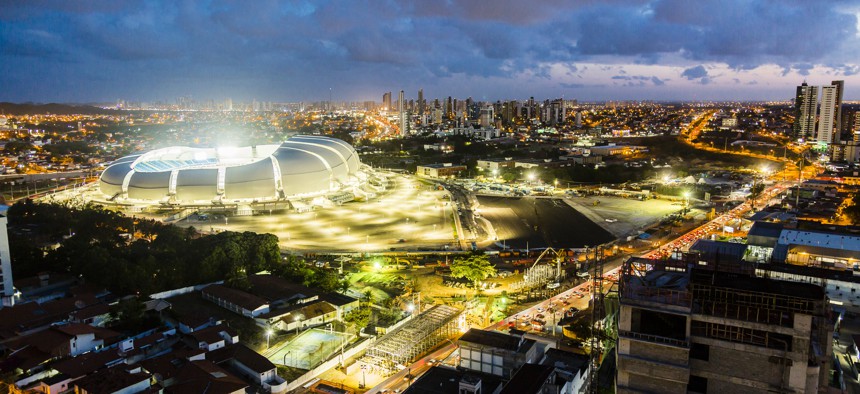
Eleven U.S. cities will host matches alongside others in Canada and Mexico for the 48-team soccer tournament. Estúdio Luciano Azevedo via Getty Images



Federal agencies urged to prepare as states warn of World Cup cyber, physical threats
State and local leaders are raising alarms about potential attacks, urging federal officials to coordinate security and protect critical infrastructure during the international sporting event.

State and local leaders warned this week that without more federal funding and better information sharing, this summer’s FIFA World Cup is at risk of being struck by a catastrophic event.
Eleven U.S. cities will host matches alongside others in Canada and Mexico for the 48-team soccer tournament. But at a House hearing this week, some local leaders said cities are vulnerable to attack, whether that be a physical one or a cyberattack, and need more help from the federal government, including financially.
Those worries have been most stark in Foxborough, Mass., where local leaders there say they cannot grant games to be hosted at Gillette Stadium in the town an entertainment license without a commitment from FIFA or a higher level of government to cover the expected $7.8 million in costs.
“States and host cities — who are already laying out huge sums of their own taxpayer dollars and have dedicated untold local resources for these events — are getting worried — and rightfully so,” Rep. Bennie Thompson, a Mississippi Democrat and the ranking member on the House Homeland Security Committee, which held the hearing, said in his opening statement. “Time is running out to finalize security preparations.”
Finances are weighing especially heavily on states and localities set to host games, or collaborate with neighbors who will host them. Multiple witnesses bemoaned the reduction in funds available from the Department of Homeland Security’s State Homeland Security Grant Program, Emergency Management Preparedness Grant and Urban Area Security Initiative, and they warned that, given the funding shortfalls created, they would have no choice but to cut back.
Those leaders also called for the release of funds from the $625 million FIFA World Cup Grant Program, which was created by Congress under the One Big Beautiful Bill Act to support various security efforts like cybersecurity, training, readiness and information sharing and analysis. That grant program, administered by the Federal Emergency Management Agency, has been temporarily halted due to the DHS shutdown as FEMA is now focusing only on “bare-minimum life-saving operations.”
“While we would welcome working with the Department of Homeland Security to reimagine grant distribution in the interest of being more efficient; this sudden reduction has left us with no choice but to decrease capabilities,” said Travis Nelson, deputy chief of staff and homeland security advisor for Maryland Gov. Wes Moore, in written testimony. “Due to the upcoming special events, maintaining the service level of previous years will be extremely challenging.”
“The FIFA funding would be critical for our staffing and our mutual aid partners to come in and assist,” Joseph Mabin, deputy chief of the Kansas City, Missouri Police Department, said during the hearing. “We just don’t have enough officers within my own department to cover all the threats.”
Ray Martinez, chief operating officer of the 2026 FIFA World Cup Miami Host Committee, warned that events like Fan Fests and others might be cancelled within 30 days without federal funds. He said during the hearing that agencies “are very anxious,” and without that money it “could be catastrophic for planning and coordination.”
The ability for agencies to share information on threats is also one aspect that is keeping some state and local officials up at night, with the World Cup just months away. Mike Sena, president of the National Fusion Center Association, said threat reporting generally “remains fragmented,” especially as tips and leads can be gathered by agencies at various levels, businesses, venue security and the public, but there is no single place through which to consolidate those tips and share them.
The World Cup highlights those challenges “in very real ways,” he said, adding that delayed or canceled grant funding further undermines the readiness of those information sharing systems.
“In some host regions, state and local law enforcement agencies are facing significant security responsibilities without clear coordination or operational alignment across all partners involved in the sprawling events from practice locations, team hotels, to official and unofficial events for fans,” Sena continued in written testimony. “As a result, local agencies are not as connected as they should be for planning, staffing, coordination, and real time information sharing for a complex, multi-jurisdictional event.”
Meanwhile, Sena warned that the systems used by DHS and the Federal Bureau of Investigation are not fully interoperable with state and local systems.
“Agencies are often working from partial information, and critical data does not always reach the right analysts or decision makers in time, which means that front-line personnel who are best positioned to recognize, report, and respond to potential threats are less aware,” he said.
While speakers highlighted various successes, including the administration’s focus on countering illegal drones, adding capabilities like better hazmat, bomb disposal and other teams, as well as conducting tabletop exercises and other training initiatives, a lot of work lies ahead, with less time in which to get it done.
“Before the first whistle blows later this year, we want to ensure that information flows faster than threats, that partnerships are stronger than vulnerabilities, and that everyone experiences a safe and secure World Cup,” said Mabin.