

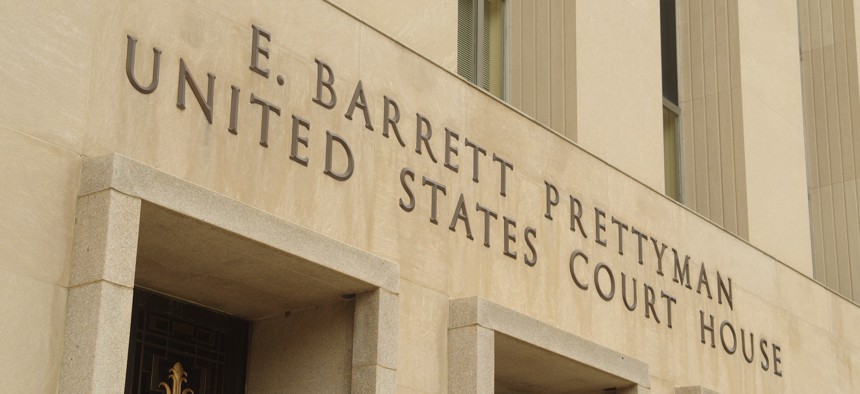
The front entrance of the E. Barrett Prettyman U.S. Court House in Washington, D.C. The Judicial Conference of the U.S. asked Congress to transfer property management authority over federal courthouses from the General Services Administration to the judicial branch. Philip Yabut / Getty Images





Judiciary requests control over courthouse property management partially due to job cuts at GSA
The General Services Administration, which manages government property, said in a statement that the “American taxpayer is best served by the judiciary focusing on the rule of law while GSA continues to focus on the federal real estate portfolio.”

The national policymaking body for federal courts is asking Congress to grant the judicial branch authority over its buildings due to concerns with the General Services Administration’s management of courthouses. While the Judicial Conference of the U.S. has held this perspective for decades, the organization argued that the issue has worsened since the Trump administration cut the staff at the federal government’s real estate agency.
“This position is being sought now because the condition of many buildings housing the judiciary has reached a crisis point after decades of inadequate management and oversight,” the entity wrote in a Feb. 24 letter to congressional leaders. “The recent unilateral actions and reorganization of GSA have only exacerbated these conditions.”
The Judicial Conference reported that there is a more than $8 billion backlog in infrastructure repairs needed at courthouses across the country. As a result, at some locations, individuals have been stuck in elevators for hours, ceilings have fallen in the middle of trials and legionella has been found in the water supply.
Federal building repair issues are not limited to the judicial branch. GSA reported in March 2025 that its deferred maintenance backlog exceeded $17 billion.
Like much of the rest of the federal government, Trump has targeted GSA for workforce reductions. The inspector general for the agency, however, found in an October 2025 report that officials implemented the staff cuts without “effective reorganization plans” creating “a series of unintended consequences.”
Also, GSA reversed the layoffs of some tech and property management employees.
Still, the Judicial Conference said that the changes at GSA have compounded the building maintenance problems. The organization reported in the letter that funded construction projects have been paused because they don’t have an agency project manager, nearly 75% of courthouses with five or more judges don’t have an onsite building manager and that some contractors have ceased work on projects due to a lack of oversight.
The policymaking body first adopted the position that the judiciary should control its buildings in 1989. Supporters argue that it would be akin to Congress managing its properties through the Architect of the Capitol.
As part of the letter, the Judicial Conference included proposed legislation that would create the Judiciary Buildings Service within the Administrative Office of the U.S. Courts to acquire, alter or lease court buildings. The new agency would be funded largely through annual appropriations and leasing excess space.
The organization also contended that such an agency would promote government efficiency by eliminating GSA as a “middleman” and reducing the amount that the judiciary pays in rent and fees to GSA.
In a statement to Government Executive, GSA rejected the Judicial Conference’s proposal.
“GSA will continue to work closely with our partners in the judiciary. We disagree with the characterization that the federal courthouse portfolio is in ‘crisis’ due to mismanagement,” said Marianne Copenhaver, GSA associate administrator for strategic communications. “While aging federal buildings present well-known challenges, their narrative omits critical context regarding our lack of access to GSA's Federal Building Fund to address delinquent maintenance. The American taxpayer is best served by the judiciary focusing on the rule of law while GSA continues to focus on the federal real estate portfolio.”
The Government Accountability Office reported in 2025 that changes the U.S. Courts made to its design guide would increase courthouse construction costs by 12%, prompting the watchdog to recommend a reassessment of the standards.
Share your news tips with us: Sean Michael Newhouse: snewhouse@govexec.com, Signal: seanthenewsboy.45
NEXT STORY: USDA to offload HQ building as it prepares to consolidate space and relocate staff