

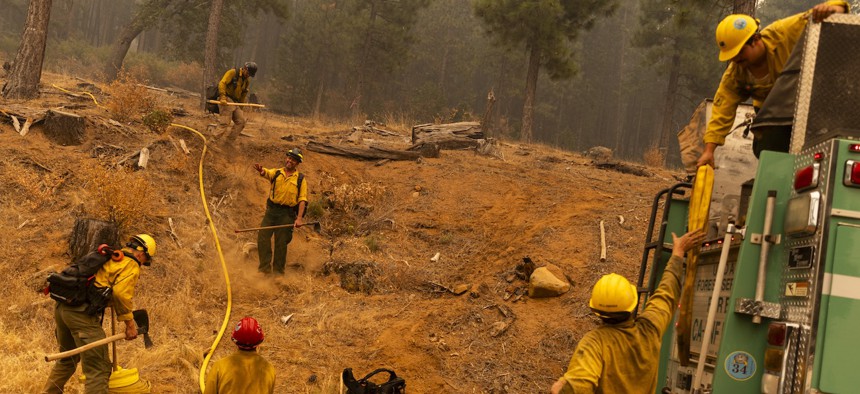
Firefighters with the U.S. Forest Service prepare a hoselay on a hillside during the Park Fire in Tehama County, Calif., on July 27, 2024. Stephen Lam/San Francisco Chronicle via Getty Images





Trump administration stands up consolidated federal firefighting agency over bipartisan congressional reservations
Interior says it is only restructuring internally, though it is still working toward Trump's goal of an interagency merger.

The Trump administration has taken the first steps in standing up its new, consolidated federal firefighting agency, despite Congress declining to fund it and voicing bipartisan reservations about the plan.
The U.S. Wildland Fire Service will, for now, consolidate wildfire response away from individual bureaus within the Interior Department—such as the Bureau of Indian Affairs, Bureau of Land Management, National Park Service, Office of Wildland Fires and others—and into the new, central office. The administration is looking to further merge firefighting operations currently within the Agriculture Departments’ U.S. Forest Service in the consolidated agency, but has not yet announced its timeline for doing so.
The announcement follows an executive order President Trump issued last year to create USWFS by merging firefighting activities within USDA and Interior. The two departments announced in September that they would stand up the agency within Interior in January 2026.
Since then, however, Congress has put forward bicameral, bipartisan legislation to fund Interior and the Forest Service, which the House overwhelmingly approved last week and the Senate is expected to send to Trump’s desk in the coming days. The measure is set to deny any funding for USWFS, despite the administration requesting a total of $6.5 billion for the agency. Additionally, in a joint statement accompanying the bill, lawmakers specifically blocked the USDA-Interior firefighting merger. Congress instead required a study into the feasibility of Trump’s proposal, including how it would differ from the current leadership provided by the National Interagency Fire Center.
A Senate version of the bill contained even firmer language definitively blocking any transfer of functions, personnel or resources from USDA to Interior, but that provision was not included in the final compromise legislation. The measure has cleared initial procedural hurdles in the Senate but has not yet completed final passage.
Interior’s announcement this week did not mention USDA, but suggested this was an initial step with more work ahead. The internal consolidation would streamline operations that had been siloed across its separate organizations, Interior said.
Elizabeth Peace, an Interior spokesperson, said the department “fully complies with all applicable laws and appropriations requirements" and the announcement amounted only to planning and coordination internal to the department without creating any new, independently funded agency. The appropriations language pertains to unification with the Forest Service, she noted, which is not part of this week's announcement—though it did link back to Interior’s press release with USDA announcing their planned unification.
“Interior is well within its authority to evaluate how its internal programs are organized and to take steps to improve coordination, efficiency, and operational effectiveness,” Peace said. “No new funding is being obligated, and no structural changes requiring congressional authorization are being implemented at this stage.”
Brian Fennessy, who has decades of firefighting experience, including in federal government and most recently as chief of the Orange County Fire Authority in California, will serve as the first USWFS chief.
“Wildfire response depends on coordination, clarity and speed,” Fennessy said. “This initial planning effort is about bringing programs together, strengthening cooperation across the department and building a framework that better supports firefighters and the communities they serve.”
In an email to staff, Fennessy said he would be issuing a “blueprint for our phased unification” in the coming weeks and noted the steps within Interior were “only the start of our journey.” He vowed to listen to the workforce, particularly as he encounters hurdles.
“Mistakes may occur along the way, but I assure you that we will address them openly, learn from them, and move forward together,” Fennessy said. “I ask for your patience and willingness to share any blind spots you observe—your insights are essential to our progress.”
He promised to maintain open communication to avoid “rumors and misinformation” and noted front-line personnel often have “the clearest understanding of what works, what doesn’t and what solutions may exist.”
In his order this week formally establishing the Wildland Fire Service, Interior Secretary Doug Burgum said the department manages 500 million acres and 4,000 permanent employees as part of its wildfire management mission. The change would streamline the chain of command and decision making, simplify budgeting, standardize pay policies, improve interagency coordination, enable more efficient use of resources and uphold the department's responsibilities to tribal governments, he said.
While Interior maintained no new funding was being obligated and no structural changes requiring congressional authorization were part of the announcement, Burgum provided USWFS with programmatic authority, positioned it within the Office of the Secretary and tasked his team with “taking appropriate steps to provide funding for USWFS.” He directed all bureau heads to take all necessary actions to transition their resources and workforces to USWFS, as appropriate.
He added, however, that all current bureau fire directors would maintain all their current authorities and delegations.
"The department will continue to work with Congress and respect congressional direction as this internal planning effort moves forward," said Peace, the Interior spokesperson.
Burgum is also overseeing another consolidation into his office: Interior is in the midst of moving thousands of back-end employee—such as those in human resources, contracting and IT—away from their bureaus and into the Office of the Secretary. In the appropriations bill, lawmakers are set to instruct the department that any shift of more than 10 employees required Interior to go through the formal reprogramming process.
Natalie Alms contributed to this report.
Share your news tips with us: Eric Katz: ekatz@govexec.com, Signal: erickatz.28
NEXT STORY: After one year of Trump, is anything left of the American Climate Corps?