

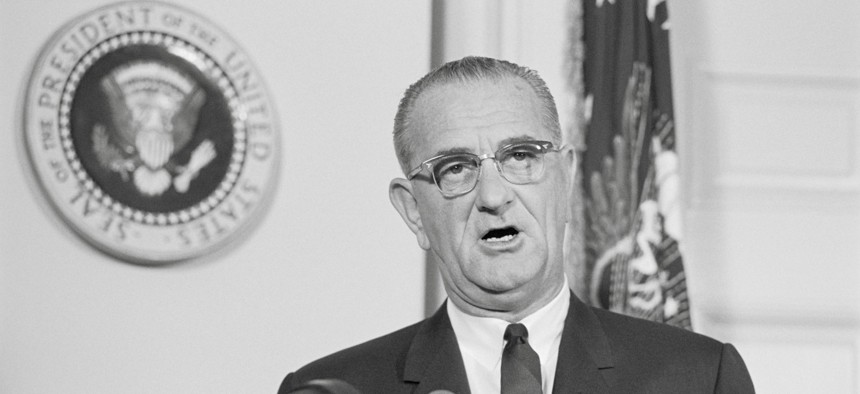
According to the Pew Research Center, Americans' trust in government peaked at 77% in 1964, after Lyndon Johnson became president following the Kennedy assassination. As of Dec. 4, 2025, 17% say they trust their government to do the right thing all or most of the time. Bettmann / Getty Images




Let's play a drinking game
COMMENTARY | Americans' declining trust in government has been an oft-discussed trend for decades, but it turns out that it's neither unique to government nor Americans. So what is happening to institutional trust?
At a recent conference focused on “reimagining government” a panel member suggested that whenever a certain term/phrase was used, we ought to all have a drink. And then we’d all be drunk by 10 a.m. (the panel has started at 8:30 a.m.). That term or phrase might well have been Americans’ declining trust in government. It’s well known, and much discussed these days, that Americans’ trust in government is a quarter of what it was in the 1960’s.
Just look at recent reports from the Pew Research Center. Pew began asking about this issue almost 70 years ago – in 1958, during the Eisenhower Administration (Richard Nixon was Eisenhower’s vice president). Then, 73% of Americans and majorities from both parties said they trusted the government to do what is right “just about always” or “most of the time”. Trust peaked at 77% in 1964, shortly after Lyndon Johnson became president after the assassination of John Kennedy.
And then Johnson declined to run in 1968, both Martin Luther King and Robert Kennedy were assassinated in 1968, the Watergate break-in occurred in 1972 and Nixon was nearly impeached and then resigned in 1974. By the end of that year, after Nixon had flown off to exile in San Clemente, California, just 36% of Americans said they trusted their government. Garrett M. Graff, author of the book “Watergate: A New History”, describes Watergate as a dividing line in history: “The Vietnam War, the Pentagon Papers and Watergate ... fundamentally rewrote the relationship between the American people and their government and caused a collapse in the public’s faith in those institutions that our nation’s leaders are still struggling with today.” Recent reports released by Pew (Dec. 4, 2025) show that today 17% of Americans say they trust their government to do the right thing all or most of the time.
Democracy’s foundation is built on trust. But alarms are being sounded by multiple good government groups and leaders about the decline in trust. How can we explain such a decline? And how concerned should we be about it? What should be done to rebuild and restore trust? Let’s explore these topics a bit more.
Other venerable polling organizations have reported similar disturbing trends. In July, Gallup reported that just 27% of Americans expressed confidence in their institutions – the lowest level of trust since the questions were first asked over 50 years ago. And that lack of confidence was widespread. Just 7% have confidence in the legislature. A tad over 20% in the presidency. Just 25% in the Supreme Court – and dropping. And not just government institutions. Just 11% of Americans have confidence in television news; 16% in newspapers. So the problem exists across the board – not just with Congress, the presidency and our high court, but also with the military, business, police, media, churches, schools and more – 14 institutions in all. The average confidence level (27%, as noted above) has declined from 46% in 1989. Americans also reported having more animosity towards one another than they used to.
Political scientists Nathan Kalmoe and Liliana Mason, based on their research, found that nearly half of registered voters think that the opposing party is not just bad but “downright evil”. Nearly a quarter concur that, if that party’s members are “going to behave badly, they should be treated like animals”. So when we have conversations about the declining trust in government, it is probably important to note that the issue of “trust” is NOT reserved for JUST government. Levels of trust in this country – in our institutions, in our politics and in one another – are ALL in decline. And while opinions of individual institutions do vary among groups, the overall distrust of institutions is universal, with little variation by gender, age, race, education or even party.
Are these findings of mistrust distinctly American? Idrees Kahloon, in an excellent New Yorker article, points to The World Values Survey that has asked residents in scores of countries about their beliefs for the last 40 or so years. The most recent data shows that Americans have a bit less trust in one another than the Germans do, but a bit more than the Japanese and South Koreans do. Kahloom notes, “As low as Americans belief in government can seem, it is exactly as predicted by this global trend line”.
So the United States in not unique. Nor is the decline in trust confined to government alone, as noted. Nonetheless, any explanation on our country’s decline in trust over time? Answers are hard to come by, but Benjamin Ho, a professor at Vassar, offers some options in “Why Trust Matters”. One factor may be economic stagnation. Social scientists tell us that 90% of Americans born in 1940 could expect to make more than their parents; for those born in the 1980’s, the rate has dropped to only 50%. It’s likely even lower for those born in 2000.
Another factor identified by Professor Ho is an increase in ethnic diversity – the prospect of a nonwhite majority in the U.S. may be intensifying tribalism. And technology has made it easier for media outlets to cater to niche audiences, for listeners/viewers to place more trust in news and news sources that confirm what they already think or already “know”. In a recent article, Rutgers professor Stuart Shapiro looks at how criticism of government and bureaucrat bashing by presidents and presidential candidates since 1960 may likely have affected trust in government.
But perhaps we should ask how trustworthy our indicators of trust are today. The partisan rancor that is so common now actually makes it much harder to measure trust. Survey questions that have been part of research studies for decades (e.g., an approval rating of the president or the Congress) seem much less useful nowadays when public sentiment hinges almost entirely on partisanship.
And technology may be playing a role as well. Author Rachel Botsman argues that advances in IT have created a new paradigm – that of “distributed trust”. In “Who Can You Trust?”, she suggests that the old hierarchical model in which trust was transmitted from institution to individual – think the earlier media days: CBS Evening News with Walter Cronkite (as opposed to the 2026 CBS Evening News with Tony Dokoupil) – has been replaced by a lateral model in which trust flows from individual to individual.
Finally, the philosopher C. Thi Nguyen raises some interesting arguments in his new book “THE SCORE: How to Stop Playing Somebody Else’s Game”. We lose so much when we demand measurability of things that are difficult to measure, such as trust. Indeed, some metrics can be so distortive that they tempt us to care about “what’s easy to measure” (i.e., Do you trust the government in Washington to do what is right….?) than what is truly important (how is government performing/serving).
So what can we learn from the varied research on declining trust in government and the many panel discussions on how it might be restored? First, while there are many good reasons to make government work better and to focus on improving service to citizens – and we should most certainly continue to strive to do so – there isn’t much evidence that we should count on any of these initiatives to change the decline noted by Pew and Gallup.
For the reasons noted above, I’d argue that today this indicator is outdated and flawed. What to look to instead? I’d suggest we turn to the American Customer Satisfaction Index – satisfaction ratings meant to serve as a cross-industry metric of how customers rate the quality of products and services in the United States based on a survey of about 7,000 people over the course of the year. Interestingly, citizen satisfaction with the federal government was on the rise according to ASCI findings released in November 2025. This is in spite of government layoffs and the work of Elon Musk’s Department of Government Efficiency. The results put satisfaction with federal government services at 70.4 (out of 100), which was a 19-year high. The report points to a renewed focus on citizen services under the President’s Management Agenda(s) and the power of new technologies as driving forces for the rise. Nextgov/FCW's Natalie Alms wrote an excellent piece on the report on Nov. 18, 2025.
So do we Americans really want good government? The muckraker Lincoln Steffens posed that question in McClure’s magazine in 1903. It appears we do. Presidents from Ronald Reagan, with his Reform ‘88 initiative, through the Clinton/Gore Reinventing Government, to the time when we expect a President’s Management Agenda to be part of the annual budget request to the Congress all demonstrate our leaders recognize and are responding to that desire. But as Steffens went on to ask “Do we know it when we see it?” That remains to be answered. In the meantime, good government conferences and panel discussions will continue until trust improves.