

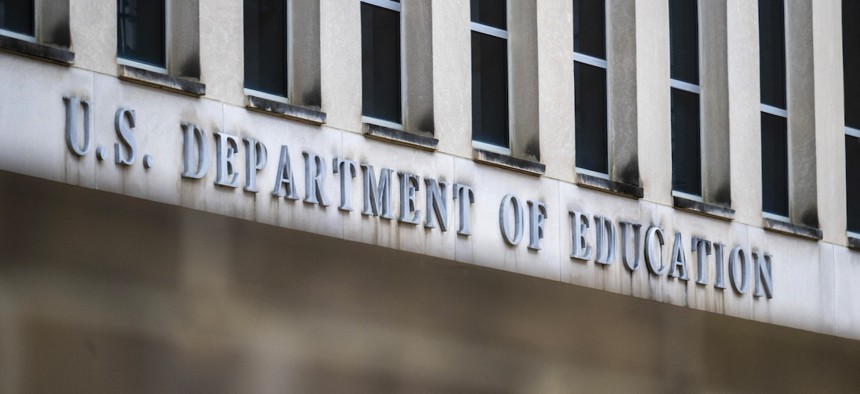
The employees still work for and are paid by Education. JIM WATSON/AFP via Getty Images



Education begins moving out employees even as Congress says it lacks authority
In bipartisan, bicameral spending package, lawmakers look to pump the brakes on the dismantling of Education that the department advanced on Tuesday.

The Trump administration has begun moving dozens of employees from the Education Department to other federal offices as part of its plan to streamline operations and unwind the agency, even as Congress is on the verge of taking new steps to slow down or stop the changes.
Between 40 and 50 employees were part of the initial detailing out from Education to the Labor Department on Tuesday, according to multiple employees briefed on the plans, as the administration takes its latest steps to implement its newly signed interagency agreements. Education is in the midst of partially offloading some of its major program offices to four other agencies, a key component of its effort to eliminate itself. Employees from the Higher Education Programs Division of the department’s Office of Postsecondary Education were the first to detail out.
The details will, so far, amount to a change in physical location without altering the actual work or chain of command of impacted staff, the employees said. In a meeting last week, workers were told their tasks would not be integrated with Labor’s. Many questions went unanswered and the process appeared rushed, employees said, and they were not even told if they should bring auxiliary equipment like monitors and keyboards.
“What it really means is, ‘Pick up your [Personal Identity Verification] card and laptop and move over to Labor,” said one Education official involved in the planning, noting existing processes were not being streamlined.
The employees still work for and are paid by Education. Only the political appointee in charge of the relocated office will see a change, as he will now answer to assistant secretaries at both Education and Labor.
“Do your Education work at Labor,” another employee familiar with the matter said of the message to impacted staff.
Detailed workers will not be provided parking at Labor, so Education has instead hired vans to run twice per day to shuttle them between the Education building—where employees will maintain their parking spots—and Labor’s. If the shuttle time does not align with their scheduled work hours, according to two workers familiar with the plan, employees may have to spend part of their day working at Education before taking the shuttle over to Labor.
The Trump administration said the new setup would allow the two departments to better work together toward a coordinated postsecondary education strategy.
“We are proud to begin implementing this historic partnership that will not only create a better coordinated federal approach to postsecondary education and workforce development, but will also ensure that students pursuing higher education pursue programs aligned with their career goals and workforce needs,” said David Barker, Education’s assistant secretary for postsecondary education.
Education has stood up various teams to smooth the transition process, focusing on issues such as talent, finance and grants. They are working with the Health and Human Services Department to integrate the HHS-owned Grant Solutions application with Education’s programs. When working on still-active, existing grants from prior years, however, employees detailed to Labor will still have to tap into Education’s own software, one Education official said. They will use the HHS application only for newly awarded grants.
In internal documents prepared for the transfers, Education itself raised concerns about its ability to offload work to other agencies and predicted significant challenges along the way.
The implementation of the interagency agreement comes at a potentially tumultuous time for the department. Congress on Tuesday unveiled a bipartisan, bicameral spending package that included fiscal 2026 funding for both Education and Labor. As part of the agreement, lawmakers stated they were concerned the “unprecedented” interagency agreements that "fragmenting responsibilities for education programs across multiple agencies will create inefficiencies, result in additional costs to the American taxpayer, and cause delays and administrative challenges in Federal funding reaching States, school districts, and schools." They added work was being transferred to agencies that do not have the “experience, expertise or capacity” to carry out the work or properly communicate with stakeholders.
It would prohibit the transfer of funding for interagency agreements without direct support in law and stated that "no authorities exist for the Department of Education to transfer its fundamental responsibilities under numerous authorizing and appropriations laws, including through procuring services from other federal agencies, of carrying out those programs, projects, and activities to other federal agencies.”
Lawmakers did not appear to explicitly ban the agreements and details altogether, however, instead asking for biweekly briefings with significant details on the costs, staffing implications and impacts on grantees and other stakeholders. The spending package has yet to receive a vote, but is expected to win broad, bipartisan support and be signed into law by the end of the month.
In addition to Labor, Education will soon be offloading work to HHS, the Interior Department and the State Department. It has already shed around half of the more than 4,000 employees who were on board at the start of last year through a combination of layoffs and incentivized separations.
Education declined to comment on the spending package or other information regarding the details. Inside Higher Ed first reported the details would begin this week.
Share your news tips with us: Eric Katz: ekatz@govexec.com, Signal: erickatz.28
NEXT STORY: Shutdown odds plummet after House and Senate strike bipartisan deal on remaining funding bills