

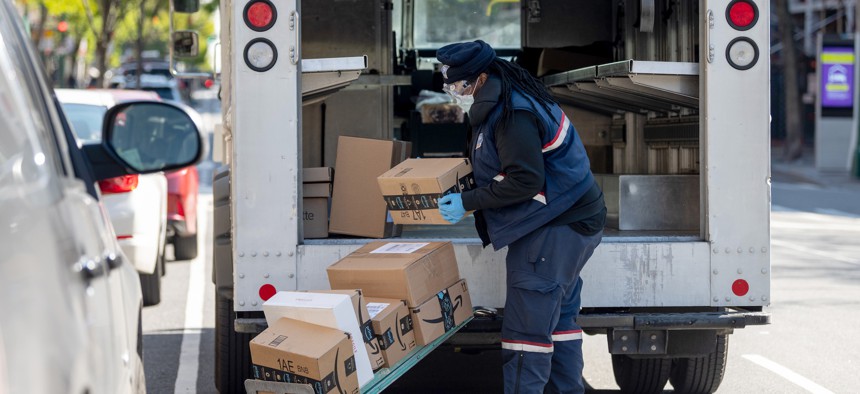
A U.S. Postal Service worker delivers packages on April 28, 2020, in New York City. The postal agency is planning to begin auctioning access to its last-mile delivery network in early 2026. Alexi Rosenfeld / Getty Images




Postal Service hopes selling access to its final-leg delivery network will provide much-needed revenue
Because the U.S. Postal Service delivers to all U.S. addresses, many private companies rely on the agency to ship to harder-to-reach places. Postmaster General David Steiner wants to enable more businesses to utilize this service.

The U.S. Postal Service on Wednesday announced plans to expand access to its last-mile delivery network, which the new postmaster general hopes will provide a boon to the financially struggling agency.
“In the logistics business, the most expensive part of delivery is generally the ‘last mile’ portion of a route. As part of our universal service obligation, we deliver to more than 170 million addresses at least six days a week, so we are the natural leader in last-mile delivery,” Steiner said in a statement. “We want to make this valuable service available to a wide range of customers that see the worth of last mile access — other logistics companies and retailers large and small.”
USPS in late January or early February 2026 will begin auctioning off access to more than 18,000 delivery destinations, according to a press release.
Steiner said in an interview with Reuters about the program that it could raise billions in revenue for USPS, which is needed as the PG also warned that the agency could run out of money in early 2027.
USPS experienced a net loss of $9 billion in fiscal 2025.
At the postal agency’s board of governors meeting on Nov. 14, Steiner suggested expanding businesses’ access to USPS last mile shipping services that reach all U.S. addresses.
“I've taken to saying that we cannot cost-cut our way to prosperity,” the postmaster general said at the meeting. “We have to grow.”
While USPS has been delivering packages for private businesses through its last-mile network for years, access has generally been limited to a few large companies. And one such corporation may be ending its relationship with the post office.
The Washington Post reported on Dec. 4 that Amazon is considering not renewing its shipping contract with USPS that expires in 2026 and instead expanding its own national delivery network. The report found that Amazon provided more than $6 billion in annual revenue for the postal agency in 2025.
USPS is in the middle of its 10-year modernization plan, Delivering for America, an initiative of former Postmaster General Louis DeJoy, who stepped down in March. While DeJoy originally predicted that the overhaul would enable the agency to break even by fiscal 2023, that has yet to happen despite increased prices and, in some cases, slower delivery.
Steiner and the bipartisan board of governors, however, have said they are committed to continue implementing Delivering for America, despite calls from lawmakers of both parties and postal stakeholders to pause or reverse it.
On Tuesday, the Government Accountability Office issued a report that criticized USPS for not including near-term financial projections in a 2024 update to its strategic plan.
“Without financial projections, USPS does not have targets to show progress or to effectively communicate how its actions will restore USPS’ financial sustainability,” investigators wrote.
The watchdog agency also cautioned that USPS likely could not take actions by itself to become financially self-sufficient. As recently as 2022, Congress passed legislation intended to stabilize USPS’ finances after more than a decade of billion-dollar losses.
An additional USPS reform that Steiner would like lawmakers to pass, which he brought up both during the Nov. 14 board meeting and in the Reuters interview, is to raise the agency’s $15 billion statutory debt limit.