

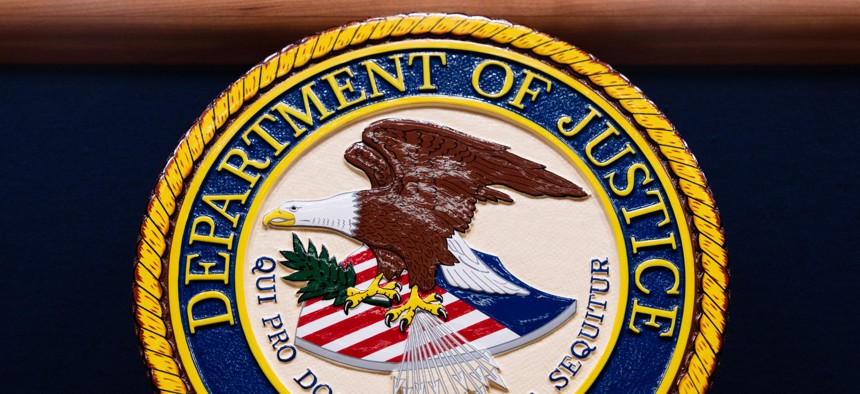
Reports have credited DOGE officials with advising on the termination of several Justice Department grants. Tom Williams / CQ-Roll Call, Inc / Getty Images




Fallout from DOGE cuts: How defunding derailed a federal microgrant strategy
COMMENTARY | Several presidents have criticized the complexities of the federal grants process, but DOGE cuts to the Justice Department have made the process worse for local law enforcement rather than helping.
After 10 turbulent months, the Department of Government Efficiency has left Washington for good. Its stated mission—to make government more efficient and accountable—was laudable. But good intentions do not negate real harm. And the damage DOGE unleashed across the country won’t disappear just because DOGE has.
When it comes to federal funding for public safety, DOGE was nothing short of an earthquake, whose aftershocks continue to reverberate nationwide. DOGE was presumably the driving force behind the abrupt termination of 373 Justice Department grants this past April, canceling awards initially worth $820 million in support for violence reduction programs, victim services and other state and local public safety efforts.
One of the most destructive consequences was the elimination of grants valued at $95 million in funding for intermediary organizations: larger, more experienced nonprofits that bridge the gap to federal support for smaller community groups and government agencies. These intermediaries deliver microgrants and hands-on support that help rural police departments, tribal justice agencies and community-based nonprofits overcome the complex barriers of federal grantmaking and build organizational capacity over the long term. When DOGE pulled the plug, it was not only the intermediaries that suffered losses, but the smallest, least resourced communities in America.
I know this landscape well. Many of these intermediary grants were originally made on my watch, during my tenure as the assistant attorney general for DOJ’s largest grantmaking office, the Office of Justice Programs. We built these programs deliberately—as detailed in a new Council on Criminal Justice report—expanding federal support to grassroots nonprofits and rural jurisdictions that had long been shut out of federal funding and resources.
This was not a partisan experiment. For decades, Republicans and Democrats alike have decried the inaccessibility of federal funding to smaller and more rural organizations. The George W. Bush administration called the grantmaking process “overwhelming and off-putting to smaller-scale organizations;” the Biden White House found it rife with “persistent barriers” for under-resourced communities; in an Executive Order, President Trump condemned it as a “notoriously complex” system that rewards applicants that can afford legal and technical experts.
They were all right.
As anyone who’s ever applied for a federal grant can tell you, the process is no joke. By most estimates, completing a federal funding application can take around 100 hours, even for organizations with experienced grant writers and legal experts. Applicants have to invest that staff time upfront, with no guarantee that their proposal will be among the lucky few selected for funding. Many small local governments and grassroots nonprofits simply don’t have the resources to dedicate to this process. Yet, ironically, these are the same groups that are often most in need of federal support.
The intermediary model helped fix this. Through this approach, OJP was able to expand the footprint of federal support among rural policing agencies, delivering much-needed training and equipment to some of the nation’s most geographically isolated communities. Intermediaries helped open the door to federal funding for grassroots community-based organizations, whose staff are interrupting violence and victimization in the hardest-hit neighborhoods.
When the funding cuts hit intermediaries, these small groups—and the people they serve—paid the price.
In rural Oregon, a microgrant allowed the Union County District Attorney to hire the office’s first investigator, who quickly zeroed in on a lead in the brutal murder of a young women in a local park—a case that had remained unsolved for over four decades. But before he could bring the case to justice, DOJ withdrew funding for the microgrant, and the investigation was abruptly shut down.
Another microgrant helped fill gaps in programming for at-risk kids in Bogalusa, Louisiana, a rural community hit hard by gun violence. The microgrant disappeared, and so did the youth violence prevention services.
And in New Orleans, the loss of a microgrant meant the elimination of victim services for the grieving families of homicide victims.
These aren’t just line items on a government spreadsheet, or entries on DOGE’s Wall of Receipts. These are real communities. They are small towns trying to solve the most serious crimes, parents navigating unimaginable loss and kids looking for a safe place to learn and grow.
If we—Republicans and Democrats alike—truly care about getting federal resources to the people and places where they can do the most good, then we should double down—not abandon—the microgrant funding model. It is one of the most promising, equitable and fiscally responsible tools we have for expanding access to federal funding.
DOGE may be gone. But the task of making government work for everyone—especially those farthest from Washington—has barely begun.
Amy L. Solomon is a senior fellow at the nonpartisan Council on Criminal Justice. She previously served as an assistant attorney general in the Biden administration’s Department of Justice overseeing federal grantmaking and the science offices.