

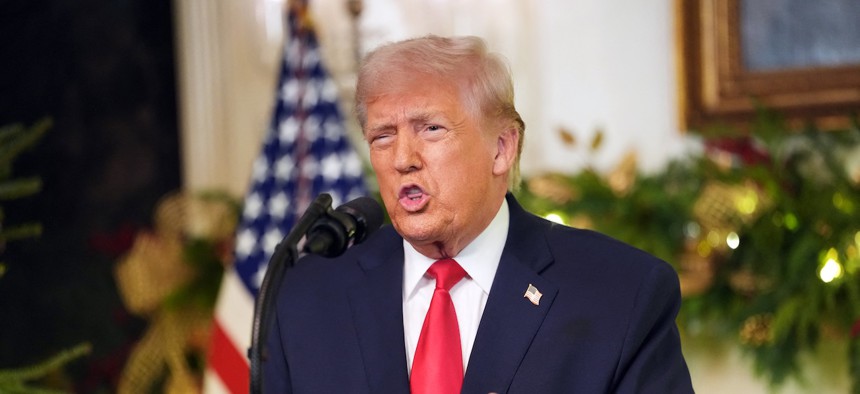
Trump is expected to follow through on initiatives he began in the opening months of his second term. Doug Mills/Getty Images



The 5 biggest stories federal agencies and employees need to watch in 2026
Trump will look to finalize his government overhaul efforts next year.

President Trump rapidly launched his efforts to overhaul the federal government and upend the norms of the civil service in his first year back in the White House, but in many ways those activities are still pending resolution.
The Trump administration has already shed hundreds of thousands of federal workers, but what the new steady state of the civil service will look like remains unknown. How agencies are funded and whether there is another shutdown will be front of mind for employees still recovering from six weeks without on-time pay. Each agency faces its own barrage of changes as Trump appointees look to put their imprint on their missions and implement the president’s vision.
Next year will start to bring answers to some of the biggest questions as the administration looks to follow through on initiatives it began in its opening months. Here are the top issues for federal agencies and their employees to monitor in 2026:
1.) Renewed shutdown watch
The first order of business when lawmakers return to the Capitol Building next year will be to pass the remaining nine annual appropriations bills for fiscal 2026. It passed three of the 12 measures last month when it reopened government, but funding the remaining agencies is set to expire Jan. 30. Lawmakers had been plugging away at another “minibus” package to departments of Defense, Labor, Health and Human Services, Education, Transportation, Housing and Urban Development, Commerce, Justice and Interior, but negotiations will drag into 2026.
Many issues could still derail those talks. Lawmakers have still yet to reach a resolution on the surging health care premium costs for millions of Americans, the issue at the root of the record-setting shutdown that began in October. Democrats are still seeking assurances that President Trump will stop acting unilaterally to withhold funds Congress has authorized. And the House and Senate must still agree on the overall funding levels for federal agencies as the White House is still pushing to implement dramatic cuts.
2.) Return of RIFs?
When Congress voted to end the shutdown, it included a provision that paused any agency layoff action through Jan. 30. A federal court has since intervened to enforce that provision. Agencies have begun notifying thousands of employees that their previously scheduled reductions in force are rescinded, for now, though they will reassess after the Jan. 30 deadline.
After ordering widespread layoffs across government, agencies mostly used them sparingly. More than 300,000 federal employees left government this year, though they mostly did so through incentivized programs. Cutting the federal workforce remains a priority for the Trump administration, however, and is a pillar of the president’s management agenda. Agencies are expected to continue limiting hiring going forward and could tap additional programs to push employees to leave in 2026.
3.) The implementation of ‘Schedule F’ and other changes to the civil service
Trump’s infamous "Schedule F” order from his first term will see a revival in 2026, when its latest iteration—now dubbed Schedule Career/Policy—goes into effect. The Trump administration put forward a proposed rule, but the final version has been drafted and circulated to agencies. Its release is expected imminently. The regulations will cite “accountability to the president” as grounds for stripping tens of thousands of federal employees of their civil service protections, according to excerpts reviewed by Government Executive. Employees in positions targeted for conversion would become effectively at-will employees. The administration has said the change will enable agencies to better hold employees accountable, while detractors have suggested it will eradicate longstanding and critical protections against political interference with the non-partisan career workforce.
Agencies recently turned over lists to the Office of Personnel Management for employees to convert to Schedule Policy/Career, though OPM will have final say on those decisions.
OPM, meanwhile, will also soon put forward proposals on overhauling the process for laying off employees and implementing a “forced distribution” system for performance management. Those changes could have major implications for how agencies manage their workforce, including who gets rewarded and who gets fired.
4.) Agency reorganizations
Many agencies throughout government are in the process of overhauling their structures and how they carry out their missions. The Agriculture Department will relocate thousands of employees and shutter offices. The State Department has shed employees and reshaped its entire organizational chart. The Interior Department is in the midst of consolidating employees away from its bureaus and into the Office of the Secretary. The Education Department is unloading key parts of its operations onto other agencies, and is expected to move employees as a result. The Consumer Financial Protection Bureau is also shifting some of its work and is looking to essentially dismantle itself entirely. The Veterans Affairs Department recently announced an overhaul of its health care network, looking to slash regional offices but maintain its current staffing levels.
All of the changes are expected to encounter turbulence. Employees and stakeholders alike have voiced concerns over the process, even as they, in some cases, recognize the opportunity for boosted efficiency. While the administration has put forward broad outlines for the changes, many of the details must still be ironed out in the coming months.
5.) Court battles
As mentioned, the Trump administration is still facing pending litigation over its layoff efforts. That is just the tip of the iceberg for the legal battles it will fight in 2026. It has faced a dozen preliminary injunctions against its efforts to strip most federal employees of collective bargaining rights, which are now in various states of appeal. That issue could also be resolved legislatively after the House passed a bipartisan measure to undo Trump’s actions.
Various efforts to dismantle agencies, such as CFPB, Education, the U.S. Agency for International Development and others are still facing legal challenges. The White House has taken an aggressive approach in withholding federal funds appropriated by Congress, which has also drawn a slew of lawsuits that are still playing out.
As Trump continues to reshape government—particularly as Congress enters campaign mode ahead of the 2026 midterm elections—he will increasingly be looking for wins in federal court.
Share your news tips with us: Eric Katz: ekatz@govexec.com, Signal: erickatz.28
NEXT STORY: Controlling ratings inflation is a good idea...but a forced distribution isn’t