

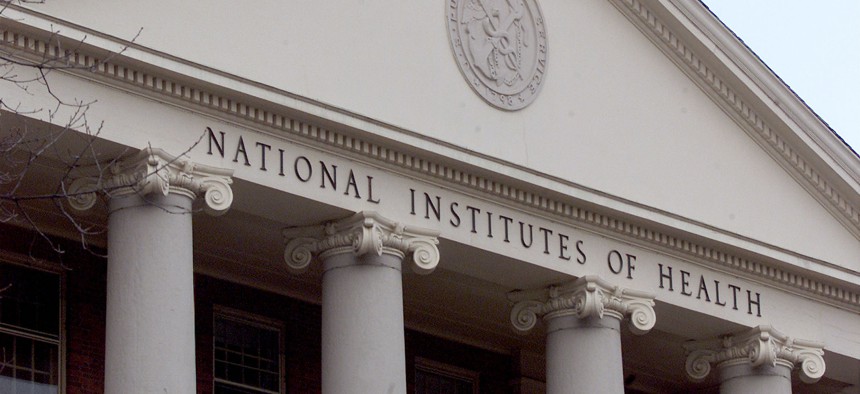
Despite there being a process for a "text analysis tool" to flag certain words in grant paperwork, National Institutes of Health employees say they have not been provided with a list of terms that prompt additional scrutiny. Mark Wilson / Getty Images




‘Highly problematic for a thousand reasons’: NIH employees criticize Trump-era requirement to scrutinize grants with words related to diversity
One staffer said that officials are employing more systematic methods to pinpoint NIH-funded research that the administration may object to, but that the additional reviews are time-consuming and lack transparency.

As the Trump administration continues its effort to root out federal funding for diversity initiatives, the National Institutes of Health has modified its grant review process to identify research that contains words associated with race or gender, which has held up some grant disbursements and forced scientists to rewrite proposals.
“I feel that this kind of censorship is making the path forward to support narrower and narrower research only to include, for example, white, straight, cisgender men,” said a program director at one of NIH’s institutes. “Any other population is being scrutinized, which is highly, highly, highly problematic for a thousand reasons. I don't want to be an instrument of an organization that is discriminating against people based on their demographics. That is 100% wrong, and I'm being forced to do that.”
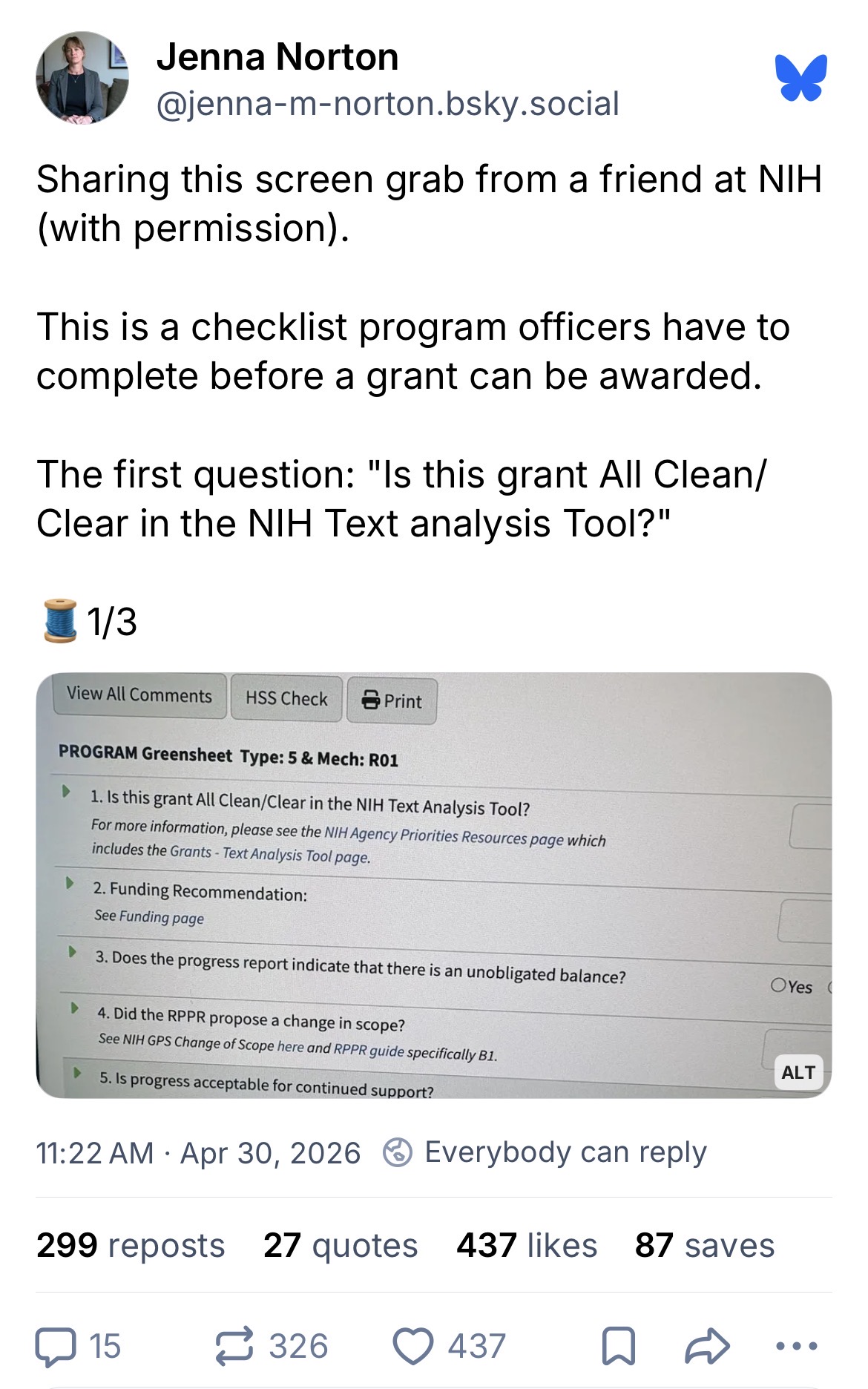
The program director, who preferred to be unnamed due to fears of retaliation, told Government Executive that beginning this year employees at their institute have been required, as part of routine administrative reviews for grant applications and progress reports, to certify that the research documents do not contain certain words identified by a “text analysis tool.”
That certification refers to whether a grant has been populated into a spreadsheet for including a term flagged by the tool. Employees have not received a list of the words that the agency is searching for, but the program director and some colleagues have crowdsourced a list of terms that have previously caused problems including: diversity, equity and inclusion; gender; LGBT; racism; climate change; vaccine acceptance.
Along with seeking to terminate federal funding for DEI initiatives, the Trump administration has also canceled research related to climate change. And Health and Human Services Secretary Robert F. Kennedy Jr., who oversees NIH, is known for spreading misinformation about vaccines.
“We are now in a situation where people are finding this to just be so utterly unethical that there are terms that are flagged in the name of [agency] priorities that really aren't about identifying important areas of science to study,” the program director said. “They are identifying particular groups of people or topics not to study.”
As an example, the NIH employee said that if a grant report were detected for including the phrase “diverse perspectives,” they would either have to write a justification for why the use of the word “diverse” is acceptable in this case or the grantee would need to use a synonym, such as “various perspectives.”
“It's wasting the time of people who are highly trained scientists and science administrators to do something that is absurd,” the employee said, adding that it’s unclear who ultimately decides if a flagged word is appropriate and funding can therefore be unlocked.
While officials have been assessing NIH grants for words that may run afoul of Trump’s anti-diversity policies since the start of his second administration, the NIH program director said that the requirement to use a tool for identifying specific terms represents a more systematic attempt to scrutinize, and potentially cancel, research.
An NIH spokesperson told Government Executive in a statement that funding decisions are based on several factors including “scientific merit, public health priorities, available funding and adherence to federal requirements.”
“The agency relies on longstanding administrative and programmatic review processes to assess grant applications and progress reports,” the official said. “These reviews ensure compliance with applicable laws, regulations, agency policies and program priorities.”
The spokesperson did not respond to a follow-up question about which agency official has the final say on whether funding for a grant with a flagged word can be disbursed.
Jenna Norton, an NIH employee who was put on paid leave after publicly criticizing the Trump administration’s research policies, on April 30 publicized through social media the mandate that grants be deemed “clean” by a text review before receiving funding.
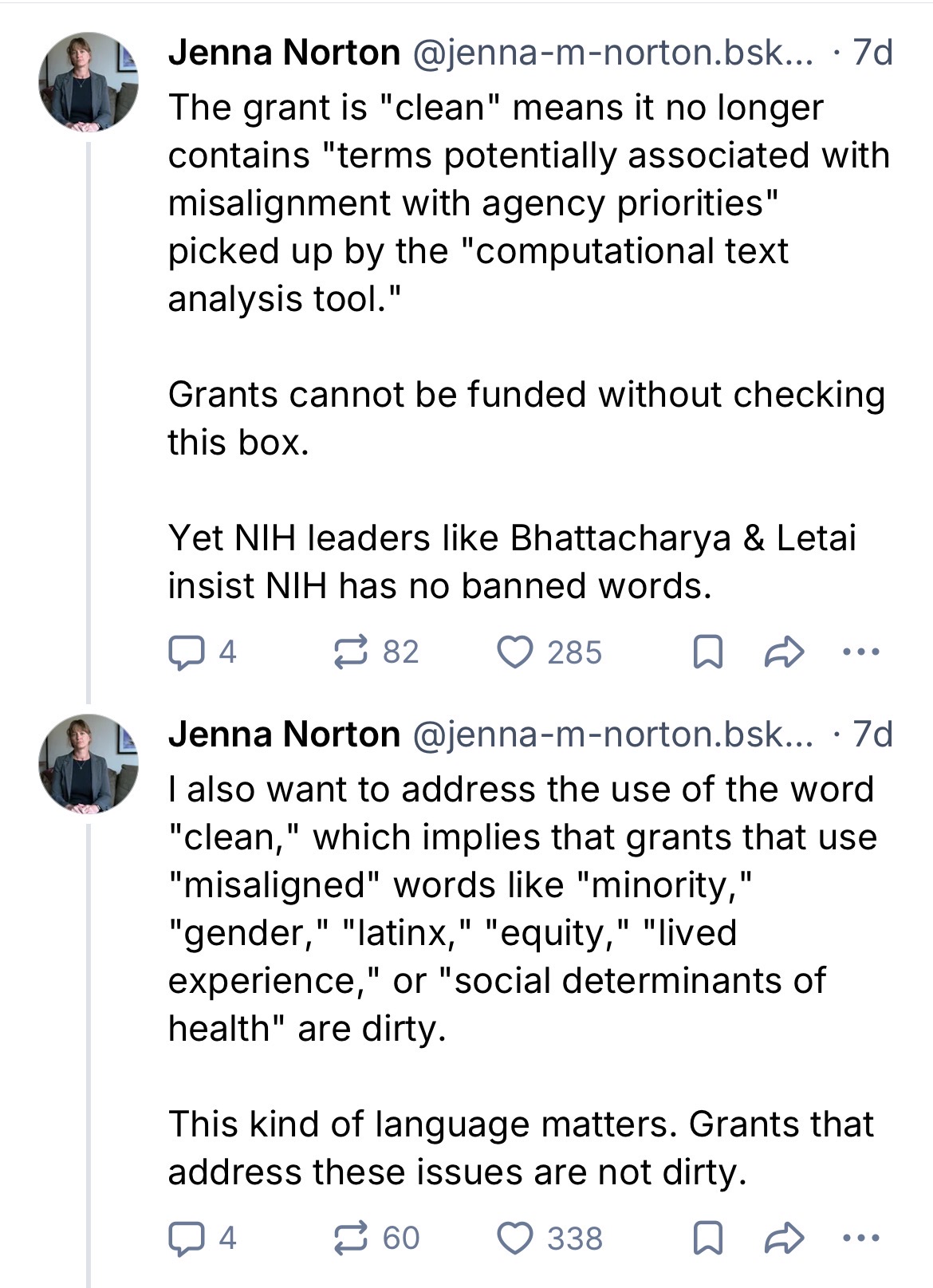
"I also want to address the use of the word ‘clean,’ which implies that grants that use ‘misaligned’ words like ‘minority,’ ‘gender,’ ‘latinx,’ ‘equity,’ ‘lived experience,’ or ‘social determinants of health’ are dirty,” she wrote. “This kind of language matters. Grants that address these issues are not dirty.”
Norton was reinstated to her position on May 4.
Additionally, The New York Times recently reported that the text scan requirement for certain words has contributed to a slowdown in awarding grants.
NIH Director Jay Bhattacharya wrote in a 2025 statement that the agency under the Trump administration would prioritize chronic health issues and “next-generation tools” like AI.
“A core function of NIH institutes and centers is to assess scientific merit within the context of NIH’s broader strategic goals and develop appropriate research funding plans accordingly,” he wrote. “In an environment where NIH receives more meritorious applications than it can fund, this review process is increasingly critical.”
The Partnership for Public Service nonprofit reported that there was a 24% reduction between fiscal years 2024 and 2025 in spending on science agency project grants.
If you have a tip that can contribute to our reporting, Sean Michael Newhouse can be reached securely at seanthenewsboy.45 on Signal.
NEXT STORY: FEMA brings back employees it recently let go as it looks to 'stabilize' its workforce