

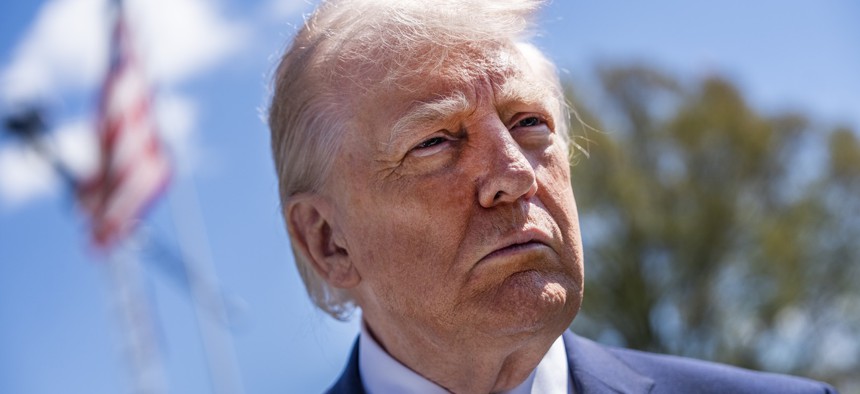
After last year’s steep cuts to the federal workforce, President Trump’s new budget calls for a modest rebound, with agencies projected to add a net of about 3,000 workers next fiscal year. Tom Williams/CQ-Roll Call, Inc via Getty Images



See where Trump is looking to make staffing cuts next year and where he wants to grow
The White House wants to stabilize the size of the federal workforce overall in FY27, though some agencies would still experience large reductions.

After shedding more than 300,000 federal employees in his first year in office and pushing for additional cuts this year, the Trump administration is seeking to hold the overall workforce steady in fiscal 2027.
Under plans put forward in President Trump’s new budget, agencies would actually see a net increase of around 3,000 workers next fiscal year. Many agencies are still proposing that they cut additional workers, but the extent of those reductions would be far more mild than the White House previously sought and would be made up for by gains elsewhere.
While some agencies are looking to further slash their workforces this year, others have begun the process of building back with new hiring. By the start of the next fiscal year, more plan to join those looking to grow.

The Agriculture Department would lose the most employees under Trump’s budget, at 19,000 employees, but much of those would result from the transfer of firefighting duties out of the Forest Service and into the newly stood up U.S. Wildland Fire Service within the Interior Department. USWFS would absorb 13,000 new employees in total. Still, Agriculture is set to shed thousands of employees on top of those transfers. It pushed out more than 15,000 employees last year with various incentives.
The Forest Service would still shed thousands of additional employees from forest management and research offices. The department is looking to eliminate many smaller offices focused on research, energy and tribal outreach. USDA is also in the process of relocating thousands of employees out of its Washington headquarters, as well as from regional offices around the country, which is expected to lead to widespread departures from the agency.
Interior is set to grow by 4,500 employees, but that includes more than 13,000 who would transfer into the department’s new wildfire agency. It would lose 14% of its workforce outside of those transfers.
Interior said it will create “an optimized workforce structure that aligns staffing levels with mission requirements.” The U.S. Geological Survey would cut around 2,000 employees, or 29% of its workforce; the Bureau of Land Management is looking to shed more than 2,100 employees, or around 27% of its current workforce; the Bureau of Indian Affairs would slash 760 employees or 21% of its workforce and the National Park Service is aiming to cut nearly 3,000 employees, or 18% of its workforce.
The U.S. Agency for Global Media is looking to fully eliminate all of its 800 remaining employees. The State Department would set up an International Communications Activities account to fund USAGM’s statutory duties, but the agency itself would largely cease to exist.
At NASA, the Science Directorate alone is looking to shed nearly 1,000 employees, or more than 40% of that workforce. Additional cuts would come from testing for aerosciences
The Treasury Department would lose only around 1,400 employees in total, though components would face more severe cuts. The Internal Revenue Service, which has already shed more than 20,000 employees under Trump, is looking to offload an additional 4,700.
Even some agencies that will see overall staffing boosts are proposing significant cuts within some of their components. Workforce increases at the Commerce Department would stem mostly from Census Bureau hiring and the absorption of the Bureau of Labor Statistics, though the National Oceanic and Atmospheric Administration would see a staffing cut of around 14%.
Most of the losses at the Labor Department would result from that proposal to shift BLS to Commerce, though additional cuts would result from the elimination of various offices including one charged with oversight of federal contractors. The Education Department, which has already pushed out or laid off about half of its workforce, would shed an additional 500 employees, which cuts coming from program administration, the Office of Civil Rights and the student aid office.
The Social Security Administration is looking to grow its workforce by 2% after shedding thousands of employees over the last 15 months. The agency said it will “hire strategically across our organization,” with a particular focus on front-line staff. After boasting of its efforts to shed 30,000 employees and installing new caps on staffing levels across the country, the Veterans Affairs Department is looking to add 9,000 employees, a growth of 2%. Most of those hires will go to medical services.
The Defense Department is planning to add more than 8,000 employees to its civilian workforce after slashing tens of thousands, a growth of around 1%.
The Justice Department is also looking to go on a hiring surge: it is aiming to bring on more than 3,200 FBI employees, nearly 1,000 new staff each at the U.S. Marshals Service and Drug Enforcement Administration, 500 employees for immigration courts and 145 hires at the Bureau of Prisons.
If you have a tip that can contribute to our reporting, Eric Katz can be securely contacted at erickatz.28 on Signal.
NEXT STORY: Interior incentivizes more staff departures after already cutting 20% of its workforce