

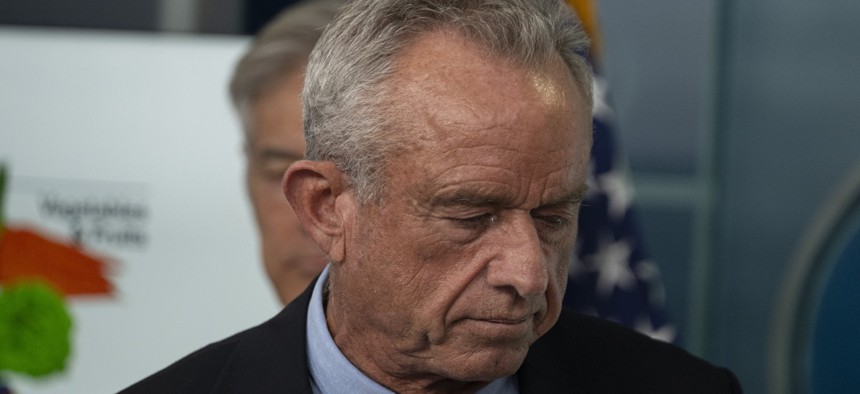
Health and Human Services Secretary Robert F. Kennedy Jr. speaks at the White House Press Briefing room on Jan. 7, 2026. Plaintiffs in a class action lawsuit against HHS cited comments Kennedy made about employee layoffs in their suit. Celal Gunes / Anadolu / Getty Images

Laid off HHS employees win judge approval to seek class action suit
Employees say they are entitled to financial compensation for the errors HHS made when trying to force them out.

A group of Health and Human Services Department employees can proceed in their efforts to pursue a class action lawsuit over their layoffs, a federal judge ruled Thursday evening, defeating the Trump administration’s efforts to have the case thrown out.
Seven HHS workers brought their case in June, arguing the department botched their reductions in force in April and therefore violated the 1974 Privacy Act. On Thursday, U.S. District Judge Beryl Howell in Washington said those individuals—who are seeking to represent all of the 10,000 HHS employees who were laid off last year—provided sufficient evidence to keep their case moving forward.
The Trump administration had sought to have the case dismissed, arguing the workers should instead take their case to an entity designed specifically for federal civil servants—such as the Merit Systems Protection Board—and that they could not prove HHS had acted with intentional malice. Howell either rejected those claims or said they were not yet sufficient to dismiss the case.
The HHS employees brought the case after their RIF notifications were rife with errors, including details about their prior performance ratings, veteran status, experience and other elements of their personnel files. Those elements can factor into who receives RIFs and who is eligible for alternative job offers, they said, meaning the errors—which amount to violations of the Privacy Act—contributed to their careers getting derailed. Additionally, they said, the department may have targeted offices it falsely believed to have a large number of poorly performing employees.
HHS contested the allegations, saying the erroneous personnel information had no bearing on which offices got slashed whole cloth. Howell said the administration can make that argument at a later stage, but was not appropriate during the “motion to dismiss” considerations.
To prove the errors were carried out intentionally, the plaintiffs noted several comments made by Trump administration officials in the lead up to, and following, the April layoffs. HHS Secretary Robert Kennedy, for example, acknowledged mistakes would be made and “that was always the plan.” The department said Kennedy was not referring to personnel file mistakes and some of the errors have since been corrected with RIF rescissions, but Howell again punted that discussion for a later time.
The judge also pointed to Supreme Court precedent that Privacy Act cases can be heard in federal court and do not first have to go to MSPB. She also noted the law requires monetary damages be paid out to successful claimants, whereas the cases before MSPB do not necessarily come with financial awards. Separate tracks for Privacy Act cases are therefore necessary, she said.
The Trump administration suggested allowing such cases to go directly to federal court “would open the back door to judicial review to perhaps an overwhelming number of CSRA claims,” but Howell said history has shown that suggestion to be “overblown” and “hyperbolic.”
While the Supreme Court has previously greenlit President Trump's efforts to carry out RIFs as he sees fit, that legal fight concerned constitutional and legislative questions over executive authority. The HHS case takes a different approach, seeking pecuniary relief for errors during the department’s hasty efforts. Howell tasked the administration to work with the plaintiffs to come up with a schedule next month for certifying or denying all impacted HHS employees as a class.
HHS has walked back many of the 10,000 layoffs it first issued. Most recently, it rescinded RIFs sent to around 400 employees at the National Institute for Occupational Safety and Health.
Share your experience with us: Eric Katz: ekatz@govexec.com, Signal: erickatz.28
NEXT STORY: GAO: Effectively ending telework increased attrition at Social Security