

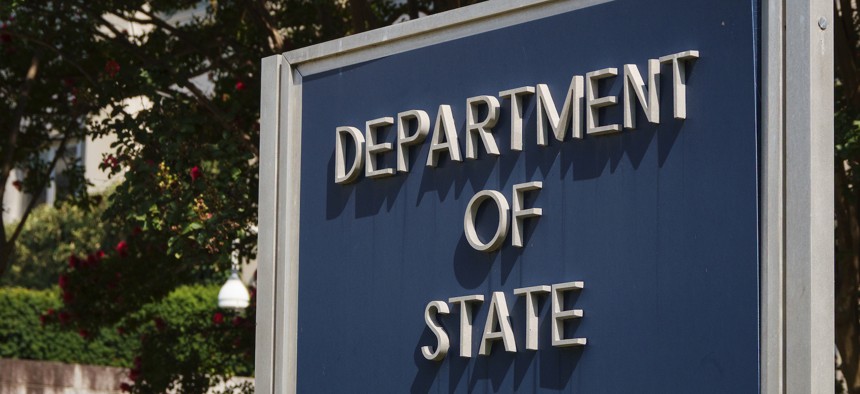
More than 9,000 State employees serving abroad live in government-funded housing. Kevin Carter / Getty Images




State’s overseas housing rules haven’t kept up with the times, GAO says
The agency is still using standards tied to the D.C. housing market of 1991 to determine how much space employees stationed abroad can have.

The State Department could be overspending on residences for employees stationed abroad because officials haven’t updated certain housing standards in more than three decades, the Government Accountability Office said in a report issued on Monday.
State manages housing for more than 9,000 agency personnel living overseas and in 2025 spent nearly $500 million on residential leases.
A majority, 64%, of such housing is leased while 36% is government-owned, as of March 2026. Officials told GAO, while leasing offers flexibility, purchasing properties provides “long-term stability and greater control over costs” but also “typically requires substantial upfront funding.”
Housing for a foreign service officer is based on their rank, family size and the location of their assignment, with countries that have the “most difficult living conditions” corresponding to the largest allowable space maximums.
For example, a standard-rank employee in fiscal 2024 with a family of two assigned to a country with a poor quality of life could reside in a unit that has an annual rent of no more than $55,000, according to the report. And an executive-rank employee that has a family of four in a country that is similar to the U.S. could live in a residence that is up to nearly 2,150 square feet.
Investigators found, however, that State has not revised its standards governing how large a government-provided home for an employee serving abroad can be since 1991. Such standards are based on “housing comparable to what an employee would occupy in the Washington, D.C., metropolitan area.” But over the last 35 years, the median housing square footage in the nation’s capital has gone down while median housing costs have increased more than Foreign Service salaries.
“Until it reviews and updates its housing space standards, State may be providing larger, more costly overseas residences than needed to meet its definition of adequate housing,” investigators wrote.
The report also found that, when calculating a unit’s space, State disregards certain areas like hallways, laundry rooms and closets, but most domestic housing appraisers count all finished square footage in a given space.
“State would have greater assurance that its housing costs are not higher than necessary, as its current measurement method could underestimate overseas square footage and allow posts to provide larger-than-needed residences,” investigators wrote.
GAO recommended that State align maximum housing space standards for overseas personnel with current conditions in Washington, D.C., and update the methods for measuring such properties. Department officials said they would implement both recommendations.
Investigators also flagged that State employees are using at least three data systems to manage the overseas housing program.
“[Bureau of Overseas Buildings Operations] officials said that staff at the posts must enter the same housing data into multiple systems, resulting in processing mistakes and inaccurate and incomplete information,” they wrote. “Both OBO officials as well as officials at the selected posts said that the IT systems are not integrated or interoperable, resulting in missing or lost information and causing delays in lease approvals, waiver processing and overall housing readiness.”
Officials told GAO that they intend to initiate a new system that will combine the existing three programs toward the end of the calendar year.
If you have a tip that can contribute to our reporting, Sean Michael Newhouse can be reached securely at seanthenewsboy.45 on Signal.
NEXT STORY: Project 2025 contributor nominated for government watchdog position