

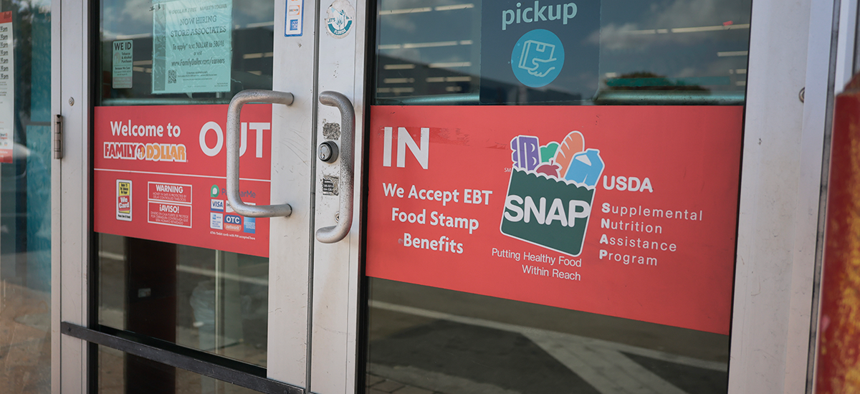
The Food and Nutrition Service, which the Trump administration recently rebranded as the “Food and Nutrition Administration,” notified employees that the agency has officially restructured its operations. Photo by Joe Raedle/Getty Images





USDA reshapes its food assistance agency, but employee relocations remain on hold
The Food and Nutrition Service is moving ahead with its reorganization, but plans to relocate most of its employees remain on hold for now.

The Agriculture Department is proceeding with a reorganization of an agency that administers food assistance for millions of Americans.
The Food and Nutrition Service, which the Trump administration recently rebranded as the “Food and Nutrition Administration,” notified employees last week that the agency has officially restructured its operations.
The biggest part of this reorganization – relocating most FNS employees across the country – remains on hold, for now.
A federal judge in San Francisco placed a temporary hold on deadlines for all “management directed reassignment” letters USDA employees have received so far. That hold is scheduled to remain in place through Oct. 13.
FNS plans to relocate most of its staff to new “hubs” that USDA has established across the country, including in Indiana, Texas, Missouri and North Carolina. A union representing the agency’s workforce says these relocations will result in further staffing losses, putting its food assistance programs at risk of disruption.
Acting FNS Administrator Shiela Corley told employees in an Oct. 6 email that the agency “officially transitioned into our new organizational structure” at the start of fiscal 2027.
According to the email, FNS operations will focus on four separate organizations – State Support & Evaluation (SSE), Nutrition Research & Regulations (NRR), Benefits & Integrity (BI), and Retailer Operations & Compliance (ROC).
“Each of these organizations are led by Deputy Administrators and form the backbone of the agency,” Corley wrote. “They are responsible for national program administration, regulatory oversight, program integrity, and operational consistency across all our nutrition assistance programs.”
FNS employees told Government Executive it’s not yet clear what impact this stage of the reorganization will have on their day-to-day work.
“It broadly talks about restructure of work areas, but no details, no timeline, nothing,” one employee said about the email staff received.
“Not sure what this means on a day-to-day level, or how this will be impacted by the larger reorg,” a second employee said. “As far as I am aware, we don’t have any additional guidance from managers, either.”
Corley wrote that the agency has “received numerous questions about how FNA programs will be organized under our new structure,” and that it will provide more information in additional biweekly updates throughout FY 2027.
An employee in USDA’s IT shop recently received a notice about an upcoming reorganization of the Office of the Chief Information Officer (OCIO).
“I have a new immediate supervisor, but the same executive leadership. IT is not making anyone move with their re-org. But it is a dramatic change, so how the new org is going to operate seems very much up in the air,” the USDA IT employee said.
According to the USDA IT employee, a reorganization of the OCIO was also supposed to go into effect on Oct. 1, but has been pushed back to mid-December because of “processing delays at HR.”
USDA did not immediately respond to a request for comment.
A coalition of federal employee labor unions, nonprofits and local governments is suing USDA over its reorganization plans. Plaintiffs argue the relocations are a veiled attempt by USDA to further shrink its workforce. USDA already cut its workforce by about 20,000 employees largely through voluntary separation incentives last year – about a fifth of its total workforce.
FNS has shed about 30% of its workforce under the second Trump administration. About one-third of its remaining 1,200 employees currently live in the Washington, D.C. region.
The National Treasury Employees Union Chapter 226, which represents FNS employees, says more than 80% of staff who took an internal survey claim they will not relocate to keep their jobs.
FNS oversees 16 nutrition programs, including the Supplemental Nutrition Assistance Program and Women, Infants and Children, that collectively serve one-in-four Americans annually.
USDA leaders say the reorganization and relocations will improve customer service, and not result in any disruption to agency programs. A senior USDA official told the court in August that out of the 725 USDA employees who have received relocation letters so far, and that 64% of them have accepted reassignment.
Employees say that figure is inflated, and that some individuals accepted relocation notices because it is the only way they can proceed with a request for a hardship or medical exemption. Other say they've opted into relocation only to buy themselves more time to find a job that would keep them in the D.C. area.
U.S. District Court Judge Vince Chhabria recently issued an administrative stay of USDA’s relocations while he decides whether or not to grant a preliminary injunction that would indefinitely bar USDA from carrying out relocation plans for about 2,600 employees.
In a recent hearing, Chhabria questioned how much authority Congress and its appropriations committees have over USDA’s reorganization decisions.
Lawmakers included a provision in the fiscal 2026 appropriations bill for USDA that blocked officials from reorganizing or relocating offices or employees without approval from the House and Senate appropriations committees.
If you have a tip that can contribute to our reporting, Jory Heckman can be securely contacted at jheckman.29 on Signal.
NEXT STORY: 8 midterm races for federal employees to watch