
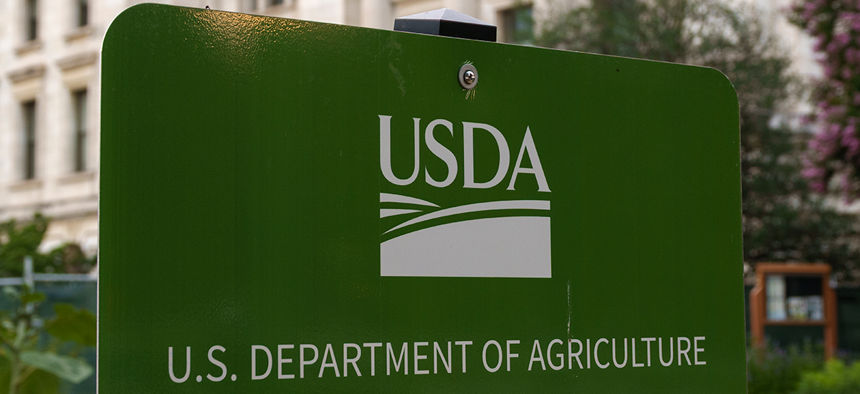
The Natural Resources Conservation Service is giving employees facing relocation across the country a shot at voluntary reassignment to a vacant position in their local commuting area Photo by Kevin Carter/Getty Images




‘Last chance to stay where you are.’ USDA gives some employees facing relocation a shot at unfilled local jobs
A Natural Resources Conservation Service employee said most critical vacancies available at his grade level would amount to a "voluntary downgrade," but would spare him from relocating across the country.

The Agriculture Department’s second-largest component is giving its workforce another chance to fill “critical” vacancies, allowing some employees to stay in place and no longer face relocation across the country.
The Natural Resources Conservation Service, an agency created in the Dust Bowl era to help farmers protect and conserve private lands, is giving employees a shot at voluntary reassignment to a vacant position in their local commuting area.
NRCS opened its online critical vacancy portal on Tuesday, and will give employees until Nov. 2 to apply for available positions at their current grade level or lower.
This is the second time the administration has offered lateral transfers to NRCS employees. Government Executive reported in July 2025 that NRCS encouraged employees to apply for critical vacancies ahead of the department’s nonvoluntary relocation plans.
“This feels like a ‘last chance to stay where you are’ move by the administration,” one NRCS employee said.
A second NRCS employee said NRCS staff were first notified about critical vacancies in September. The employee said that when he last checked the portal, there was only one position listed in the D.C. area that would have been a lateral move for him. All other available positions, he added, would effectively be a "voluntary downgrade."
“Anything [else] I wanted to do, I would have had to take a downgrade,” he said. “There were jobs available, but they all would have required relocation for me. There was nothing that would have allowed me to stay within my commuting area, as it is right now, and stay in my current grade.”
Some may see these critical vacancies as a chance to avoid relocation across state lines. USDA, as part of its sweeping reorganization plans, has sent letters of intent to NRCS employees, informing them that they may have to relocate to Fort Worth, Texas, Raleigh, North Carolina; and Indianapolis, Indiana.
“You’re going to go to one of these places if you want to remain a GS-14. This is what you would have to do,” the second NRCS employee said. “If you want to maintain your current grade and pay, really your only option is to move.”
NRCS is USDA’s second-largest component. The agency has shed more than 20% of its workforce so far under the Trump administration.
A USDA spokesperson told Government Executive that “this initiative provides employees with opportunities to pursue voluntary reassignment to positions that support the continued delivery of NRCS programs and services.”
According to an internal notice obtained by Government Executive, NRCS employees can apply to multiple open critical vacant positions using the portal, but employees “may apply only for positions that are at their current grade level (lateral moves) or lower grade levels.”
In an Aug. 28 court filing, a USDA official told the U.S. District Court that 725 USDA employees had received management directed reassignment (MDR) letters so far, and that 64% of them have accepted reassignment. Employees say that acceptance rate is highly inflated, because colleagues are applying for exemptions or applying for local jobs.
“For the most part, you have people with spouses that are working [or] have other commitments … that them moving is not really feasible,” the second NRCS employee said.
USDA’s relocation plans are currently on hold. On Oct. 13, a federal judge in San Francisco ordered an indefinite stay of the department's plans to relocate about 2,600 employees.
The Trump administration appealed the ruling to the Ninth Circuit Court of Appeals, but the appeals court has kept the lower court’s ruling in place for now.
The administration has until mid-November to brief the appeals court on its challenge to the lower court’s stay. A coalition of federal employee labor unions, nonprofits and local governments fighting to block USDA’s relocations are scheduled to brief the appeals court by Dec. 11 – the same day that spending bill provisions blocking USDA from using congressional funds on reorganization are currently set to expire.
U.S. District Court Judge Chhabria wrote his stay does not prevent USDA from relocating or reassigning employees in the Washington, D.C. area to other offices within the region. The stay specifically bars USDA from “closing or eliminating offices” at component agencies impacted by reorganization plans, or “relocating or reassigning employees or their positions or functions to different and/or new locations outside the local commuting area.”
The second NRCS employee said agency staff hasn’t communicated why some agency employees have been tapped to relocate, while others working the same job in the same location have been exempt from relocation.
“There are some individuals that are staying in their current locations now. Whatever process, if there was one, the determination was made that, ‘OK, this person is staying in this position, in their current location. They don’t have to relocate.’ Those were Willy Wonka Golden Ticket kinds of things handed out in the dark, and there was no clear, defined process,” the employee said.
USDA said its relocations will bring its employees closer to the farmers, ranchers and other agriculture customers it serves. But about 90% of USDA employees already live and work outside of the D.C. area. The second NRCS employee said agency staff who work directly with the public are already working state-level jobs.
“Relocating them to some central hub throughout the country is not going to provide any better service to our customers,” he said. “You're going to see a decrease in service. You're going to see slowdowns. You're going to see more disruptions by carrying this out.”
If you have a tip that can contribute to our reporting, Jory Heckman can be securely contacted at jheckman.29 on Signal.