

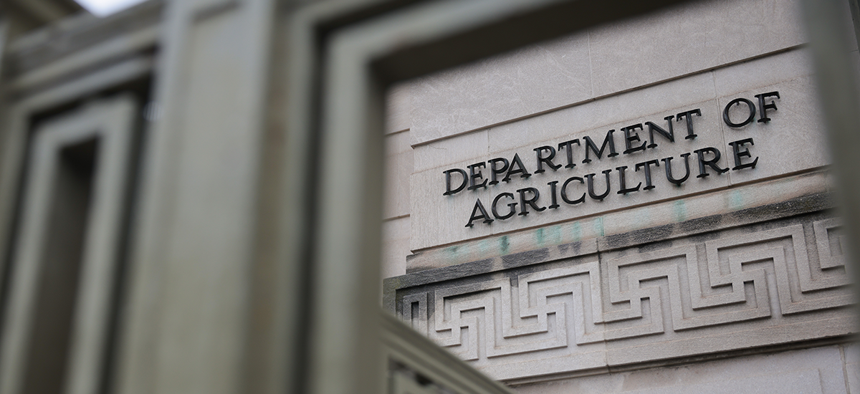
A federal judge wrote that there is ultimately “strong evidence that USDA’s planned reorganization activities deviate from Congress’s expectations." Kayla Bartkowski/Getty Images




A judge just put USDA’s employee relocation plans on ice
The order blocks the department from moving about 2,600 employees or closing affected offices while a legal challenge to its reorganization proceeds.

A federal judge in San Francisco is putting an indefinite hold on the Agriculture Department’s plans to relocate many of its employees across the country.
U.S. District Court Judge Vince Chhabria granted a stay on Tuesday that indefinitely bars USDA from carrying out relocations for about 2,600 employees while the court continues to review the merits of the case.
A coalition of federal employee labor unions, nonprofits and local governments argued USDA has been trying to circumvent guardrails on USDA reorganization established by Congress in its most recent spending package.
Lawmakers included provisions in the fiscal 2026 appropriations bill for USDA that blocked officials from reorganizing or relocating offices or employees without approval from the House and Senate appropriations committees.
Chhabria wrote that there is ultimately “strong evidence that USDA’s planned reorganization activities deviate from Congress’s expectations at the time it appropriated the funds.”
The ruling effectively extends an administrative stay Chhabria issued on Sept. 14 that put a hold on deadlines for all “management directed reassignment” letters USDA has issued so far. Employees who received relocation notices were generally told to report to their new offices by September or October.
The stay specifically bars USDA from “closing or eliminating offices” at component agencies impacted by reorganization plans, or “relocating or reassigning employees or their positions or functions to different and/or new locations outside the local commuting area, including by issuing or enforcing MDR letters or any other notice or directive of reassignment or relocation in whole or in part."
Chhabria wrote his order does not prevent USDA from relocating or reassigning USDA employees in the Washington, D.C. area to other offices within the region. The stay also does not require USDA to return employees to their original duty stations if they were relocated before the judge’s administrative stay on Sept. 14.
Justice Department attorneys representing USDA asked the judge to consider narrowly tailoring his stay to cover only employees represented by the unions. But Chhabria did not grant that request, stating that “the most appropriate remedy is indeed to stay USDA’s reorganization expenditures, full stop.”
“It would be contrary to the public interest to require USDA to keep some employees in their current offices — preventing closure of those offices — while allowing the agency to move other employees to new offices, as this would require expenditure of congressionally appropriated funds on two offices with two sets of employees rather than one,” he wrote.
USDA has two business days to notify its employees about the terms of the preliminary stay, and to post the ruling on its website about the reorganization.
In a Sept. 30 hearing, Chhabria debated how much authority Congress and its appropriations committees have authority over USDA’s reorganization decisions.
While Congress controls funding for federal agencies – and specified that USDA may not “reprogram” any funds for reorganization plans – Chhabria said the specific mechanism lawmakers included in the FY 2026 spending package was unconstitutional.
“Both sides agree that this committee-approval language is unconstitutional,” he wrote, but agreed that ultimately “Congress was actively working to restrict the agency’s ability” to use appropriated funds to reorganize and relocate employees.
“This Court will proceed on the understanding that it has discretion to temporarily halt all the reorganization activities that likely violate the appropriations statutes. And that’s what this ruling will require,” Chhabria wrote.
The judge cautioned the scope relief from his stay “could end up being quite short.” The Trump administration is likely to appeal his ruling, and spending bill provisions blocking USDA from using congressional funds on reorganization are currently set to expire on Dec. 11.
“If the agency wishes to move forward with its plans to close offices and relocate employees, it will soon have the opportunity to convince Congress of the merits of those plans. Congress, if it agrees, can choose not to extend the restrictions at issue in this case. But until then, USDA is preliminarily enjoined from spending appropriated funds on the challenged office closures and employee relocations,” Chhabria wrote.
USDA agencies saw major staffing losses when they relocated hundreds of D.C.-based employees to Kansas City, Mo., under the first Trump administration — a much smaller-scale plan than what USDA is proposing under the second Trump term.
Citing polls conducted by unions, showing that a majority of their members will not relocate to keep their jobs, Chhabria agreed with plaintiffs that “there is at least some risk that USDA’s office closures and employee relocations would impede these components’ ability to carry out their critical functions,” and in the process, disrupt “programs on which many Americans depend.”
“Although it’s unclear how many employees USDA plans to actually relocate, if the relocations are allowed to proceed, it’s likely that many affected employees will decline to move and will instead leave,” he wrote.
Chhabria added that “it does not appear USDA has conducted any analysis to show that these risks are not real or are outweighed by any potential benefits."
“With respect to the balance of equities and the public interest, the Court has no view on whether USDA’s planned reorganization is a good idea or a bad one,” he wrote. “Perhaps USDA is organized in an inefficient or outdated fashion, such that the harm some employees would suffer from a reorganization could be outweighed by the potential benefit to the taxpayers, not to mention citizens who interact with the agency more directly. But on this record, the balance of equities and the public interest strongly support an stay”
Elena Goldstein, a legal director at Democracy Forward, one of the plaintiffs in the lawsuit, said the stay “will allow the vital work of the department and its employees to continue, protecting the families and communities across the nation that rely on its vital work.”
If you have a tip that can contribute to our reporting, Jory Heckman can be securely contacted at jheckman.29 on Signal.
NEXT STORY: Disability accommodations at Labor get extra scrutiny with annual reviews