

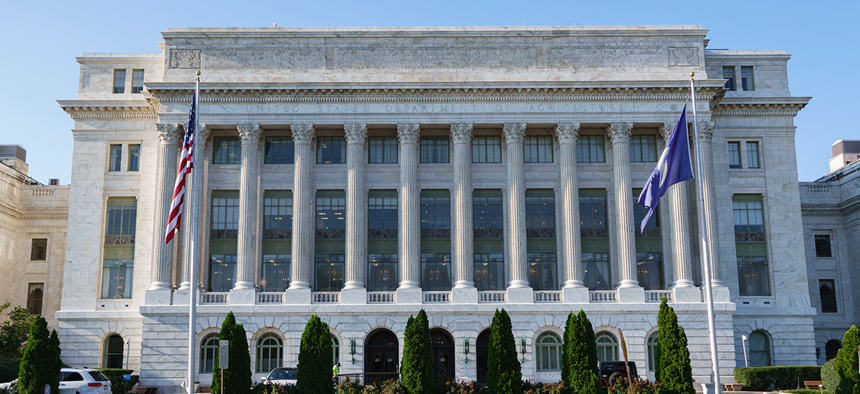
A federal judge in San Francisco is allowing USDA to proceed with its relocation plans for now, after telling plaintiffs that their claims should be brought up in a separate lawsuit. Kevin Carter/Getty Images





USDA employees dispute ‘inflated’ claim that most staff asked to relocate will do so
USDA employees say they have nothing to lose by saying they plan to relocate, even if they have no intention of moving, or are only considering it as a last resort.

Updated at 12:00 p.m. ET on Sept. 4
The Agriculture Department is telling a federal court that a majority of employees who received relocation notices so far have agreed to relocate – a higher acceptance rate than what the department experienced with a smaller-scale relocation under the first Trump administration.
In an Aug. 28 court filing, Mary Pletcher Rice, USDA’s acting principal deputy assistant secretary for administration, told a federal judge in San Francisco that 725 USDA employees have received management directed reassignment (MDR) letters so far, and that 64% of them have accepted reassignment.
USDA agencies saw major staffing losses when it relocated hundreds of D.C.-based employees to Kansas City, Mo., under the first Trump administration — a much smaller-scale plan than what USDA is proposing under the second Trump term. The Government Accountability Office found the vast majority of employees at the Economic Research Service and the National Institute of Food and Agriculture quit rather than relocate to Kansas City in 2019.
USDA employees who currently face relocation and the unions representing them say the department’s figures don’t reflect the number of employees who will actually move across the country to keep their jobs. The department has sent relocation notices to less than a third of the approximately 2,500 employees expected to receive them. The department did not immediately respond to a request for comment.
USDA so far has sent relocation notices to employees at ERS, NIFA, the Agricultural Research Service (ARS), the National Agricultural Statistics Service (NASS), the Food Safety and Inspection Service (FSIS), the Foreign Agricultural Service and the Office of General Counsel. Employees at other components facing relocation have yet to receive notices.
USDA expects no more than 2,000 of the 4,600 employees currently working in the national capital region will remain there after moving staff to five regional hubs being stood up across the country.
Some employees say they’ve accepted relocation notices because that is the only way they can proceed with a request for a hardship or medical exemption. Others say they have nominally agreed to relocate, but are still applying for other jobs. If that plan doesn’t work out, they may quit rather than move.
A Natural Resources Conservation Service employee told Government Executive that he accepted relocation, but only so that he has more time to look for another USDA job within the D.C. metro area.
“My intention is to stay in the D.C., Maryland, Delaware, Virginia area. That's my intention. And whatever I need to do to do that is what I want to do. I'm just trying to buy myself some time where I can make that happen,” the NRCS employee said.
NRCS is USDA’s second-largest component, and helps farmers and other agricultural producers protect and conserve private lands. The agency has shed more than 20% of its workforce so far under the Trump administration. Government Executive reported last summer that NRCS is looking to backfill critical vacancies through lateral transfers.
“If I see a position that suits me and that I’m interested in, I can apply for that. However, it’s either going to be at an equal grade or lesser,” the NRCS employee said. “That’s one way of forcing people to take a voluntary downgrade.”
More than 28,000 employees have separated from USDA, largely through voluntary separation incentives, since the start of the second Trump administration. Factoring in hiring, the department has seen a net decrease of nearly 16,000 employees. USDA officials told the court on July 24 that the department is planning to hire nearly 16,000 employees this year to “offset expected attrition.”
A NIFA employee who opted to relocate said USDA’s claim that 64% of employees have opted to relocate is “highly inflated,” because colleagues are applying for exemptions or applying for local jobs.
“I know people who have accepted the MDR, but only accepted so they could try to stay employed, apply for other jobs in their area, and keep their jobs in case of an injunction,” the NIFA employee said. “I know a number of people who accepted because they needed to apply for hardships or reasonable accommodations, and the agency required you hit ‘accept’ in order to apply for those. These people will not move if they don't get their hardship or RAs.”
The NRCS employee said staff have nothing to lose by telling USDA they plan to relocate, even if they have no intention of moving, or are only considering it as a last resort.
“If I had said ‘no’ to the letter, the position that I'm assigned to, it goes away. There's no benefit to me to say ‘no.’ You’re almost pushed in a position of saying ‘yes’ to the letter," the NRCS employee said. “If you say no to the reassignment, ultimately you’re going to get removal. If your answer is anything other than, ‘Yes, I’m going to move, and yes, I”m going to show up on this date,’ the ultimate path is that you’re going to be removed."
Keywan Johnson, a labor relations specialist with the American Federation of Government Employees, told the court that USDA’s figures are “inflated,” because they must accept relocation in order to request hardship exemptions or reasonable accommodations.
"Due to their personal circumstances, many of those employees will not be able to relocate if their requests are denied,” Johnson wrote.
In some cases, USDA employees said they cannot relocate because their spouse’s job requires them to remain in the area, or because they are the sole caregivers for elderly parents. Union leaders told reporters in July that internal polling indicates that women, people of color, older workers and workers with disabilities are disproportionately being asked to relocate.
“They’re overwhelmingly the group of individuals that are being moved and relocated and put in positions of lesser responsibility than what they were before,” the NRCS employee said. “By targeting these individuals, you’re looking at reducing your overhead through salaries and benefits because you’re getting these higher-cost employees off the books, and by having such a secretive process, then you’re able to do this, and cherry-pick individuals to stay in place that you have more of an affinity to.”
A coalition of federal employee labor unions, nonprofits and local governments is asking a federal judge in San Francisco to stop USDA’s relocation plans arguing that the move is an attempt to downsize its workforce without congressional approval.
U.S. District Court Judge Susan Illston, in a ruling Wednesday, allowed USDA to proceed with its relocation plans for now. Illston told plaintiffs challenging the USDA reorganization, via a lawsuit filed in April 2025 to challenge the Trump administration’s widespread federal workforce layoffs, that their latest claims “do not belong in this case,” and should be brought up in a separate lawsuit.
"The Court concludes that the claims plaintiffs seek to bring regarding the USDA reorganization involve new and distinct causes of action that should be the subject of a separate lawsuit,” she wrote.
If you have a tip that can contribute to our reporting, Jory Heckman can be securely contacted at jheckman.29 on Signal.
NEXT STORY: OPM taps new healthcare and insurance chief ahead of Open Season