

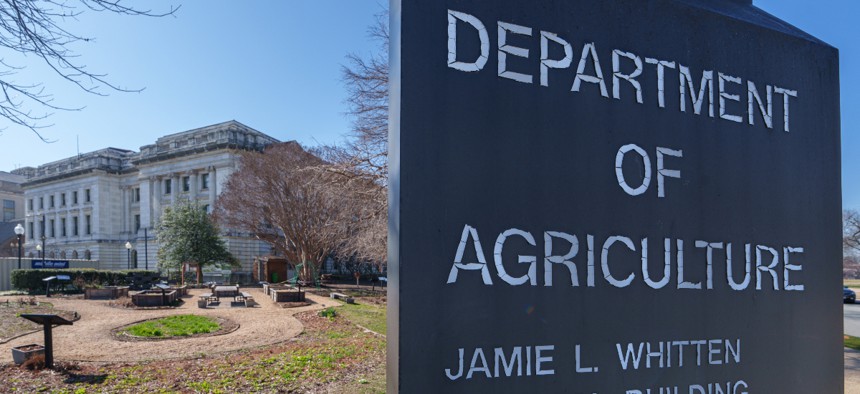
USDA is trying to relocate many more employees than it attempted to under the first Trump administration. J. David Ake/Getty Images



USDA hasn’t looked at staff attrition ahead of relocations, but downplays its impact
Internal data shows the department is preparing for significant churn as it presses forward with office moves, raising questions about whether new staff can fill the gap left by seasoned experts.
The Agriculture Department plans to hire 16,000 employees this year, but senior officials expect these hires will mostly “offset expected attrition," driven by sweeping reorganization plans.
A coalition of federal employee labor unions, nonprofits and local governments is asking a federal judge to stop USDA’s plans to move thousands of employees across the country, arguing that the move is an illegal attempt to downsize its workforce. Lawmakers included a provision in the fiscal 2026 appropriations bill for USDA that blocked officials from reorganizing or relocating offices or employees without congressional authorization.
Department officials pushed back on plaintiffs’ claims that its relocation plans are a reduction in force in disguise, but Justice Department attorneys told the court last month that the “reorganization plans include workforce optimization measures, including downsizing.”
“The fact remains that relocating employees — even if some voluntarily resign instead — is not the same as implementing large-scale RIFs as Plaintiffs suggest,” DOJ attorneys wrote. “USDA has reiterated time and again that it is relying heavily on completely voluntary tools to reduce its workforce.”
The department told employees receiving relocation notices it was a “myth” that the reorganization is “just another way to shrink the workforce and get rid of federal employees.”
A USDA spokesperson said in a statement that the "department has made clear the reorganization is a regimented, multi-step process, and that all services and supports will continue without interruption."
The human cost of relocation
Tom Bewick, vice president of American Federation of Government Employees Local 3403, told the court that NIFA employees were required to accept relocation offers before being allowed to apply for a reasonable accommodation or hardship exemption.
“NIFA appears to be aware that the relocation is likely to cause a mass exodus of experienced staff because they have recently implemented new systems to attempt to preserve institutional knowledge,” Bewick wrote.
Those new systems include having employees document the steps necessary to run particular grant programs.
“That experience cannot be easily replaced,” Bewick wrote, adding that it takes a new hire at NIFA about three or four years to learn how to run a grant program independently.
“Many of the employees hired in 2020 (to address the attrition from forced relocations in 2019) are just beginning to hit their stride,” he added.
Collin Bradley, president of the American Federation of State, County and Municipal Employees Local 3976, which represents Foreign Agricultural Service employees, wrote that in a recent internal survey of more than 150 bargaining unit employees, 94% said they would quit rather than relocate to Kansas City. Other internal polls conducted by unions have found similar results.
“I am certain there will be significant attrition if the relocation orders proceed,” Bradley wrote. “We have shared the results of our survey with the Agency and we have communicated our concerns about attrition.”
Downsizing efforts revealed
Internal documents shared with the court show that USDA requested an extension of its Voluntary Early Retirement Authority in February 2026 as part of its reorganization plans and to “support USDA's efforts to Downsize the Federal Workforce.”
More than 28,000 employees have separated from the Agriculture Department, largely through voluntary separation incentives, since the start of the second Trump administration. Factoring in hiring, the department has seen a net decrease of nearly 16,000 employees.
Agriculture officials told OPM it expected another 5,000 employees to accept its extended VERA offer. If the department fell short of that goal, USDA wrote that it would try to shrink its workforce through relocations, reassignments and downgrades – but not through RIFs.
In the recent filing the department noted that, “due to delays related to expansive litigation impacting USDA reorganization planning," its reorganization plans will continue through at least February 2027.
DOJ attorneys wrote that USDA hasn’t conducted any attrition analysis yet, but will do so, "in conjunction with hiring and facilities planning at relocation sites as it finalizes relocation plans on an agency-by-agency basis."
“The best information currently available to the agency indicates that, as a result of the current job market, attrition will be less than during prior reorganizations,” they wrote.
The department is trying to relocate many more employees than it attempted under the first Trump administration. The 2019 relocation of the Economic Research Service and the National Institute of Food and Agriculture set the stage for what followed, with those agencies losing more than half their staff after employees quit rather than relocate to Kansas City, Mo.
Agriculture officials told the court on July 24 that the department is planning to hire nearly 16,000 employees this year. But according to updated staffing plans, the department expects that a “majority” of its hiring initiatives will “result in no net gain,” and will instead “offset expected attrition.”
“In fact, through workforce optimization initiatives, these organizations may end FY 2026 with reduced employee counts where attrition outpaces gains,” USDA wrote.
Under USDA’s staffing plans, the Forest Service “expects to reduce the number of onboard employees by the end of FY 2026,” with hiring “focused on” logging and mineral production, “to support the Administration’s priorities.”
Plaintiffs in the lawsuit argue USDA’s hiring plans are focused on recruiting less-experienced staff into different positions than the ones its more experienced workers are leaving.
The department reported that the Food and Nutrition Service, which has lost about a third of its employees under the Trump administration, “does not anticipate hiring in FY 2026 unless mission-critical vacancies occur.” The Economic Research Service and National Institute of Food and Agriculture will conduct “nominal” hiring.
According to department figures, nearly a third of its new permanent hires this year will be early career employees.
Concerns over staffing and expertise
Plaintiffs warn that “early career employees will not have the experience, skills, expertise, or training to replace the highly experienced staff who are forced out by the relocation.”
AFSCME's Bradley wrote that FAS is already borrowing staff from other USDA components through three or four-month details to maintain staffing for its programs.
“Relocating to Kansas City will mean that the Agency won’t have the same experts readily available, which could lead to critical staffing gaps,” he wrote.
A Natural Resources Conservation Service employee with decades of experience received a “notice of intent” on Aug. 5 that she would be reassigned to a position more than 1,200 miles from where she currently lives. Besides the new job title, the employee said that she has not been provided with a description of the new position’s responsibilities.
The NRCS employee has worked remotely for years under a reasonable accommodation, which she said was recently reapproved. Agencies provide reasonable accommodations to employees with disabilities in order to help them more easily perform their jobs.
When she pointed this out, an HR official responded in an email viewed by Government Executive that “you will need to accept [the new position] and report to your new duty location in order for us to move forward with the reasonable accommodation process for that position and/or location.”
“I don't know anything about the job. I don't know if it violates my rights,” the employee said. “I have several disabilities. My husband is my caregiver, and my doctors already work with me. Moving to another location will require me to have to find new doctors and also have to see if my husband can relocate, which his job doesn't have reciprocity, and I can't provide for myself.”
Multiple agencies have cracked down on remote work and telework reasonable accommodations as part of the Trump administration’s directive ending work from home for the civil service.
The NRCS employee has until Aug. 20 to decide whether to express intent to accept the reassignment, express intent to decline with the possibility of getting a new job at the agency or apply for retirement. She said that the stress of the decision has exacerbated her conditions and forced her to take sick leave.
“There's so many unknowns, and the agency intentionally, I think, did this to force people to make rash decisions,” she said. “But I don't make rash decisions like that when it comes to my life and the life of my family.”
A second NRCS employee said many of her coworkers were hired as remote workers, and that the Trump administration’s relocation plans are “decimating the staff that does the work on the ground.”
A NIFA employee said she opted into relocation after unsuccessfully looking for another job that would keep her in the D.C. metro area.
“It boiled down to whether I could find another job that met my and my family's needs and I couldn't,” the NIFA employee said. “We're currently under-staffed and will be critically short of staff after the relocation occurs. We don't know if or when we'll be able to hire back all of the needed positions. Challenges will continue at the agency for the foreseeable future.”
A Food and Nutrition Service employee said staff working out of the Braddock Road office building in Alexandria, Virginia have been directed to relocate to the Yates Building in downtown Washington, D.C., or the George Washington Carver Center in Beltsville, Md.
According to the employee, union negotiations over cross-country relocations have just begun. The FNS employee said she “definitely would not have moved out of state.”
“I’m close, but not quite close enough, to retirement. Trying to hang in there through the administration and hoping we’ll get some telework back one of these days,” she said.
If you have a tip that can contribute to our reporting, Jory Heckman and Sean Michael Newhouse can be securely contacted at jheckman.29 and seanthenewsboy.45 on Signal.
NEXT STORY: National crisis and support hotline operations remained consistent despite staffing cuts, watchdog found