

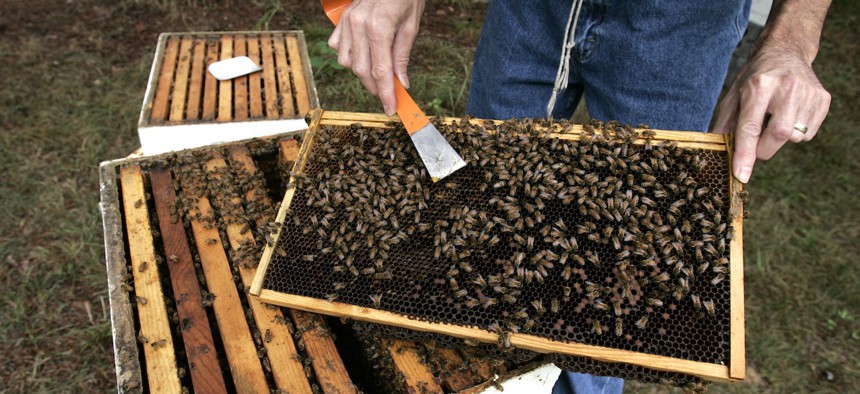
A honey bee comb hive at the Bee Research Laboratory in Maryland. The lab supports beekeepers nationwide, and is located in a prime farming and beekeeping region. SAUL LOEB/AFP via Getty Images





Beekeepers are losing a key USDA backstop at the worst possible time
As colony losses mount and pollinator research faces broader cuts, the planned closure of the Beltsville Bee Research Lab threatens a critical line of support for the nation’s food system.
America’s bees and beekeepers are losing a valuable ally just when they need its help most.
The U.S. Department of Agriculture plans to soon close the Beltsville Agricultural Research Center, a 6,500-acre agricultural research station in Maryland that is home to the nation’s premier bee research and disease diagnosis hub, the Beltsville Bee Research Lab.
The closure comes at a critical moment for bees. In winter 2025, many beekeepers lost over half their operations as pesticide-resistant varroa mites spread, bringing deadly viruses. The losses have led to low honey production, and soaring fuel costs have made shipping bees cross-country for agricultural pollination increasingly expensive, further stressing the industry.
During my 14 years researching bees and beekeepers, and in writing my new book, “Bitter Honey: Big Ag’s Threat to Bees and the Fight to Save Them,” I’ve seen beekeepers frequently turn to the USDA bee labs for support during crises like this. Because honey bees contribute roughly $15 billion to U.S. crop production – native and managed bees pollinate more than 130 crops – these labs help stabilize the nation’s food system.
Today, that scientific support system is at risk, just as beekeepers face their greatest challenges and native bee populations continue to decline.
Why the Beltsville Bee Lab matters
USDA’s bee researchers have served beekeepers for over 130 years, including nearly 90 years at the Beltsville station. One of the Beltsville Bee Lab’s standout services is its bee disease diagnostic service, where beekeepers can send samples for analysis free of charge.
Since the early 2000s, Beltsville researchers have helped beekeepers respond to varroa mites – a primary driver of high colony losses each year. Now, the lab is helping them prepare for a deadlier mite that is infesting honey bees in Asia, Tropilaelaps mercedesae, or “tropi” mites – by developing detection and response protocols that beekeepers can use to protect their colonies.
While the Beltsville Bee Lab supports beekeepers nationwide, it’s located in a prime farming and beekeeping region. Its closure would leave a critical research gap in the Northeast, where beekeepers help pollinate cranberries, squash, blueberries and other crops.
Its location has also allowed researchers to conduct extensive studies on winter colony losses, research that would be difficult to replicate at the remaining USDA bee labs, which are primarily located in more temperate climates.
Hidden costs of bee lab closures
The USDA states that it will decommission the entire Beltsville Agricultural Research Center because building maintenance and renovations would cost an estimated $500 million. But closing the lab could cost beekeepers, farmers and consumers far more.
For example, in winter 2025, beekeepers experienced their highest losses in U.S. history. Many opened their colonies in January that year and found that more than 60% of their colonies had died – nearly 1.7 million colonies nationwide. Beekeepers contacted Beltsville, and researchers quickly flew out to test affected colonies for pesticide residues, diseases and varroa mites, data that could help guide beekeepers’ treatment response.
A few weeks later, as the lab’s scientists were working on the crisis, the Trump administration fired probationary researchers and staff at the bee labs, along with thousands of other employees across the USDA. The Beltsville team was hobbled, and the remaining staff restricted from communicating with beekeepers.
Because of the communication lockdown, it took nearly six months for researchers to deliver their findings. By then, the season was over and beekeepers had been forced to navigate the crisis on their own.
The loss of bee colonies ultimately cost beekeepers an estimated $600 million in lost honey production, pollination income and colony replacement costs – far more than the one-time projected costs to modernize the entire Beltsville Agricultural Research Center.
These losses can hit consumer pocketbooks too.
When beekeepers lose nearly half their operations, they often need to charge farmers more for pollination services to stay afloat. Those added costs can ripple through the food system and affect what everyone pays for the fruits, vegetables and nuts that depend on pollinators.
More cuts planned to US pollinator research
The Beltsville Bee Lab closure is not an isolated case. The administration has proposed eliminating the U.S. Geological Survey’s Ecosystems Mission Area, a move that could defund the USGS Bee Lab, an essential resource for research on native bees.
It also plans to decommission 16 USGS research centers nationwide, including the Northern Prairie Wildlife Research Center in North Dakota, the highest honey-producing state in the nation. For decades, beekeepers have brought colonies to forage on grasslands in the region. Researchers have been tracking how the shift from grasslands to crops has affected honey bee health and beekeeper revenue.
The U.S. Forest Service also faces widespread cuts, including the planned closure of 57 of its 77 research stations throughout the United States. Since the Forest Service manages over 193 million acres of federal lands that support native plants and pollinators, those closures could affect crucial pollinator habitat as well.
These closures risk a severe brain drain.
When the first Trump administration moved the USDA Economic Research Service from Washington to Kansas City, Missouri, in 2019, the agency lost over 75% of its experienced research staff. A recent survey suggests that history may repeat itself. If the reorganization goes through, farmers and beekeepers will lose experts with decades of institutional and technical knowledge.
The Beltsville Bee Lab is a key part of the often-unappreciated federal research infrastructure that supports the health of pollinators and the nation’s food supply.
If the USDA and the USGS move forward with their plans to close bee labs and research sites, the result could be slower responses to bee threats, weaker tracking of native bee populations and diminished pollinator habitat for bees – all of which raise costs and risks for beekeepers, farmers and everyone who depends on the food system.

Jennie L. Durant, Research Affiliate in Human Ecology, University of California, Davis
This article is republished from The Conversation under a Creative Commons license. Read the original article.