

sponsor content What's this?





Five paradoxes: How AI is making funders confront the hidden tensions in their workflow
AI isn't creating new problems for research funders — it's exposing five hidden tensions. See how governed data helps funders navigate them.
Presented by
Elsevier

Presented by
Elsevier
Over the last 25 years public research funders have faced a number of severe systemic shocks – the austerity resulting from the global financial crisis, the disruption of the pandemic, geopolitical shifts and the related cuts to international aid. At first sight the operational crisis caused by AI tools flooding agencies with automated grant applications, discussed in detail in Adjudicators to orchestrators – how public research funders are responding to AI – seems like an unwelcome addition to the series, but there are some important differences. While previous crises tended to be shocks of scarcity – limited funds, restricted mobility, less political support etc. – the AI grant crisis is a problem of hyper-abundance. And it is more serious than previous crises because it is asking questions of the whole funding ecosystem and pushing the institution of peer-review close to breaking point.
While this is a global problem, responses have been varied, including outright AI bans, tolerance of some declared AI usage and a range of tweaks to the funding workflow. Perhaps inevitably, however, funders are increasingly turning to AI tools themselves to help to process and filter incoming applications. This leads to a paradoxical situation whereby : AI is the reason polished, easily-generated grant submissions are overwhelming funders’ systems, but AI is also the technology most agencies are counting on to fix the problem. In other words, funders of all kinds are being pulled in two directions at once – tightening control over submissions while opening the door to AI almost everywhere else in the award cycle. While determined efforts are being made to ensure human experts make the most important judgement calls, this raises the possibility of a digital feedback loop where AI tools write grants for other AI tools to review. The difficult question that needs to be asked is: how far does this apparent contradiction matter?
Before we answer, it is worth noting that the AI paradox is not a one-off. Funders, however disparate they may be, have a long track record of simultaneously wanting two things that pull against each other. In this article we will review four more of these operational incongruities – the workflow paradox, the sovereignty paradox, the innovation paradox and the neutrality paradox – looking at how Elsevier's solutions can help support these mutually contradictory goals and where funder’s themselves must make an informed judgement call to resolve the situation on one side or the other. As for AI, it may be less the cause of these tensions than a turning point that means it is no longer possible for funders to ignore them.

The workflow paradox: Openness and scarcity
Most state funders embrace the idea of fairness and are committed to giving every credible grant applicant a real chance of success. This is usually part of a wider obligation to be accountable to the taxpayers who pay for- and benefit from- the research they manage. Agencies show they are worthy custodians of public money by pursuing a policy of openness – sharing grant data, providing free access to papers, posting project results online and so forth. However, these democratically solicited submissions need to remain manageable or the systems used by funders will rapidly become overwhelmed. A limited pool of human reviewers can only draw fine distinctions between a relatively small number of proposals, so quality has to be scarce enough to ensure the process continues to run smoothly. Although openness and scarcity are contradictory, Funders have always wanted to have both of them at once. While this may sound like an affront to logic, before the rise of AI this was more or less possible because the time and effort required to write a strong grant proposal ensured that genuine contenders for funding remained in manageably short supply. It is important to note the ecosystem was already severely strained by flat budgets and hyper-competition, with success rates at agencies like the US National Institutes of Health (NIH), the National Science Foundation (NSF), and the European Research Council (ERC) regularly hovering between 10% and 20% and occasionally even plummeting into the single digits for the most sought-after schemes. However, the arrival of AI tools, making the completion of high quality grant applications significantly faster and easier, has transformed this problem into a full-blown crisis, effectively removing the scarcity bar. While it looks like AI tools are causing a submission overload crisis, they are really just surfacing of an organizational inconsistency that was there all along.
What this means is that funders are now being forced to deliberately choose how they manage the flow of grant applications. Some agencies, like the NIH, have introduced caps, while others, like the independent Spencer Foundation, are reviewing less often. The third option has been to turn to partial randomisation, where a funder like the British Academy deploys targeted lotteries for proposals that fall above a certain quality threshold (see Adjudicators to orchestrators for further discussion). The problem with caps and shorter cycles is that they must sacrifice some openness to preserve a rigorous human review process. Lotteries, meanwhile, keep openness intact above a certain quality level, but they selectively cede human judgement to randomness to keep the system running. AI-assisted screening looks like the only approach that avoids the trade-off altogether because it can automate the top half of the selection funnel, but it risks bias, opacity and over-reliance on incomplete or poorly governed data. This leaves funders with a set of imperfect responses, each of which protects one principle while compromising another. The choice is not simply between accepting more applications and rejecting them; it is about deciding where to place the trade-off between openness, review quality, speed and human judgement.
The main approaches currently available can be summarised as follows:
| Approach | Main benefit | Main drawback | Most appropriate when |
| Application caps | Quickly control submission volume and protect review quality. | Reduce openness by limiting how many applications an individual researcher can submit. | A small number of applicants are submitting disproportionately high volumes, as reported by NIH. |
| Fewer or shorter cycles, combined with preproposal screening | Reduce pressure on reviewers and preserve full peer review for a more manageable number of proposals. | Slow some funding decisions and reduce the number of applicants receiving a full review or detailed feedback. | Reviewer capacity is the main constraint, particularly when application volumes rise sharply. Spencer Foundation |
| Partial lotteries | Preserve openness among proposals that have already met a defined quality threshold, while reducing reviewer burden. | Give up some fine-grained human judgement by using randomisation to distinguish between broadly comparable proposals. | Many proposals remain above the quality threshold but are difficult to rank reliably or transparently. British Academy |
| AI-assisted screening or triage | Potentially process large volumes more quickly and identify applications requiring further review. | Risks bias, opacity, false confidence, and over-reliance on incomplete or poorly governed data. Evidence of its effectiveness in grant selection remains limited. | Only where the funder has high-quality, governed data, clearly defined evaluation criteria, human oversight, and the ability to audit outcomes. NIH |
This decision is complicated by the fact that reviewers are no longer completely sure what they are looking for. Funders have spent years defining what an excellent grant proposal looks like – clear writing, strong framing, well-articulated significance – only for AI to make it easy for applicants to produce exactly that. According to the metric funders have set for themselves, quality has gone up – so why is nobody celebrating? In fact, written quality was never really what they wanted to measure – it was a proxy for care, competence and command of the material, worth measuring only because producing a polished proposal required an expenditure of effort that was, more or less, correlated with those traits. In a textbook example Goodhart’s law ("When a measure becomes a target, it ceases to be a good measure"), AI undermines this proxy – even while AI tools search for submissions that meet its criteria.
A common response to this situation has been to shift evaluation away from the proposal text and towards the wider context of the applicant. For example, while the ERC lists its sole evaluation criterion as "scientific excellence", much of its assessment is focused on the track record of Principal Investigators (PI). Research context has one telling advantage over proposal quality as a criterion for grant evaluation: verifiability. A claim about prior publication impact, collaboration patterns or field-level standing can be checked against independent, disambiguated data – the kind held by the Scopus abstract and citation database and the SciVal research analytics tool – in a way that a well-written paragraph never can be. As we have seen, the downside of judging applicants by their track records is that it can end up swapping the “good proposal” scarcity proxy for one that is based on factors like age, wealth and academic orthodoxy, replicating the very power relationships that the funding system is trying to broaden as part of its commitment to openness. A broad-based and well-maintained database of researcher information can also offset these risks. For example, Scopus’s author and institutional profiles, which are also present in SciVal and the Research Information Management System (RIMS) Pure, can help resolve recurrent challenges like entity resolution – distinguishing between researchers with similar names and consistently linking to the same person's work across career moves. In short, great data can help a peer-review pipeline move faster without sacrificing the transparency funders need to defend their reviewer choices.
Verifiability is as important to grant applicants as it is to funders themselves. If the focus of the evaluation process is going to extend beyond the proposal text to cover researchers' wider contributions, then applicants need a credible way to evidence those contributions. UK Research and Innovation (UKRI) is one of a number of funders that have responded to this problem by replacing the traditional résumé with a more narrative format. The UKRI’s Résumé for Research and Innovation (R4RI) prompts grant applicants to describe their contributions to new knowledge, the development of others and the wider research culture in a way that a publication list alone cannot capture. Rather than deepening reliance on traditional metrics and consolidating the status quo, UKRI has deliberately set out to widen the pool of evidence. The problems is that, as with most real world impact stories, the kind of material required here is harder to marshal than a list of published papers. Details of areas like mentoring, software and data outputs, review and committee history and public engagement tend to be scattered across university systems, rather than sitting in one well-structured, exportable record. This is where a RIMS like Pure has a role to play. Rather than trying to reconstruct a career's worth of context from scratch under a deadline, Pure enables researchers to capture this wider range of activity as it happens, providing a ready evidence base to draw on when a funder asks for a narrative CV.
The position of organizations like UKRI and the Japan Science and Technology Agency (JST), open to some level of declared AI involvement in proposals, implies that applicants have a way to use AI that stays traceable rather than producing the kind of fluent, unmoored prose that is no longer a reliable proxy for quality. This is the specific design brief behind LeapSpace, Elsevier's AI-assisted research workspace, which grounds its outputs in publisher-neutral peer-reviewed content and surfaces Trust Cards showing the strength of the evidence behind any given result. While most public funders are unable to endorse commercial products, many will be actively considering guidance around traceable AI assistance. The principle of transparency is important to agencies that find themselves having to make conscious choices between the openness democratic systems expect and the scarcity they need to function effectively with limited time and resources.

The sovereignty paradox: Control and connectivity
Many agencies are building in-house sovereign AI systems, seeking to develop, own and control their own infrastructure, data and capabilities. For example, major UK funders have deployed shared Enterprise Data Protected (EDP) generative AI tools, the NSF embeds internal AI engines directly into its administrative "Merit Review" process, while In Singapore leading agencies manage national research funding through a centralized portal called the Integrated Grant Management System (IGMS). At the heart of this idea is a drive for independence from external – and especially non-allied foreign – providers. While this form of native AI is a very direct response to rising geopolitical tensions, as well as increased compliance demands and a need for custom solutions for country-specific problems, it does have some drawbacks. Chief among these are the enormous costs of building such systems, especially when there are global shortages of specialized hardware and talent, but there are also less obvious risks. Among the most difficult to resolve is the fact that a system that can only reason over internal data tends to become insular, lose context and become isolated from the global research ecosystem, jeopardizing funding, collaboration and impact goals. In other words, funders want full control over their AI systems and full connectivity to the wider world of research both at the same time.
While there are no automated answers to the security vs. openness dilemma, practical help for funders is available from an unexpected source. In recent years, some leaders have been tempted to regard Research Information Systems (RIMS) as legacy solutions that compete with their AI ambitions for budget share, but mature offerings like Pure provide a real opportunity to enjoy the best of both worlds. With its high security and data privacy standards, the Elsevier RIMS can do this by functioning as a governance membrane between an agency's internal AI environment and the outside world, providing:
- Tiered data classification that distinguishes personal or sensitive applicant data from externally shareable outcomes.
- Federated identity standards like ORCID, ROR and eduGAIN that authenticate external parties without giving them direct access to the AI layer itself.
- Controlled ingestion from trusted sources like Scopus or funder registries rather than the open web.
- Auditable logging of exactly what was shared, with whom, and under what policy.
While the internal AI system can reason freely over the full internal dataset, Pure can govern what actually crosses the boundary.
Although this sovereignty tension is closely associated with enterprise AI systems, it is also present in areas like the identification of funded research, where agencies can struggle to keep track of the work they have supported because of incomplete acknowledgements and fragmented data holdings. Funders want to develop a definitive internal picture of the science and scholarship they have made possible, but they are usually dependent on external actors like researchers, institutions and publishers to ensure it remains current and comprehensive. Here, too, Pure's standardized metadata and consistent taxonomies can make it easier to match outputs with their originating awards.
In both cases, AI and funding attribution, it is important to get the developmental sequencing right. In recent years it has not been uncommon for funders to begin work on sovereign AI platforms intended to protect their data, only to realize late on that these solutions still need to interact with the wider research ecosystem, then undermining security by hastily adding outreach features on top of what has already been built. It is important to begin with an authoritative data foundation, deciding which persistent identifiers to adopt, how to classify data and what the canonical metadata schema looks like, before building integration architecture around well-defined APIs. Pure is admirably well suited for this purpose and its governance and access policies – and the human culture of data management and workflow discipline that goes with them – can be readily extended to cover AI use. An agency that skips these steps, hoping AI will resolve fragmented reviewer records or inconsistent grant taxonomies on its own, should bear in mind Gartner’s 2026 warning that, industry-wide, organizations will abandon 60% of AI projects due to a lack of AI-ready data.

The innovation paradox: Bold ideas and rewarding safe bets
Many funders officially seek to further disruptive, novel ideas – either though mechanisms like the NIH's High-Risk, High-Reward Research program and the European Research Council (ERC), or in the context of ambitious mission research initiatives focused on societal grand challenges like curing cancer, decarbonization or removing plastic from the world’s oceans. However, by focusing on criteria like research track record, citation performance and institutional prestige, agencies structurally reward the already-established over the new. The problem is underlined by a Centre for Economic Policy Research (CEPR) study of the ERC that found researchers with a track record of novel research were less likely to be funded than other applicants – especially striking given that organization’s foundational commitment to countering risk-averse science funding. With the advent of AI, some funders are seeking to circumnavigate the submission overload problem by developing models trained on previously successful proposals. In effect, they are seeking novel research using tools that are far better at finding its opposite.
From the societal perspective, there is no evidence that the big step of disruptive research is “better” than the many small steps of incremental research. Indeed, the consensus is that they form an interdependent, symbiotic loop, with Mariana Mazzucato and Caetano C.R. Penna approvingly quoting the Maastricht Memorandum of Luc Soete and Anthony Arundel that holds “incremental innovation is as important as radical innovation” within a mission. Each mode of discovery brings with it its own advantages – a rare, risky leap forward vs. slow but reliable progress – although, as we have seen, the system is currently skewed more in the incremental direction. Based on the policy objectives, funders must make a judgement call about the type of research they want to support. Elsevier tools like SciVal and InsightGraph can guide this process and ensure it remains transparent, mapping a portfolio's collaboration networks, benchmarking funding concentration against a field's actual research landscape and surfacing patterns around historically-underfunded-but-later-successful work. These types of insights allow funders to see, in verifiable terms, whether they really are supporting novel work, or quietly reverting to the safe bets that are the current system’s default setting. Similarly, the NSF Directorate for Technology, Innovation and Partnerships' public TIP Investments platform, built on Pure, allows users to explore funded projects by geography, program pillar and technology area, revealing the novel-incremental balance in a way that would not be possible with a simple list of grant titles.
While the best available resolution to the innovation paradox is informed judgement, it is worth noting that the growing use of research AI tools may support a shift towards more innovative work. LeapSpace, which synthesizes across a very broad range of literature, enables the kind of audacious cross-disciplinary connections that a researcher working inside their own comparatively narrow field might never have found. Like all disruptions, acceptance of these unexpected connections might require researchers, institutions and funders to step outside their respective comfort zones to follow where the evidence points. Indeed, tools like LeapSpace currently adjust their capacity to make these leaps to fit the expectations of their users. However, by surfacing genuinely novel connections in an open, evidence-grounded way, LeapSpace and similar solutions could still pose a direct challenge to the status quo. As with the AI paradox, funders may be compelled to broker a boldness/safe bet compromise in a newly deliberate and transparent way.

The neutrality paradox: adjudication and orchestration
Public funders seek to shape the research agenda to support social, economic and ethical goals. Increasingly they are evolving from passive adjudicators of competing proposals into orchestrators of the wider innovation ecosystem. An orchestrator, by definition, has a view about where investment should go before any research proposals are submitted and actively steers towards it. This is at odds with the fairness commitment – the desire to impartially review the submissions of every credible grant applicant – that we discussed above. Indeed, it creates a whole new organizational anomaly, the neutrality paradox. The more successfully a funder assumes the role of orchestrator, the harder it becomes to claim it is neutrally judging the submissions that come pouring into its grant management system.
While a funder cannot promise that every researcher has an equal chance of being funded, they can promise that every grant applicant has an equal, transparent and evidence-based opportunity to show how their work serves their declared public objectives. In these terms, having a mission does not contravene a funder’s commitment to fairness, so long as the opportunity-based evaluation criteria are applied consistently, clearly and in an evidence-based way. Tools like Scopus and SciVal can help funders manage their approach to grant applicants with the appropriate degree of integrity, allowing them to benchmark the work of individual researchers against their declared objectives, or verify claims about their prior work. Elsevier offerings can also help funders ensure they remain accountable to governments that typically combine a public-facing interest in transparency and even-handedness with a desire to see consistent mission-alignment. Here they can use Pure to capture their impact against consistent, audited metrics, or deploy InsightGraph to turn this data into a briefing that a minister or an oversight committee can actually use. Whichever way agencies are facing, the same principle holds – a mission is only compatible with fairness if it is clearly articulated and if adherence to its principles is verifiable.

Harnessing data to own the tension
Paradoxes are everywhere if you look for them. That said, the prevalence of organizational contradictions among public funders seems to be more than just a case of the frequency illusion. This may be because public funders’ position at the heart of the research ecosystem means they also sit at the confluence of several different value systems. The interplay between these contrasting perspectives is what shapes and enriches to progress of science and scholarship, but it also makes the funder’s role extraordinarily difficult. A schematic representation of a public funders viewpoint – almost literally a “moral compass” — appears below.
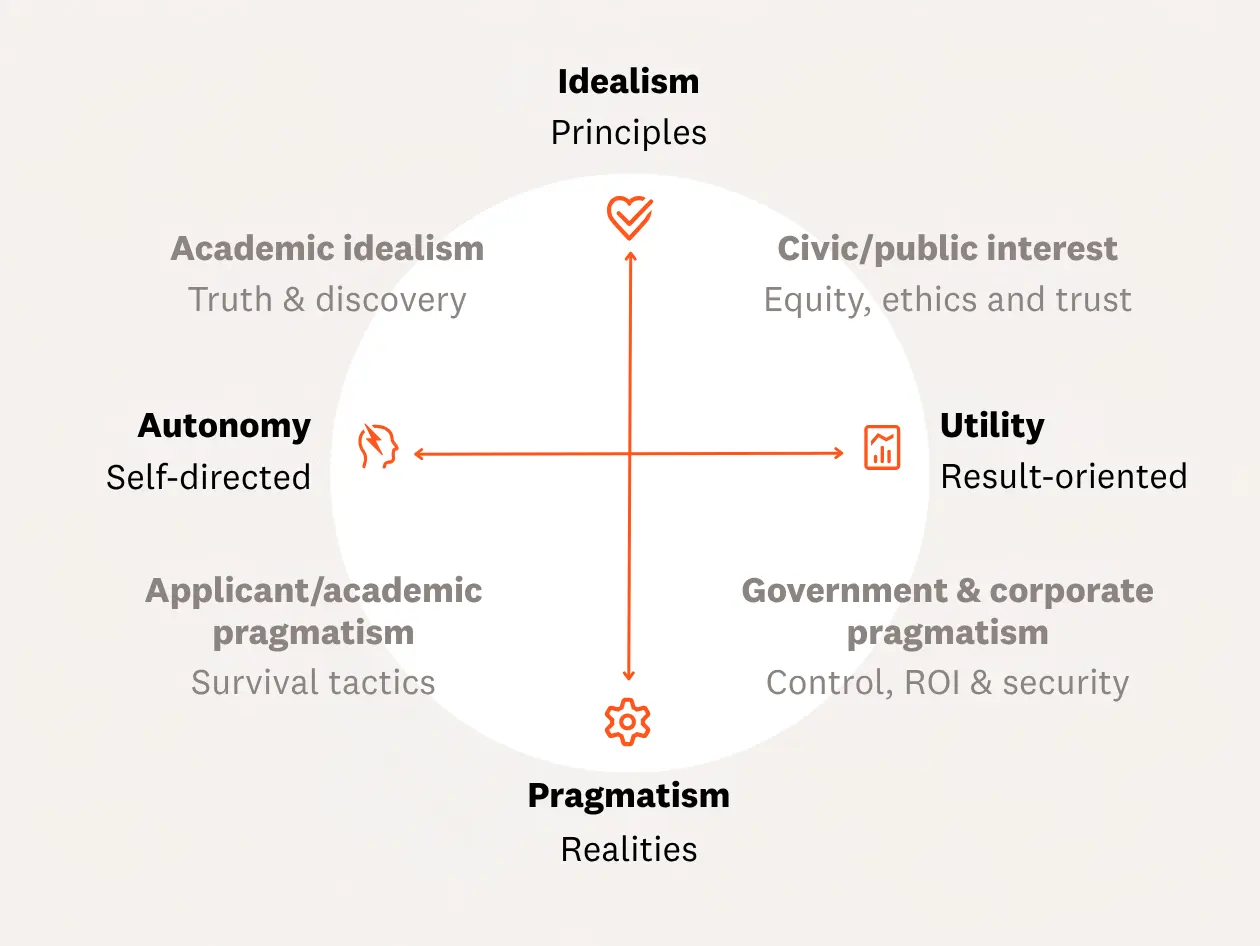

In this article, we have reviewed several of the most highly charged inconsistencies in the funding landscape, most of which can be traced back to a clash between one of more of these different value systems:
- The AI paradox (AI solutions vs. AI problems) is academic pragmatism’s need to publish and secure funding in a hyper-competitive system coming up against government pragmatism’s need for speed, efficiency, and cost containment.
- The workflow paradox (openness vs. scarcity) is public morality's demand for fair access running into government pragmatism's need for a process it can afford.
- The sovereignty paradox (control vs. connectivity) is government's inclination toward data control and national capability colliding with academic idealism's commitment to open science.
- The innovation paradox (bold vs. safe) is academic idealism's tolerance for high-risk, curiosity-driven research clashing with both government pragmatism (need for visible short-term wins) and corporate self-interest (need for risk to be concentrated where the payoff is clear).
- The neutrality paradox (adjudicate vs. orchestrate) is academic idealism's insistence on peer-reviewed autonomy charging headlong into government's and industry's shared interest in steering money towards strategic priorities.
We cannot look to technology to “solve” these paradoxes in any simplistic way. AI is an amplifier and accelerator of existing conditions – conveyed to it in the form of training data and algorithms – and as likely to accentuate inherent problems as it is to promote existing virtues. For this reason, the onus should not just be on good AI, but on good data infrastructure. This allows funders to be clear about the tensions described above and decide which side they should be leaning into at any given time. In essence, quality data is what allows agencies to navigate the complex ethical environment described above. Supported by tools like Scopus, SciVal, InsightGraph and Pure, it enables them to support their choices with real evidence in a way that is both transparent and responsible. Lotteries, submission caps or AI screening are all legitimate responses to the AI solutions to AI problems paradox, but will only hold up under public scrutiny if they are backed by governed, disambiguated, verifiable research and performance data.
For years, the paradoxes described above have been quietly buried in a more-or-less self-regulating system. AI is now bringing these contradictions to the surface and forcing funders to acknowledge them and be explicit about their responses. Agencies that prioritize their data foundation will be able to do this more successfully, trading a defensive posture toward AI-assisted submissions for a confident, evidence-led role at the center of the research ecosystems they fund. Going forward, they must make more conscious decisions around the tensions that underlie and enrich their workflows. As they do so they will become both more effective and more accountable – to their publics, to their ecosystem partners and perhaps, in the end, to history itself.
Learn more about how Elsevier partners with funders and government agencies to drive research impact and advance discovery with AI.
This content is made possible by our sponsor Elsevier; it is not written by and does not necessarily reflect the views of GovExec’s editorial staff.
NEXT STORY: Beyond the pilot: A framework for scaling AI safely and efficiently