
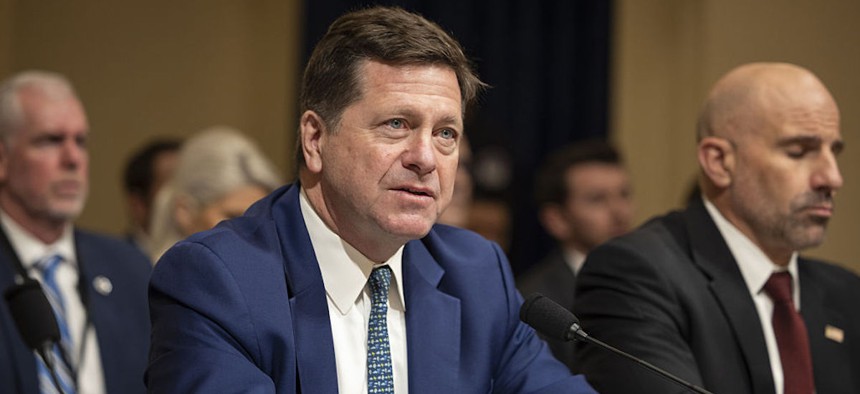
Director of National Intelligence Jay Clayton testifies during a House Homeland Security Committee hearing on threats to the homeland, in the Cannon House Office Building in Washington, DC, United States, on November 18, 2026. Nathan Posner/Anadolu via Getty Images



Intelligence chief Jay Clayton to lead White House cyber office in interim capacity
Clayton would add the temporary assignment to his intelligence and AI duties while Kirsten Davies seeks Senate confirmation as national cyber director.

Director of National Intelligence Jay Clayton will temporarily lead the White House’s top cybersecurity office while Pentagon Chief Information Officer Kirsten Davies seeks Senate confirmation for the job, a White House official told Nextgov/FCW on Monday.
The assignment would give Clayton a third major responsibility in the Trump administration, alongside overseeing the nation’s spy agencies and coordinating the government’s approach to artificial intelligence.
Davies will serve as a senior adviser in the Office of the National Cyber Director during the confirmation process, said the official, adding that broad support for Davies persuaded President Donald Trump to pursue her nomination for the permanent position.
The arrangement follows Trump’s removal of Sean Cairncross as White House cyber chief on Thursday. At the time, a source close to the White House told Nextgov/FCW that Davies would take over in an acting capacity.
“I’m excited to work more with Kirsten, who has the experience and capabilities needed to help America navigate our increasingly complex and powerful digital infrastructure as our next National Cyber Director,” Clayton said in a statement. “I look forward to working with the ONCD team to ensure Kirsten has a seamless transition into the role upon her confirmation by the Senate.”
Clayton’s interim role was first reported by Axios.
Congress created the national cyber director’s office in 2021 to advise the president and coordinate cybersecurity policy across the government. Its work includes tracking agencies’ implementation of the national cyber strategy and helping align efforts to protect critical systems, improve technology security and counter malicious hacking.
Clayton would take on those responsibilities as the administration faces questions about widespread technology failures affecting air travel, banking, Microsoft services and classified communications at the National Security Agency.
Clayton and other senior officials told the House Homeland Security Committee on Wednesday that the disruptions were tied to technical problems and security updates rather than malicious cyber activity. The outages have nevertheless raised concerns about how reliably government and industry can update systems that support essential services.
During appearances on Sunday news programs, Clayton continued defending that assessment. On CNN, he said Americans should expect more “glitches, gaps, interruptions in service” as organizations modernize their technology.
Davies brings experience managing technology and security in both government and industry. At the Pentagon, she oversees information technology and cybersecurity strategy, including efforts to modernize military systems. Her previous employers include Unilever, Estée Lauder, Barclays Africa, Hewlett Packard Enterprise and Siemens.
If you have a tip you’d like to share, David DiMolfetta can be reached on Signal at djd.99
NEXT STORY: ‘A team without a game plan.’ IRS staff displaced from their jobs aren’t sure what happens next