

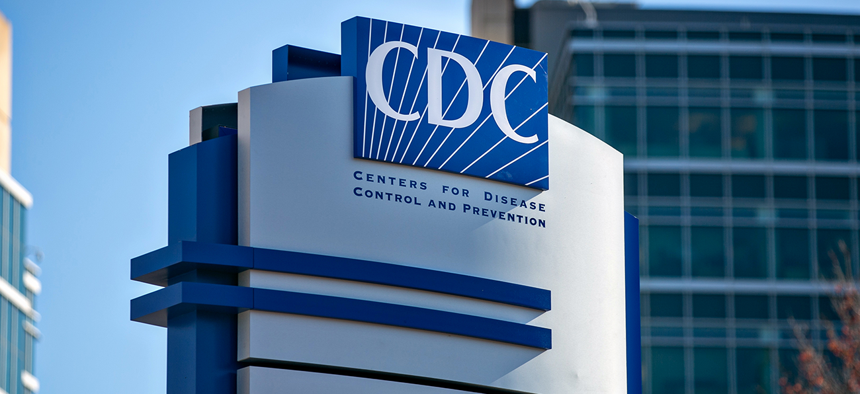
CDC Director Dr. Erica Schwartz told employees that the measles elimination designation is not what protects Americans, and stressed vaccination as a means of stopping outbreaks. Jason Armond / Los Angeles Times via Getty Images



CDC looks to bolster employee morale after U.S. loses measles elimination status
CDC Director Dr. Erica Schwartz told employee that “this news may be especially difficult for those of you who have dedicated years of your career to preventing measles and responding to outbreaks across the country.”

The Centers for Disease Control and Prevention is looking to prop up morale among its employees, after the United States officially lost its measles elimination status last week.
On Nov. 17, the Pan American Health Organization, a branch of the World Health Organization, revoked the U.S.’s measles-elimination status, which had been in place for 26 years. The country is experiencing the largest measles resurgence since 1991.
CDC Director Dr. Erica Schwartz, in an internal email obtained by Government Executive, told employees that “this news may be especially difficult for those of you who have dedicated years of your career to preventing measles and responding to outbreaks across the country.”
“This development does not diminish the work you have done or change the importance of the work ahead,” she wrote.
Schwartz told employees that the measles elimination designation "is not what protects Americans."
“Vaccination does,” she added. “Our focus remains on stopping outbreaks, preventing illness, and supporting the communities and public health partners who depend on our expertise.”
Schwartz told staff that their work in surveillance, laboratory science, outbreak response, communications, and prevention “remains essential” to these efforts.
“I especially want to recognize the teams actively supporting the measles response. Your dedication, expertise, and continued efforts are making a difference for the communities we serve. As we move forward, I will continue to rely on your knowledge, experience, and commitment to guide our efforts,” she wrote. “I know this has been a challenging time for many across the agency. I want you to know that | value your work and remain committed to ensuring CDC has the tools, resources, and support needed to carry out our mission."
Since taking office, Schwartz has been filling vacancies in its leadership ranks and telling employees that a hiring plan to mitigate the agency’s deep staffing cuts is coming into focus. She has also conceded that employee morale is at an “all-time low” as the agency works to rebuild trust with its workforce and a skeptical public.
Public polling has generally improved for most federal agencies since last year, but recent data from the Pew Research Center and Gallup show that fewer Americans think CDC is doing a good job.
“To me and my team, the email rings hollow,” a CDC employee told Government Executive. “A driving force for low vaccination rates has been disinformation from RFK, and she's unwilling to publicly challenge what he says.”
HHS Secretary Robert F. Kennedy, Jr. posted on X that the department will “work to regain U.S. measles elimination status.”
He wrote that CDC has worked alongside state teams in Texas, South Carolina, Virginia, Kansas, New Mexico, and Wisconsin to help bring outbreaks under control, and is also supporting Pennsylvania and New York with epidemiologists and other health experts.
“We are working to close vaccination gaps and rebuild public trust. We will answer families’ questions honestly about vaccine benefits and risks and work with trusted health care providers and community leaders to prevent measles, limit its spread, and support timely treatment,” Kennedy wrote on Nov. 17.
Schwartz has said she and Kennedy agree that the measles-mumps-rubella (MMR) vaccine “is the number-one way to prevent measles.” But on other matters of public health, Schwartz said, “I disagree all the time” with the HHS secretary.
HHS has pursued a vaccine-skeptical agenda under Kennedy’s leadership. Former CDC Director Dr. Susan Monarez told a Senate panel in September 2025 she was fired for resisting his orders regarding vaccines.
Schwartz said CDC should work with state agencies on outreach into communities experiencing outbreaks of measles cases.
“The CDC is certainly there to provide resources to the states and provide support to the states. But what's most important is that the states know these communities very well. And what we're trying to do is lean in with the states to say, ‘How can we help you reach those communities and be the trusted agents,’ because they're the trusted agents for these communities. Having big CDC come in and say ‘Verily, thou shalt,’ is not going to work,” she said during a fireside chat at the Milken Institute Future of Health Summit last week.
If you have a tip that can contribute to our reporting, Jory Heckman can be securely contacted at jheckman.29 on Signal.
NEXT STORY: Intelligence chief Jay Clayton to lead White House cyber office in interim capacity