

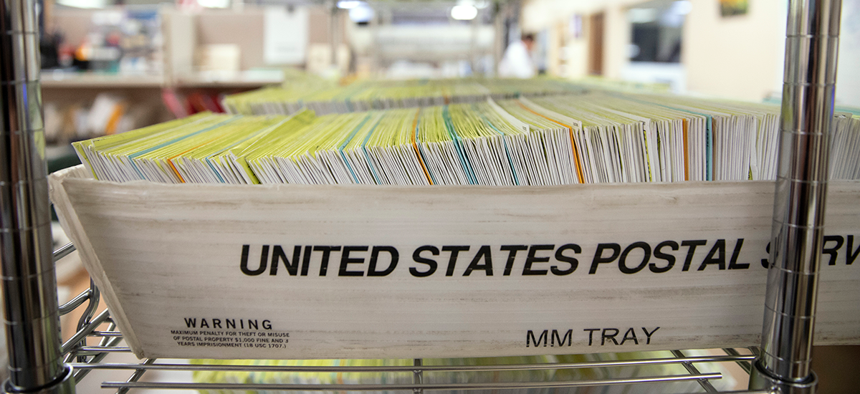
APWU President Jonathan Smith says bargaining unit employees haven’t gotten training on the changes outlined in the Trump administration’s executive order. Alex Edelman/Getty Images



USPS workers most impacted by mail-in ballot EO haven’t been trained yet, union warns
If the Supreme Court clears the way for USPS to implement the Trump administration’s mail-in ballot executive order, the American Postal Workers Union says its members will have little time to prepare for these changes.

The Postal Service’s top executive says the agency stands in the middle of a legal battle over mail-in ballots that is largely out of its control.
The head of the American Postal Workers Union says its frontline employees are being put in a similar situation.
In the lead up to this year’s midterm election, federal lawsuits are challenging the Trump administration’s executive order imposing new rules on mail-in voting. Those cases are once again before the Supreme Court.
APWU President Jonathan Smith told Government Executive that bargaining unit employees haven’t gotten training on the changes outlined in the Trump administration’s executive order. USPS, he added, is contractually required to meet with the union before making any significant changes to the work that bargaining unit employees are expected to perform.
“They’re going outside of the normal measures that we go through. In the contract, they're required, when there's a serious change in the duty assignment, to sit down with the union and explain to the union what you're asking the people that I represent to do. None of that has happened. They have not been trained,” Smith said.
In a final rule USPS released in August, any state that plans to use mail-in or absentee ballots must provide USPS with a list of participating voters. The final rule also establishes new barcode and envelope-formatting requirements. USPS provided nonbinding guidance to states in previous elections, but now says it will reject ballots that don’t meet its standards.
APWU raised its concerns to the Supreme Court in an amicus curiae brief filed on Wednesday.
"The Final Rule would likely cause catastrophic wholesale non-delivery of mail to hundreds of thousands of voters. An enormous number of postal clerks in facilities nationwide would be needed to implement the Final Rule’s restrictions on mail ballot acceptance," the union wrote. "These postal clerks cannot realistically be trained in the operation of the Ballot Portal in the short time before the November elections. The hurried launch of this unprecedented system, at odds with the normal workflow of the Postal Service, will inevitably grind the operation of the postal system to a halt, delaying or preventing timely delivery of mail ballots."
APWU represents the frontline Business Mail Entry Unit (BMEU) clerks who accept large batches of mail-in ballots to be delivered to voters. According to a USPS whistleblower, these clerks will scan a sample of each batch to confirm the voter information on individual ballots matches the information states uploaded to an online portal. APWU also represents the IT workers tasked with creating that online portal.
The whistleblower claims that if clerks identify any errors in the sample, USPS will refuse to accept the entire batch - in many cases, tens of thousands of ballots - until election officials resolve these errors.
“We have the best postal system in the world because we are great at doing what we are trained to do. We are not great at doing what we're not trained to do," Smith said.
Last week, a federal judge in Massachusetts granted a preliminary injunction barring USPS from taking further steps to implement key provisions of its final rule. The Trump administration quickly appealed that ruling and the Supreme Court will soon have the final word on the legality of the executive order.
If the Supreme Court clears the way for USPS to implement the executive order, Smith said frontline employees represented by APWU will have little time to prepare for these changes. North Carolina began mailing ballots last week, and more states are expected to mail theirs in the coming weeks.
USPS conferred with APWU the last time the mail agency was tasked with carrying out new, complex work in a short amount of time – working with the Biden administration to mail millions of COVID-19 tests to households.
APWU signed a memorandum of understanding with USPS in 2022 that allowed postal clerks covered under its collective bargaining agreement to package and label parcels that contained free COVID tests. The memo stated this was “new work” that postal clerks were ordinarily not expected to perform.
“It addresses a problem that does not exist,” Smith said about the mail-in ballot executive order. “It’s to create chaos and put doubt in the American people's minds about voting by mail.”
Smith said he’s concerned the public will blame frontline USPS workers if they run into problems receiving a mail-in ballot this fall. He said the Trump administration is “giving the false impression that postal workers should determine who gets a ballot and who doesn't get a ballot.”
“When a customer does not receive their ballot, they're not going back to the White House. They're not going back to upper-echelon postal officials. They're coming to that poor frontline clerk, angry and upset,” Smith said. “We never should put our employees in that position. It's a dangerous position to take, and no one is talking about the safety and the security of the clerk who's just doing their job, doing what they’re told when they have no choice.”
Smith said that USPS employees are well-versed in carrying out “extraordinary measures” for mail-in ballots in the run-up to elections. Those include extra deliveries and collections, special pickups, expanded hours at processing plants, Sunday collections and visual checks of various points for ballots.
Postmaster General David Steiner told Government Executive in an interview last month that USPS will continue to carry out these extraordinary measures. But Smith said the steps USPS is expected to take under the executive order will make it harder to carry out those extraordinary measures.
“We're going to do what we have always done,” Smith said. “We are going to deliver, and we are going to do the best possible job we can do, but do not put us in a position to fail, is what we're saying, and that's what's happening right here.”
Steiner said USPS “is not a political organization,” and is prepared to carry out its end of the executive order if the Supreme Court ultimately rules in favor of the administration, or comply if the court decides to permanently block the EO’s implementation.
Steiner said implementation of the executive order is “really not dramatically different than what we've been doing for years.” Smith, however, said many of the employees he represents feel unprepared for changes that may be coming.
“Talking to the people I represent, they don't even want to do this. They're not comfortable doing this. The postmaster general says this is not much different than what we regularly do … This is totally different,” Smith said. “What other mail do we verify who can get it and who can't get it? Don't tell me it's nothing different than what we've ever done before. It's totally different. It's not our job to determine who can receive mail. It's our job to deliver the mail. The blame is already being laid where it doesn't belong.”
USPS is tasked under the executive order with launching a Federal Mail Ballot Portal for states to upload their voter lists. Steiner told Government Executive interview that creating the portal “did take a little bit of IT time, but not a dramatic amount.”
“We create the portal, and then all we have to do is compare that manifest to the ballots that get mailed out to make sure that all the ballots were mailed to the right person. It's what we do every day,” Steiner said in the interview in August.
Smith said USPS is putting together the portal under an accelerated timeline with insufficient time for testing.
“They're asking them what would normally take more than a year to do in a matter of three months. That's a recipe for disaster,” Smith said. “They're prepared to release something this critical, knowing it's impossible to get all the bugs out of the portal.”
A USPS whistleblower recently claimed that the agency has rushed to complete work on the portal, and hasn’t followed “standard principles of testing and debugging new software before launch.”
Steiner said in a statement last Friday the USPS “takes these concerns seriously,” and those concerns have been “promptly escalated to the appropriate decision-makers.”
USPS Chief Customer and Marketing Officer and Executive Vice President Steven Monteith told the U.S. District Court in Massachusetts last week that the portal should be “available to users for voluntary use” sometime this week.
“If you're saying ‘ready’ is, ‘We’ve got an acceptable amount of bugs in the system, where it will only reject about 10% of the ballots,’ then we're going away from our oath that everybody has a right to a vote, and everybody has a right to a ballot. That's unacceptable,” Smith said.
In his statement last Friday, Steiner said that although USPS developed the portal on an accelerated schedule, "our standards for quality, security, and system integrity were not compromised.”
“Testing and validation have been continuous throughout the development lifecycle, and our process requires that deployment be delayed whenever significant defects or security vulnerabilities are identified, until those issues are appropriately resolved,” he said.
If you have a tip that can contribute to our reporting, Jory Heckman can be securely contacted at jheckman.29 on Signal.
NEXT STORY: Trump is staffing up agencies with political appointees. They’re not sticking around, new analysis finds