

sponsor content What's this?




From backlogs to mission impact: How defense organizations can unlock agentic AI
Presented by
Google Public Sector | Accenture Federal Services
Presented by
Google Public Sector | Accenture Federal Services
Evolving generative AI capabilities are ushering government agencies into the agentic era, rapidly expanding the horizons of what is possible. Moving beyond the basic chatbots of the past, sophisticated agentic systems are transforming government operations through advanced reasoning, autonomous decision-making and execution.
Earlier this year, the Department of War (DOW) underscored a commitment to advancing agentic AI capabilities in its Artificial Intelligence Strategy, prioritizing “AI agent development and experimentation for AI-enabled decision support and operational management.” To operationalize the strategy, the DOW introduced GenAI.mil, built for “democratizing AI experimentation and transformation across the Department.” The platform, designed for unclassified work, now has over 1.7 million active users, according to Pentagon officials, more than half of the DOW’s approximately 3 million personnel.
The enthusiastic adoption of GenAI.mil underscores a broader, department-wide reality: Defense personnel across every component need scalable, secure AI tools to accelerate decision-making — whether through agency-specific systems or central platforms like GenAI.mil.

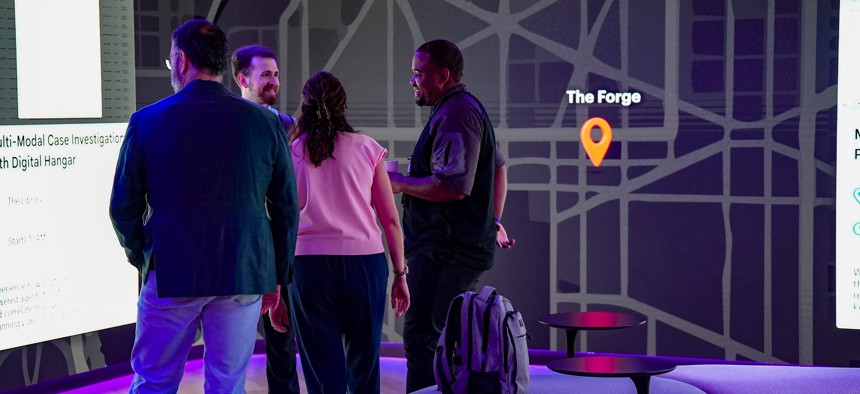
| Book a session at The Forge: Engage directly with Accenture Federal Services and Google Public Sector to walk through your agency’s mission challenges and explore how agentic AI can accelerate analysis, surface hidden patterns, and deliver auditable, mission-ready insights tailored to your operational needs. |
From proving ground to mission impact
While the DOW provides strategic mandates, industry partners play a crucial role in helping defense personnel visualize what is possible. To demonstrate how agentic AI can solve everyday administrative friction, Accenture Federal Services runs internal "agent builder challenges" — using its own development environment to build proof-of-concept AI agents designed for real-world defense workflows.
While built in Accenture’s cloud sandbox environment rather than directly on GenAI.mil, these prototypes showcase the exact level of sophistication and utility that defense agencies can replicate and deploy on the GenAI.mil platform. Built by Accenture Federal Services experts using Google Cloud, Gemini models, and other Google solutions, four recent use cases illustrate how agentic AI can transform routine operations:
1. Agile operations: The SAFe Team Coach Assistant
Managing software development projects requires manually parsing through hundreds of work items, both tedious and time-consuming. The SAFe Team Coach Assistant was built to automate Scaled Agile Framework (SAFe) functions by ingesting data and flagging potential issues like bottlenecks or capacity discrepancies. If a sprint depends on delivering at a velocity of 60 story points, for example, but the team’s historic average velocity is 35, the agent will flag and offer suggestions.
A human is in the loop at every stage and a product manager will need to review any information the agent provides to either agree, reject or ask a follow-up question. The goal is to speed up tedious manual review, helping teams get to decision-making faster and discover red flags sooner.
“One of the big challenges for agile teams is sitting around with a to-do list of requirements and building them out,” said Seth Dow, a program and project management manager at Accenture Federal Services. “Here the AI does a lot of that heavy lifting. It will take the raw requirements and build out those work items, so instead of hours a week having the team sit around decomposing user stories, that’s cut down to 35 or 40 minutes.”
2. Logistics: Quartermaster AI
One small typo in a parts order for the military can stall critical defense systems. To streamline and evaluate order accuracy, Quartermaster AI provides a multi-agent logistics pipeline. Using four different agents, covering routing, resolving, eligibility and compatibility, Quartermaster AI uses National Stock Numbers (NSN) or National Item Identification Numbers (NIIN) to cross-check order details.
The user is provided with four options: auto approve, alternative proposed, human review required and auto reject. With current manual processes, even a fast-tracked critical order can take 45 minutes to 24 hours or more to be processed. Quartermaster AI reduces validation time to less than three minutes.
“When the system is critical but you need a part — the airplane needs to fly or the vehicle needs to be used today — you can’t afford delays,” said Hiran Patel, senior manager of cloud engineering at Accenture Federal Services.
3. Procurement: PR Market Research Evaluator Agent
Procurement is a notoriously lengthy, complex process requiring a significant amount of market research. This solution uses an orchestration agent to parse files of purchase requisitions (PR), flag which will require market research, then use the PR, internal knowledge and web search to produce a market research brief and PR analysis record.
“We don’t want the agents to make procurement decisions, so we produce this as a report to send to analysts so we still use their in-depth industry knowledge,” said Tyler van Burk, software engineering consultant at Accenture Federal Services. “This highlights suggestions and issues based on the documents it’s trained on. It’s like your helpful assistant” that turns hours and days of manual research into minutes.
4. Task management: The TMT Tasker Agent
For years, Accenture Federal Services’ Task Management Tool (TMT) has helped agencies improve efficiency and accuracy across the massive volume of tasks and approvals they juggle each day. By integrating AI into TMT, the TMT Tasker Agent allows users to seamlessly query data about taskers, summarize the details, autogenerate lists of tasks and response plans, determine how to delegate tasks, and more, enabling users to unify typically fragmented workflows.
“What we’ve been hearing is people want to work in a one-stop shop, which is why we’ve been working so closely with Google,” said Shailja Somani, a full-stack LLM development manager at Accenture Federal Services. “The goal is to provide them the ability to access their data, documents and custom AI within GenAI.mil so they can query all of their information in one place.”
Achieving commercial parity at mission speed
The breadth of these proofs of concept demonstrate that agentic AI is now an active, scalable reality for defense organizations with clear ROI. When defense agencies and industry leaders collaborate, the result is commercial-grade solutions that meet complex security and compliance requirements, closing long-standing gaps between private sector innovation and public sector adoption.
“The speed at which we can introduce new features, functions or even new products is extremely accelerated,” said Jim Kelly, vice president of federal for Google Public Sector. “As an example, on the day Gemini launched in our commercial cloud, it was available on GenAI.mil at IL5. That’s a paradigm shift we’ve never experienced in the federal government.”
To learn more about how Accenture Federal Services and Google Public Sector are accelerating delivery of agentic AI solutions, request a visit to The Forge.
This content is made possible by our sponsor Google Public Sector; it is not written by and does not necessarily reflect the views of GovExec's editorial staff.
NEXT STORY: Protecting government’s most personal service channel