

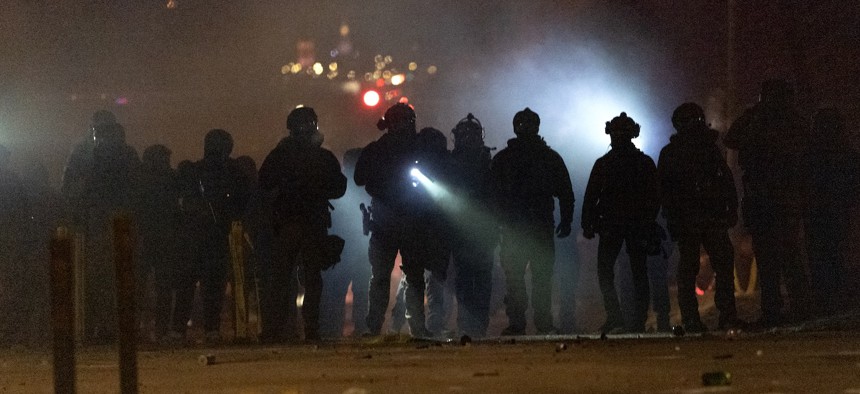
Federal agents guard a perimeter following a shooting involving an ICE agent who shot a Venezuelan man the agent said was resisting arrest, as angry residents protest the federal presence in Minneapolis on Jan. 14, 2026. Scott Olson/Getty Images





ICE agent faces assault charges in Minneapolis case raising questions about federal-local law enforcement coordination
Minnesota prosecutors accused 52-year-old Christian J. Castro of shooting a man through a door and then lying about what happened.
Minnesota prosecutors charged Immigration and Customs Enforcement agent Christian J. Castro, 52, on Monday with assault for the alleged Jan. 14 shooting of Julio Sosa-Celis in north Minneapolis.
The ICE agent, identified for the first time publicly on Monday, faces four counts of second-degree assault as well as one count of falsely reporting a crime.
The latter charge stems from Castro’s earlier accusation that Sosa-Celis and the subject of the agents’ car chase, Alfredo Aljorna, both Venezuelan immigrants here legally according to state prosecutors, had assaulted him with a broom and a snow shovel before Castro opened fire.
The Justice Department dropped its assault charges against Sosa-Celis and Aljorna after federal prosecutors belatedly reviewed surveillance camera footage that contradicted the accounts of Castro and a second ICE agent. In a rare move, the ICE acting director said the agents appeared to have made “false statements.”
“A violent crime did occur that night, but it was Mr. Castro who committed it. He shot through the door of a home with many people, including children, inside while fortunately missing several others,” Hennepin County Attorney Mary Moriarty said in a Monday press conference.
Moriarty’s office has issued a nationwide warrant for Castro’s arrest. Moriarty said they do not know where Castro is, but there are “mechanisms out there to find him.” She added that she feels “pretty confident that we will get him in here to start this process.”
The case is currently in state court, though Moriarty said her office expects Castro’s defense to try to move the case to federal court, after which he can assert immunity under what is known as the Supremacy Clause, which protects federal agents for reasonably carrying out their duties. If Castro were convicted, she noted, he would be ineligible for a presidential pardon.
Both Moriarty and Attorney General Keith Ellison, who is partnering with the county, emphasized that “there’s no such thing as complete immunity.” Ellison also noted there is a “long line of cases” in which state prosecutors have charged federal agents for breaking state law, a practice that stretches back to the 1800s and has had mixed results.
Castro was identified mainly through the state’s Bureau of Criminal Apprehension, Moriarty said. Investigators arrived at the scene on Jan. 14 and heard FBI agents identify him. She added that her office received no cooperation from the federal government in obtaining evidence.
In Castro’s original statement to the FBI, he claimed Sosa-Celis and Aljorna repeatedly struck him with a broom and a snow shovel. He said he then drew his gun and “simultaneously fired” a round as they were running toward their home. Sosa-Celis and Aljorna have maintained that they never attacked Castro and that Castro shot Sosa-Celis in the leg through the front door.
The arrest warrant filed by prosecutors, based on an investigation by the BCA and citing surveillance camera footage, aligns with Sosa-Celis and Aljorna’s accounts that Castro fired at the front door of the house. It includes a description of holes from the bullet’s trajectory through the front door, a foyer wall, a closet and the wall of a child’s bedroom.
The shooting was the second of three injurious shootings in Minneapolis during the federal immigration surge this winter, occurring between the fatal shootings of Renee Good and Alex Pretti. The Jan. 14 case, which drew more than 100 protesters to the scene, was initially shrouded in mystery compared with the other two shootings, since there was no video evidence of the altercation before the city of Minneapolis released surveillance footage in April.
The federal government has corrected its own account multiple times, including its initial press release that incorrectly identified Sosa-Celis as the driver of the car and a subject of a “targeted traffic stop.” It later determined that ICE agents had mistaken Aljorna, who was driving the car, for another Latino man wholly uninvolved in the incident, and that Sosa-Celis, Aljorna’s roommate, was not involved in the car chase at all, according to an affidavit accompanying the DOJ’s charges.
Aljorna and Sosa-Celis were both detained for weeks after the shooting, then re-detained by ICE after a judge ordered their release. Their partners were also detained and transported to Texas in January. They have all since been released from detention and were temporarily barred from deportation during the case against them, the Star Tribune reported.
The charges come a month after Minnesota prosecutors filed their first charges against an ICE officer for allegedly brandishing his service weapon at two people in what prosecutors said appeared to be a road rage incident. Gregory Donnell Morgan Jr., the ICE agent, is still not in custody, though Moriarty said they have made “substantial progress” in getting Morgan to state court.
Moriarty said her office is still working on the fatal shootings of Good and Pretti and that she does not have a clear timeline for when they will be confident enough to decide whether to charge the federal agents who killed the two U.S. citizens. As in the Jan. 14 shooting, local investigations into the killings of Good and Pretti have been significantly hindered by federal non-cooperation, including denial of access to evidence. In March, Minnesota prosecutors filed a lawsuit seeking evidence from the federal government on the two fatal shootings and the Jan. 14 shooting.
Minnesota Reformer is part of States Newsroom, a nonprofit news network supported by grants and a coalition of donors as a 501c(3) public charity. Minnesota Reformer maintains editorial independence. Contact Editor J. Patrick Coolican for questions: info@minnesotareformer.com.