Government Business Council Government Business Council
Menu
  • Reducing data center footprint
  • Maritime operation centers
  • Full speed ahead!
  • Delivering secure, mobile network access to the Navy
  • Enhanced capabilities coming for deployed units
  • Empowering Navy Recruiters
  • Creating a secure path to the cloud
  • Fostering innovation and partnership
  • Download the Book
background image

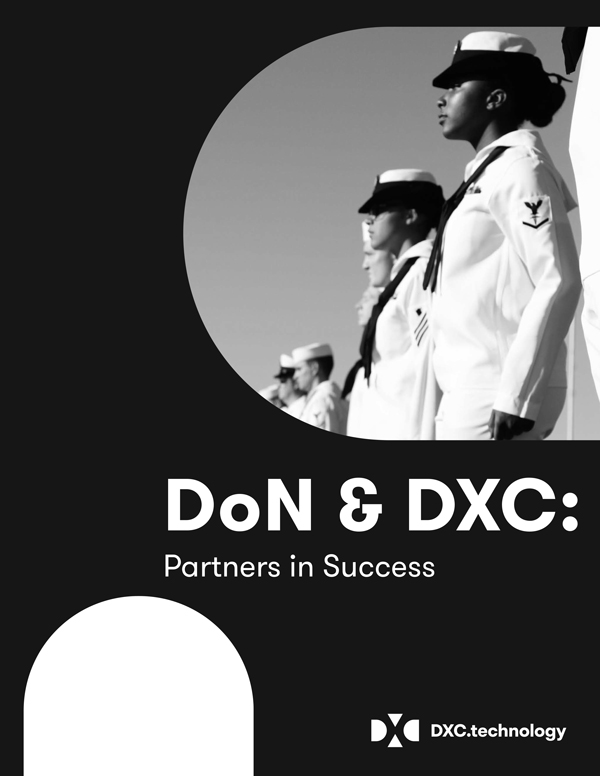
The relationship between the Department of the Navy and DXC Technology goes beyond daily efforts to support those who depend on the Navy Marine Corps Intranet (NMCI) network. NMCI was a first-of-its kind network when DXC and Navy worked together to create it more than 15 years ago, and it remains world-class today. On this page — and in the downloadable report — you will find a synopsis of relevant Next Generation Enterprise Network (NGEN) activity, including significant milestones from both recent and upcoming activities.

This success story was originally written by HPE Enterprise Services, which is now a part of DXC Technology as of April 2017.

Reducing data center footprint

U.S. Navy photo by Mass Communication Specialist 3rd Class Nathan Burke.

Leveraging converged infrastructure

As part of the refresh of the Enterprise Virtual Infrastructure (EVI), DXC is leveraging a converged infrastructure approach that allows for a reduced footprint, denser virtualization, less power and cooling requirements, and smaller data centers. While NMCI end users won’t see a difference in their services, the Navy will enjoy reductions in data center consumption, cost for refresh, and licensing.

Going forward, there will be an add-on of additional features to further monitor and consolidate to improve operating efficiencies in the data center environment.

Benefits to the Navy:

  • • Reduced data center footprint and power consumption
  • • Lower costs and licensing requirements
  • • Increased mobility of servers and server density
  • • Better server manageability and monitoring

Navy data center consolidation efforts to yield substantial cost savings

Together with the Navy, DXC is working to consolidate 21 data centers into 14. This effort is part of Navy’s Data Center Consolidation (DCC) strategy to maximize cost savings and avoidance, increase efficiency and standardization of Navy data center operations, and increase the Navy’s data center cybersecurity posture.

Reducing the Navy’s physical data center footprint allows them to reduce maintenance costs. Additionally, by introducing virtualization in the remaining data centers, the Navy is able to realign resources according to requirements, which saves money in terms of space optimization and computing power to run systems efficiently.

Cost savings achieved through:

  • • Reduced maintenance and equipment requirements
  • • Decreased power and cooling costs

Download the full report for more on this topic.


Maritime operation centers at Third Fleet and Fleet Forces commands receive high marks

U.S. Navy photo by Mass Communication Specialist 3rd Class Justin R. Pacheco.

In an effort to ensure the Navy maintains critical communications capabilities during a real-world crisis, the DXC team recently completed successful testing of the Maritime Operations Centers (MOCs) belonging to the Third Fleet and Fleet Forces commands. During the testing, the DXC team simulated multiple scenarios within the live NMCI environment to ensure both equipment and people responded correctly. One scenario included likely issues associated with a Category 3 hurricane’s impact on the Norfolk, Va. area. The team tested the ability of the MOCs to maintain the ability to send and receive information as the storm approached.

The MOC is a core Navy initiative to standardize technology, operational processes and tactical procedures into a common framework to enable Navy commanders to operate effectively in a joint force maritime environment. The initiative aligns and standardizes interoperability between sister forces so they can synchronize crossfunctional warfighting capabilities at the operational level.


Full speed ahead!

Effort underway to accelerate NMCI traffic

NMCI users will see a marked improvement in the speed of network traffic as DXC completes an enterprise-wide wide area network acceleration initiative. Instead of adding additional costly hardware, this initiative optimizes network speeds by reducing bandwidth usage while also accelerating applications.

Bandwidth reduction efforts have already shown a more than 50% traffic reduction across the NMCI network.

Put another way, if NMCI was a freeway this initiative has effectively doubled the amount of available lanes while significantly reducing the number of vehicles. That reduction in traffic frees up bandwidth for mission critical applications and provides a 4X increase in network response times.

Making better use of existing bandwidth also allows the Department of the Navy defer capacity investments, freeing up funding for other investments.

Accelerating NMCI to 10G

In response to end user feedback, the Navy and DXC have a major initiative underway to significantly speed up data flow on the NMCI network. The project is expected to be completed in July 2017 and will increase overall network traffic from a 1G speed to 10G. The first phase of the project is an assessment and upgrade of existing equipment in the larger NMCI data center locations. Once that is completed, the focus will move to the smaller server farms. In addition to faster network response times, NMCI end users will also see an enhanced Voice over Internet Protocol (VoIP) and video teleconferencing (VTC) experience.

NMCI virtual private networks get speed boost

In an effort to provide a better end user experience without compromising security, DXC recently completed an upgrade of the VPN hardware on the NMCI network. A VPN, or virtual private network, is a method used to add security and privacy to the data NMCI users share both inside outside of the Navy’s largest network. All NMCI traffic runs through a VPN, and the hardware was identified for the upgrade when it became clear it would not support desired traffic speeds and was actually creating a network traffic roadblock.

Upgrading the hardware has sped up VPN traffic by 900%, resulting in the desired 10G speed.

The next phase of the project is to eliminate the VPNs completely. Technology advancements have allowed existing outer routers to virtually assume the VPN function. This will decrease the technology footprint and allow for the transfer of functionality to another existing system without loss of security controls, all while still maintaining network speed.

Benefits at a glance:

  • • 25 terabyte reduction in NMCI network traffic
  • • 51% reduction in bandwidth
  • • 4X increase in end user network response time
  • • Deferred capacity investments
    • • 10X improvement on network speeds, resulting in faster network response times
    • • Enhanced VoIP and VTC experience
    • • VPN traffic increased by 900% (1G to 10G)
    • • Eventual removal of VPNs and movement of functionality to outer routers
    • • No change in security controls or network speed



Delivering secure, mobile network access to the Navy

U.S. Navy photo by Mass Communication Specialist 3rd Class Carter Denton


Recently in New York City, Navy personnel celebrated Fleet Week, an annual weeklong celebration of the sea services that features more than 100 public events, including ship tours and parades, and brings in more than 68,000 visitors.

To support operations while deployed in New York, Navy Fleet Week support personnel leveraged the NMCI Deployable Site Transport Boundary (DSTB) solution. The DSTB is a portable solution that packages the hardware, routers, power supply, virtual private network capability and direct connectivity required to securely connect to the NMCI network from anywhere the mission takes Sailors and Marines.

Enhanced capabilities coming for deployed units

In response to emerging requirements from customers like Commander, Pacific Fleet, DXC Technology is expanding what the NMCI Deployable Site Transport Boundary (DSTB) solution can do in the field.

By late 2017, DSTB units will be authorized to connect to file servers either in the field or back in the office, giving end users access to critical information. The new DSTB will also be authorized to connect to NMCI communities of interest (COIs), such as the NNPI and NETC COIs. Additionally, the DSTB’s will now be able to support wireless LAN connectivity, video teleconferencing as well as scan-to-file capability. DXC has also worked to shorten the time it takes to re-home a DSTB to less than two weeks.

Benefits at a glance:

  • • Expanded capabilities and authorization, including wireless LAN, COI connectivity and VTC ability
  • • Faster delivery of DSTB units, shortened re-homing time
  • • Ability to take and connect to file shares and other servers

Empowering Navy Recruiters

U.S. Navy photo by Mass Communication Specialist 1st Class Timothy Walter.

Next-gen detachable laptops and technology enhance functionality for recruiters

The goal of the Mobile Recruiter Initiative (MRI) is to put state-of-the-art technology in the hands of recruiters to not only improve their workflows out in the field, but to make a better initial impression on today’s tech-savvy recruits. This includes mobile scanners, printers and fingerprint scanners. Throughout this initiative, DXC gathered user feedback to provide continuous improvement. To that end, the next generation of the new Mobile Recruiter Initiative (MRI) is underway for the Navy Recruiting Command. DXC began deploying the next generation solution in April 2016, empowering recruiters with enhanced functionality and next-gen technology designed to streamline efficiency in the field.

The new detachable laptops transition into tablets, allowing for ease of transport and include the touchscreen capabilities of the Windows 8.1 operating system.

In addition, recruiters now connect to the Navy Marine Corps Intranet (NMCI), resulting in an additional layer of data security, while still maintaining the flexibility of operating in a dot com environment. To date, 4,970 new detachable laptops have been procured, imaged and delivered to 27 Navy Recruiting Districts, and all recruiters are scheduled to have the new MRI V2 devices in their hands by mid-September.


Creating a secure path to the cloud

U.S. Navy photo by Mass Communication Specialist Seaman Cole C. Pielop.

The Department of the Navy and DXC have taken one of the first steps in realizing the benefits of cloud computing. The initial design phase of the Cloud Access Point pilot kicked off in July 2016 and is expected to ultimately support up to 6,000 users. The cloud access point is the security conduit through which the Department of Defense is connecting to the commercial cloud. This effort will enable the Navy to take advantage of commercial cloud solutions such as Microsoft Office 365.

Scheduled to be completed in May of 2017, the first phase of this pilot is the initial engineering and design portion of the project. Once finished, the next step of the project will be the implementation of the engineering design. The final phase of the project will be a cloud access point that has the ability to scale to meet the needs of all of NMCI’s 400,000 unclassified users.

Throughout the initial phase, DXC will be leveraging agile development methodology. Agile development describes a set of principles under which requirements and solutions evolve through the collaborative effort of self-organizing cross-functional teams. It promotes adaptive planning, evolutionary development, early delivery, and continuous improvement, and it encourages rapid and flexible response to change. Leveraging this methodology allowed DXC to cut the overall initial timeline in half.

Benefits at a glance:

  • • Positions the Navy to securely take advantage of industry-leading cloud technologies such as Microsoft Office 365, SaaS, IaaS and PaaS
  • • Provides end users access to the latest workplace tools and applications

Fostering innovation and partnership

U.S. Navy photo by Mass Communication Specialist 2nd Class Nathan Wilkes.

Innovation Cell Challenge yields Enhance Virtual Desktop improvements

In an effort to foster industry innovation for the Department of the Navy’s enterprise IT, the Program Executive Office for Enterprise Information Systems (PEO EIS) created the Innovation Cell (IC) initiative. The IC provides a forum for industry to present ideas and engage collaboratively so they may present solutions that improve the Navy’s information systems environment. Each year, the IC issues enterprise challenges to vendors and asks them to respond by outlining innovative solutions that accelerate speed to market and deliver new capabilities to users.

To support this Navy initiative, DXC formed a dedicated team to work with the Navy on implementing the selected solutions from the enterprise challenges. As a result, the team was able to streamline communications, enhance transparency, and more rapidly acquire and introduce mature technologies that meet the Navy’s current and future needs.

One of the first challenges was the Enhanced Virtual Desktop. The Enhanced Virtual Desktop (EVD) project is designed to improve the current hosted virtual desktop (HVD) environment. The overall goal of EVD is to enhance the user experience with greater reliability and performance.

To meet the EVD challenge, DXC is upgrading the underlying software and firmware to provide increased performance and reliability.

Additionally, new caching technologies provide a snappier user interface to the virtual desktop. The upgrade also increases the solution reach by enabling CAC-enabled Android tablets and iPads to connect to the virtualized desktops and applications.

Future enhancements include extending access and functionality to tablets and mobile phones. The platform could be leveraged to support other DoD initiatives like DMZ v2 and the Joint Information Environment (JIE) technologies to provide simultaneous access to multiple security level content via virtualized desktops, should the Navy choose to do so.

Benefits of EVD:

  • • Secure, fast and better access to Navy applications, data and web sites.
  • • Continued access to Navy resources via Navy or personal CAC-enabled devices without having to procure additional laptops when working remotely.
  • • Cloud-based access to NMCI desktops.
  • • Foundation for providing virtualized Windows 10 desktops
  • • Leverages existing Navy investments in desktop virtualization hardware and software
  • • Expanded device support

Download the Book

Download
background image

Hewlett Packard Enterprise is an industry leading technology company that enables customers to go further, faster. With the industry’s most comprehensive portfolio, spanning the cloud to the data center to workplace applications, our technology and services help customers around the world make IT more efficient, more productive and more secure.

  • Exercise Your Privacy Rights
  • Exercise Your Privacy Rights