Government Business Council Government Business Council
Menu
  • Finding #1
  • Finding #2
  • Finding #3
  • About
 background image
Underwritten by
Veritas

Flash Poll Series:
Data Management

State & Local Perspectives on the Impact of the Data Explosion


We live in a Cambrian era of big data,” declared former U.S. Deputy Chief Technology Officer Beth Noveck in 2012. Four years later, her pronouncement is more relevant than ever. We’re at an unprecedented age in history: streams of unstructured data are generated by traffic cameras, security video, audio files, social media, search engine data, and beyond at incredible rates. While all this data has the potential to produce stunning insights, state organizations need to first address the initial step of storing and processing these vast swaths of raw data.

 background image

Finding #1

 background image

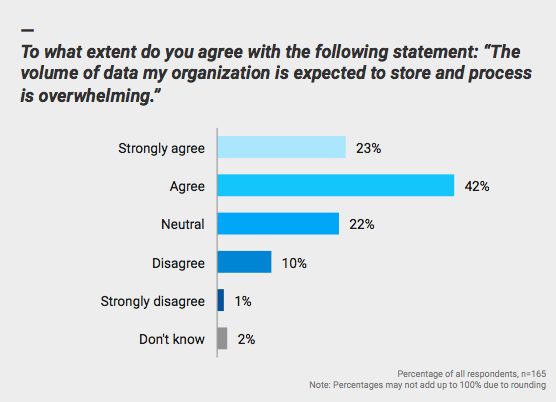
65 percent of state & local leaders feel that their organization is “overwhelmed” by data


To learn more about the implications of this data explosion in state and local government, Government Business Council released a flash poll in July 2016 on the following question:

To what extent do you agree with the following statement: 'The volume of data my organization is expected to store and process is overwhelming.'
GBC received responses from 165 state and local leaders representing a range of organizations. Most feel that their organization is overwhelmed by data: 65 percent of respondents agree or strongly agree that the volume of data their organization is expected to store and process is “overwhelming,” 22 percent are neutral, and only 11 percent disagree or strongly disagree.
 
A successful data storage and processing strategy should be simultaneously disciplined and flexible: data should be shared as much as possible with relevant stakeholders and the public, but it must also be subject to acute oversight in order to prevent unauthorized access. The development and implementation of this strategy rests on the ability of organization leaders to devise consistent, thoughtful processes for organizing data, merging silos, managing access and security protocols, and reducing redundant or obsolete data sources.

While a glut of unstructured data can be, as respondents note, a major headache for state and local government, effective management and governance processes can help organizations filter and leverage the data at their disposal to derive mission-critical insights, drive innovation, and enhance citizen services.
 
 background image

Finding #2

 background image

State & local organizations are at different states of implementing a data management strategy


These days, the buzz is all about data. Check out any tech meetup or innovation conference, and you’ll find overwhelming consensus: data is our most powerful resource in uncovering key business insights and driving change. However, simply possessing data isn’t enough. In order to unlock value from enterprise data, the public and private sectors need to establish, communicate, and implement a comprehensive data management strategy across the organization.

With their central role in providing and enhancing citizen services, state and local government organizations have a lot to gain from data — but how effectively are they communicating data management processes to the employees tasked with implementing them?

In order to answer this question, Government Business Council took a closer look at state and local data management with a July 2016 flash poll:


In order to successfully derive insights from vast quantities of unstructured data, state and local governments need to establish a comprehensive data management strategy (e.g., guidelines for organizing, disseminating, protecting, and leveraging data) and provide necessary resources for the implementation of that strategy.
 
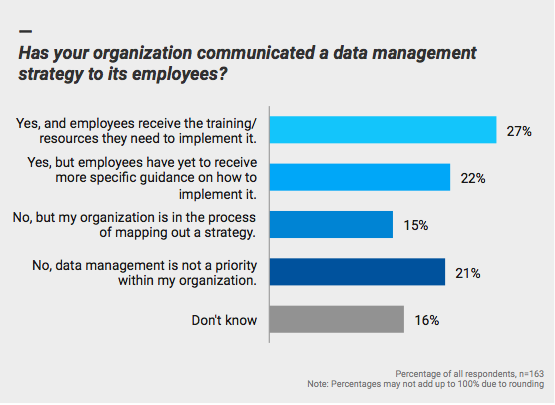
Has your organization communicated a data management strategy to its employees?

163 state and local leaders representing various organizations responded to the poll. According to the results, organizations are at different stages of communicating a data management strategy to employees: 27 percent say that their organization has communicated a strategy and is providing employees with the training/resources they need to implement it, 22 percent say their organization has communicated a strategy but has yet to provide more specific implementation guidance, 15 percent say that their organization is still in the process of mapping out a strategy; and 21 percent say that data management is not a priority within their organization.

Establishing a holistic data management strategy is a prerequisite of processing, storing, and leveraging data — but even the most carefully crafted strategy is obsolete if it isn’t successfully communicated throughout the organization. Moving forward, state and local governments need to provide comprehensive data and records management training, ensure that data handling processes are standardized across the organization, and promote a culture of data literacy by building a workforce with the requisite skills and support to put strategy into action.
 
 background image

Finding #3

 background image

Data security processes in state & local government still have room for improvement


Approximately 3.6 million social security numbers and 387,000 credit and debit numbers were exposed as a result of a 2012 hack on the South Carolina Department of Revenue. The attack forms only a small piece of a growing tapestry of public sector data breaches, and, apprehensive at the possibility of being the next big headline story, state and local organizations are increasingly investing in enhanced security capabilities. But not all threats can be prevented, and in addition to maintaining perimeter defense, it is imperative that organizations simultaneously focus on their post-breach game plan.

In order to assess state and local data and recovery processes, Government Business Council released a flash poll in July 2016 on the following question:

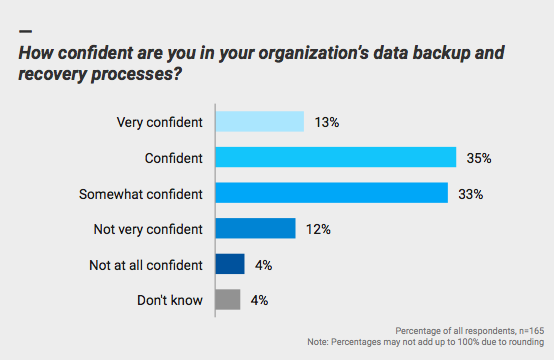
Securely storing growing quantities of unstructured data is one of the chief challenges state and local governments face. How confident are you in your organization’s data backup and recovery processes?

165 state and local leaders representing various organizations responded to the poll. According to the results, 48 percent of respondents feel confident or very confident in their organization’s backup and recovery processes, 33 percent are somewhat confident, and 16 percent are not very or not at all confident.

While a plurality of respondents express confidence in their organization’s capabilities, there’s still definite room for improvement as state and local governments seek to protect themselves in an increasingly power and unpredictable threat environment. According to the National Institute of Standards and Technology (NIST), when creating effective containment strategies, organizations should tailor disaster recovery according to incident type, with consideration given to necessary time and resources, service availability, solution duration, and possible evidence preservation. At this time, the need for eradicating malicious elements should also be assessed. Finally, recovery — which entails restoring systems from backups, replacing compromised files, changing administrative passwords, and other activities — should be conducted in a phased approach that emphasizes both immediate remediation and long-term steps to tighten organization security.

background image
 

About Government Business Council

As Government Executive Media Group's research division, Government Business Council (GBC) is dedicated to advancing the business of government through analysis, insight, and analytical independence. An extension of Government Executive's 40 years of exemplary editorial standards and a commitment to the highest ethical values, GBC studies influential decision makers from across government to produce intelligence-based research and analysis. 


Report author: Rina Li


About Veritas

Veritas Technologies enables organizations to harness the power of their information to drive business success, with solutions designed to serve the world’s most complex, heterogeneous environments. Veritas works with state and local governments, helping them improve data availability and unlock insights into their data to reduce risk and increase compliance. http://www.veritas.com

  • Exercise Your Privacy Rights
  • Exercise Your Privacy Rights