Menu
  • Finding #1
  • Finding #2
  • Finding #3
  • Veritas Content
  • Register for the Digital Event
  • More Information
 background image
Underwritten by
Veritas

Flash Poll Series: Information Management

Your source for federal leaders' views on information management


If you’ve ever requested a document from a federal agency, you may understand the urgency behind initiatives to modernize federal records management. According to Department of Justice statistics, the number of backlogged Freedom of Information Act (FOIA) requests rose by 67 percent in the last year. Similarly, a Syracuse University study found only one-third of federal agencies were able to process even the most basic of FOIA requests within a reasonable period of time. Similarly, recent controversies involving documents rendered irretrievable as a result of technological failure illustrate just how costly gaps in the official record can be.

67 percent Increase in backlogged FOIA requests in 2014

U.S. Department of Justice

Effective records management is at the heart of government’s core mission to be efficient, transparent, and accountable to the public. Nevertheless, ensuring that the information required to support litigation or a FOIA request can be an extremely time- and labor-intensive process. In 2011, President Obama issued the Presidential Records Management Directive (PRMD), aimed at overhauling federal information governance and records management policies. 

Register Now for the Digital Event:

Using Information Governance to Streamline Records Management

background image

Finding #1

background image

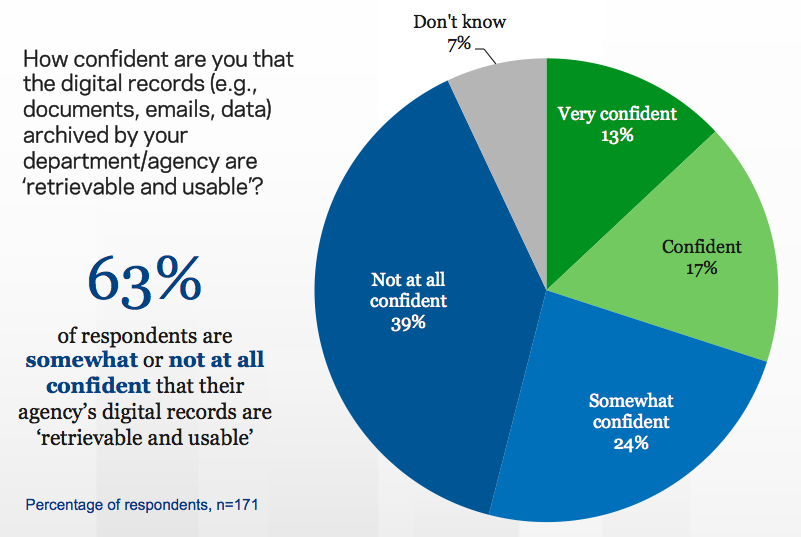
63 percent of feds lack confidence that their agency's digital records are "retrievable and usable"

To keep pace with the deluge of digital information agencies are tasked with storing, PRMD directs federal agencies to transition record storage from paper documents to digital formats by December 2016, requiring each agency to “ensure all records within [its] repository are retrievable and usable.”

To get a sense of federal employees’ comfort level with their agency’s switch to digital records management, Government Business Council conducted a poll using a random sample of federal employees subscribed to Government Executive, Nextgov, Defense One, and Route Fifty. Respondents were asked to what extent they agreed or disagreed with the following statement:

How confident are you that the digital records archived by your department/agency are 'retrievable and usable'?"

Of the 171 federal employees to take the poll, 63 percent say they are less than confident that their agency’s archived documents are “retrievable and usable.” What’s more is that almost four in ten say they are “not at all confident.” These findings seem to suggest that many are concerned that challenges maintaining official records, fulfilling FOIA requests, and supporting litigation are likely to persist despite the switch to electronic record-keeping.


GBC Flash Poll, September 2015

A 2013 National Archives and Records Administration (NARA) Self-Assessment Report found 28 percent of agencies to be at “high risk” of not meeting PRMD-mandated benchmarks, while 43 percent were at “moderate risk.” Further, only 60 percent of Senior Agency Officials (SAOs) surveyed reported that the necessary functionality in terms of “capture, retrieval, and retention” had been incorporated into the design and implementation of their agency’s electronic records management system. Although a May 2015 report by the Government Accountability Office (GAO) found that most agencies met the December 2013 deadline for submitting as to how they planned to migrate paper records to digital formats, between now and December 2016 they face the even more challenging task of putting those plans in motion.

Four years after PRMD was first issued, federal agencies still have considerable work ahead of them. Exploring solutions that automate the archival of records in a retrievable and usable format can help federal agencies streamline litigation support, enhance transparency, and ensure accountability to the public.

background image

Finding #2

background image

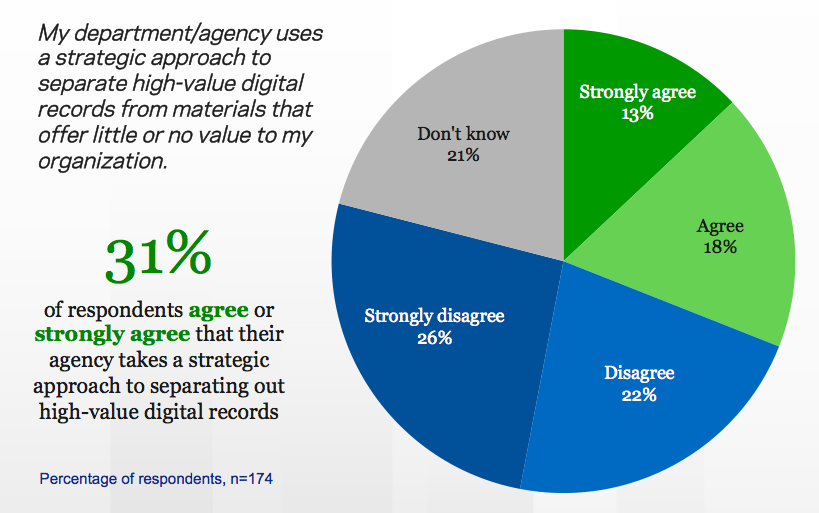
Only 31 percent of feds say their agency takes a strategic approach to records management

The days of “print and file” are over. Federal agencies are shifting to digital storage for their official records – documents, data, and more importantly, employees’ emails. Given the sheer volume of emails and their highly variable contents – everything from official correspondence to small talk between employees – it’s clear that a “save everything” approach to records management is no longer an option.

Nancy Hunn, Director of Records and Privacy with GAO, suggests that as much as 80 percent of all government emails have little to no value to the organization, but nonetheless take up space on government hard drives. The technology research firm Gartner estimates the cost of enterprise data storage at more than $2,500 per terabyte [paywall] when you factor in the cost of hardware, software, personnel, facilities, disaster recovery, and downtime. Considering that a given agency might be responsible for storing hundreds or thousands of terabytes of digital records, the costs of indiscriminate email storage can add up quickly.

$2,500 The per terabyte cost of enterprise data storage

Gartner, 2015

To help address the government’s information governance dilemma and comply with the PRMD, the National Archives and Records Administration's (NARA) Capstone initiative empowers agencies to develop strategies to capture high-value email records for permanent storage, while culling those that offer little or no value.

To better understand government employees’ attitudes toward their agency’s Capstone progress, GBC polled a random sample of federal employees and asked them whether they agreed or disagreed with the following statement:

My department/agency uses a strategic approach to separate high-value digital records from materials that offer little or no value to my organization.

Of the 174 respondents to take the poll, only 31 percent agree or strongly agree that their agency is using a strategic approach to separate the high-value digital records from materials that offer little or no value. Meanwhile 48 percent disagree or strongly disagree. This finding suggests that federal employees are not confident in their agency's strategy for identifying and cataloguing high-value digital records. 


Learn more by registering for the upcoming digital event on October 22nd here.


Capstone, a role-based retention method, relies on designating the emails of senior officials, C-suite executives, and other key staff members for permanent archival. However, the effectiveness of Capstone is limited by its focus on retaining materials generated by specific roles within the organization, rather than on retaining materials most likely to hold strategic value for the organization based on their content. As a result, reliance on Capstone alone will undoubtedly result in the over-retention of unimportant materials generated by high-ranking individuals, and under-retention of high-value materials generated by employees outside of the executive suite.

"Capstone dispenses with content analysis...It's a crude, simplistic approach. It may not be great, but it's better than the existing approach." Gary Stern, General Counsel, NARA

In order to better identify materials likely to contain high-value content, agencies must rely on one of two methods: either requiring employees to manually designate whether or not a given email possesses organizational value, or implementing a technology solution to automate collection of high-value records based on a set of predetermined rules, keyword mining, and metadata analysis.

As GBC will explore in the next installment of its Flash Poll Series on Information Management, due to the scale and complexity of the federal government's records management challenge, relying entirely on manual processes can be a risky proposition.

background image

Finding #3

background image

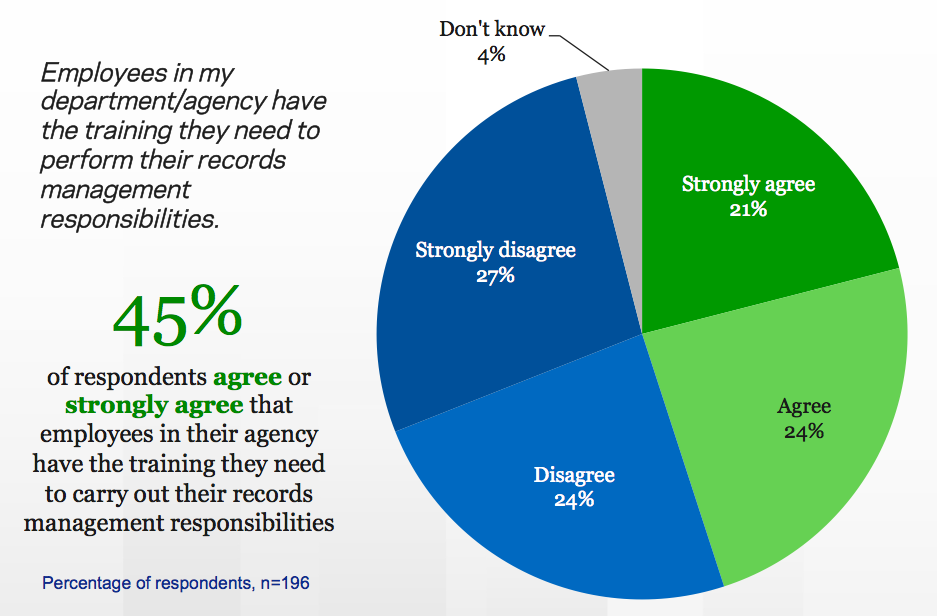
Only 45 percent of feds say their agency provides adequate records management training

The average federal employee can receive 100 or more emails in a day, with senior officials likely receiving even more. The requirement to evaluate the record-worthiness of each and every email can be chore and could lead to inconsistencies in record-keeping, given the highly subjective nature of the task. As a 2014 NARA Report notes, “It is very difficult to get consistent compliance using this approach because of the reliance on end user action. The approach does not scale up to large volumes of records or staff, risking failure to effectively manage both permanent and temporary electronic records.” Although manual processes may be appropriate for some smaller agencies, says NARA, larger agencies with more complex organizational structures should seek more reliable methods.

The difficulties involved with relying on manual processes for records management can be compounded by inconsistent records management training across the federal government. All agencies were required under PRMD to inform all employees of their records management responsibilities and to establish training by December 2014. To assess the effectiveness of these initiatives, GBC asked a sample of federal employees if they felt their agencies provided sufficient training for employees to perform their records management responsibilities. 

Employees in my department/agency have the training they need to perform their records management responsibilities.

Only 45 percent of federal employees polled believe employees in their agency have received adequate training to perform these important records management duties. 51 percent of those surveyed disagree or strongly disagree.


Records management training can prove valuable in helping employees recognize and flag high-value materials, minimize human error, and instill a sense of purpose for their records management activities. Nevertheless, training deficits – combined with the risks associated with manual processes – can result in inconsistencies in official government records and cause agencies to lag behind on their PRMD goals. Inconsistencies can be costly; although enterprise storage costs discourage saving everything, agencies can find themselves at risk of culling materials that may later prove valuable for a FOIA request or in support of litigation.

To mitigate the inherent risks of relying on manual processes for such a complex problem, NARA encourages federal agencies to explore a variety of automated solutions. Rules-based methods are well-suited to working within a Capstone framework, allowing agencies to collect all materials matching a set of predetermined criteria, for instance, emails generated by key officials within the agency or those containing valuable keywords or metadata.

Alternatively, there are more advanced autocategorization methods that rely on algorithms and machine learning to identify and catalogue high-value materials. These tools actually improve accuracy over time and are well-suited to unstructured data streams like images or audio recordings. Automated information management solutions not only minimize the risk of human error, they can also reduce the records management burden on employees, allowing them to concentrate on mission-critical objectives.

purple background

By Tom Kennedy
Tom Kennedy is the General Manager
of Veritas Public Sector.
How to Approach Your Information
Governance Strategy

Where you should start when it comes to records management

When it comes to records management, a majority of government employees — 63 percent — say they're not confident or only somewhat confident in their agency's ability to retrieve and make use of its digital records. That’s a real problem for the public sector, which is constantly pushing for more advanced, digital services. And, it’s a key reason why an information governance strategy is needed to help government leaders get the most out of their digital archives.

For decades, government operated on a “print and file” method of service. It was a period where digital records were relatively small and where access to files, like permanent document files, was fairly limited. But today, government is making a more concentrated shift to digital.

Agencies are producing many types of digital records, and those files are building up over time, sometimes at an alarming rate. This poses a big challenge for government leaders. In the pursuit of public service and transparency, the search and retrieval process can take significant time and resources.

Most agencies have defaulted to retaining too many records with the prevailing philosophy: ‘When in doubt, keep it.’ Our data shows that only 31 percent of federal employees feel that their agency takes a strategic approach to identifying high-value records for permanent archive. And, most agencies do not define specific categories of record keeping — things like the records retention period — which can leave enforcement of records up to the individual.

Retention must have a more process-driven approach. By leveraging the right tools and software, agencies can ensure that records retention is an automated process and remove much of the burden from government employees. Automation makes it easier to search for public records, particularly when it comes to FOIA requests and legal matters, and the same technology tells you a record’s age, permissions, and usage. This information informs the data lifecycle process which can guide everything from records management, to compliance, to risk factors associated with each record.

A proper retention strategy has always been important, but it is especially so right now with the looming Capstone Compliance deadline that requires agencies to digitally archive all email records by next year and permanent electronic records by 2019.

Though records management requires a long-term strategy, agencies can start off small and leverage already existing technologies. By thinking of records management as a journey, with multiple stops along the way, agencies can begin to find larger payoffs from their information governance plan.

For more on information governance with Tom Kennedy, register today for the Viewcast: Using Information Governance to Streamline Records Management

background image

Digital Viewcast

background image

Continue the Conversation on Information Management by Registering Today for the Digital Event

Government Business Council Report: 63% of Feds Lack Confidence in Agency's Digital Records

Digital Viewcast to Explore How Agencies Can Use Information Governance to Help Agencies Streamline Records Management and Comply With White House Directives

In 2011 President Obama issued the Presidential Records Management Directive (PRMD) requiring federal agencies to shift from “print and file” paper-based records management to digital archives that are easily retrievable and usable by December 2016. This digital event will highlight the recent study conducted by Government Business Council regarding various government agencies progress in modernizing their information management systems.

Watch this digital event to learn:

  • The costs of an ad hoc approach to information governance
  • Federal employees’ confidence in the reliability of their agency’s information management tools
  • Whether federal employees believe their agency is taking a strategic approach to information governance
  • Agencies’ progress in implementing archival and eDiscovery tools ahead of the December 2016 deadline

Underwritten by:

Date: October 22, 2015
Time: 2:00 PM ET

Register Below


If you are unable to see the registration box above, please click here.

If you experience any difficulty registering for this event, please see the help document attached here.

If you are still unable to register, please contact support@brighttalk.com and Cc: crasa@govexec.com.

background image

Want to learn more?

Helpful Links:

  • Rethinking Your Information Governance Strategy, An E-Course Presented by Veritas and Symantec
  • National Archives and Records Administration, Records Management Handbook
  • National Archives and Records Administration, Automated Electronic Records Management Plan
  • Government Accountability Office Report, May 2015: Additional Actions Needed to Meet Requirements of the Managing Government Records Initiative
  • Congressional Research Service, Retaining and Preserving Federal Records in a Digital Environment: Background and Issues for Congress 
 

About Government Business Council

Government Business Council (GBC), the research arm of Government Executive Media Group, is dedicated to advancing the business of government through analysis and insight. GBC partners with industry to share best practices with top government decision makers, understanding the deep value inherent in industry’s experience engaging and supporting federal agencies.

  • Exercise Your Privacy Rights
  • Exercise Your Privacy Rights